Do At-Home Light Therapy Devices Work for Skin?

At-home light therapy devices are defined as consumer-grade tools that emit red or near-infrared light to stimulate skin cells and improve texture, tone, and firmness. The short answer to whether do at home light therapy devices work is yes, but with important conditions. These devices can produce real, measurable skin improvements, provided you use the right wavelengths, commit to daily sessions over several months, and choose a device with verified output. The science is legitimate. The results, however, are modest compared to professional treatments, and the market is crowded with products that fall short of clinical standards.
How do at-home light therapy devices work to improve skin?
At-home light therapy devices work through a process called photobiomodulation, which is the technical term for using specific wavelengths of light to trigger biological responses in skin cells. The mechanism is well understood. Light in the red and near-infrared range penetrates the skin and is absorbed by cytochrome c oxidase, a protein inside the mitochondria of your cells. This absorption triggers increased ATP production, nitric oxide release, and gene expression changes that promote collagen synthesis. More collagen means firmer, smoother skin over time.
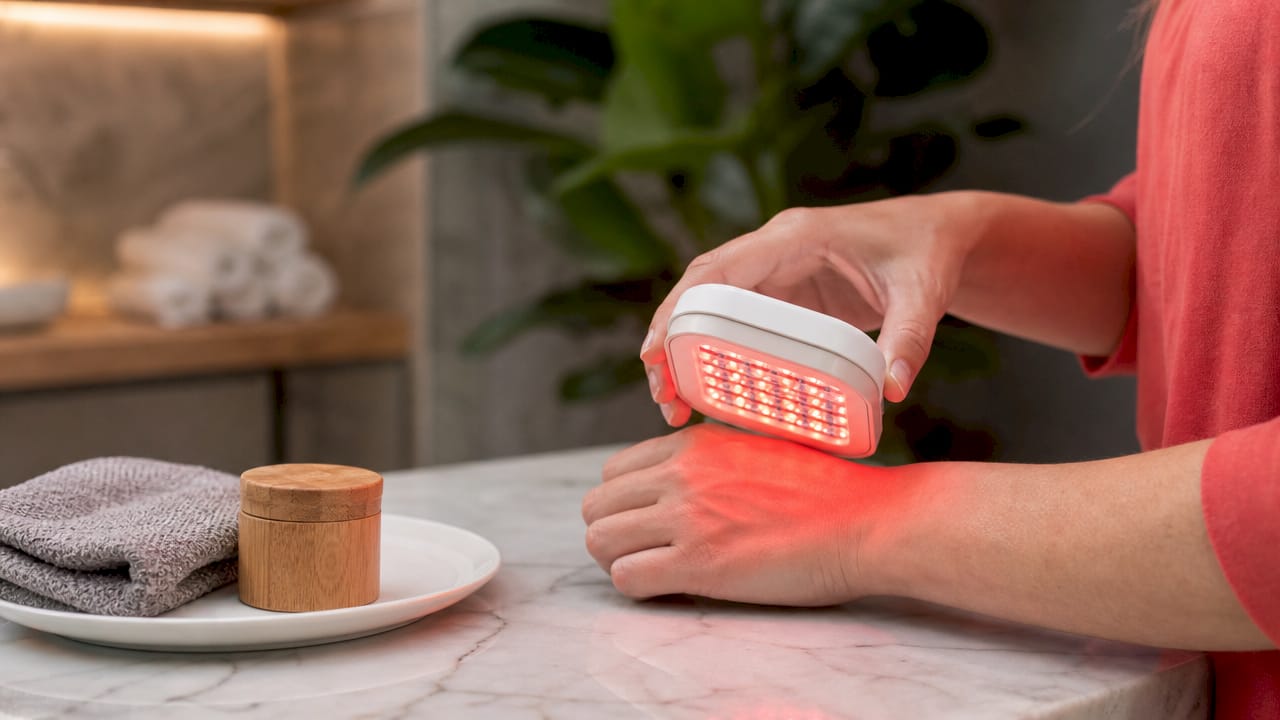
Wavelength selection determines which skin layer you target and what result you get. Skin rejuvenation requires wavelengths in the 620–1072 nm range, while pattern hair loss responds best to 630–800 nm. Red light at roughly 620–700 nm works primarily in the upper dermis, improving surface texture and tone. Near-infrared light at 700–1070 nm penetrates deeper, reaching the structural layers where collagen and elastin live. Devices that combine both wavelengths address a broader range of concerns.
The cellular effects build gradually. Collagen remodeling does not happen overnight. You are essentially training your skin cells to produce more structural protein through repeated light exposure, which is why consistency matters more than any single session.
- Red light (620–700 nm): Improves surface texture, reduces redness, and supports collagen at the dermal level
- Near-infrared light (700–1070 nm): Penetrates deeper tissue, stimulates fibroblasts, and reduces inflammation
- Combined wavelengths: Address both surface tone and deeper structural improvement simultaneously
Pro Tip: Always confirm that your device lists specific nanometer (nm) wavelength values, not just “red light” or “infrared.” Devices without published wavelength specs are unlikely to deliver consistent results.
What does scientific research say about home device effectiveness?
At-home light therapy devices can yield statistically significant but modest skin texture and wrinkle improvements with consistent daily use over at least 12 weeks. That word “modest” is doing real work in that sentence. You are not getting the same outcome as a professional laser peel or an in-office photobiomodulation session. You are getting a slower, gentler version of the same biological process.
The energy output gap explains most of that difference. Consumer LED masks typically provide low energy output in the range of 5–35 mW/cm², which falls below the optimal fluence of 20–60 J/cm² needed for full biological activation seen in professional photobiomodulation systems. Lower output means slower mitochondrial stimulation and less visible results per session. Professional systems deliver more energy per session, which is why clinic treatments produce faster outcomes.
“The photobiomodulation field faces a significant challenge separating legitimate science from commercial hype. The consumer device market has surpassed a $1 billion forecast by 2030, but many products lack independent data and robust scientific backing.”
That market reality matters for anyone reading at-home red light therapy devices reviews online. Positive testimonials are common. Independent, peer-reviewed trials on specific consumer devices are rare.
One more regulatory point that trips up many buyers: FDA clearance for at-home devices only indicates safety and substantial equivalence to existing devices. It does not confirm efficacy for wrinkle reduction or skin rejuvenation. Many people confuse FDA clearance with FDA approval, and that distinction changes what you can reasonably expect from a device.
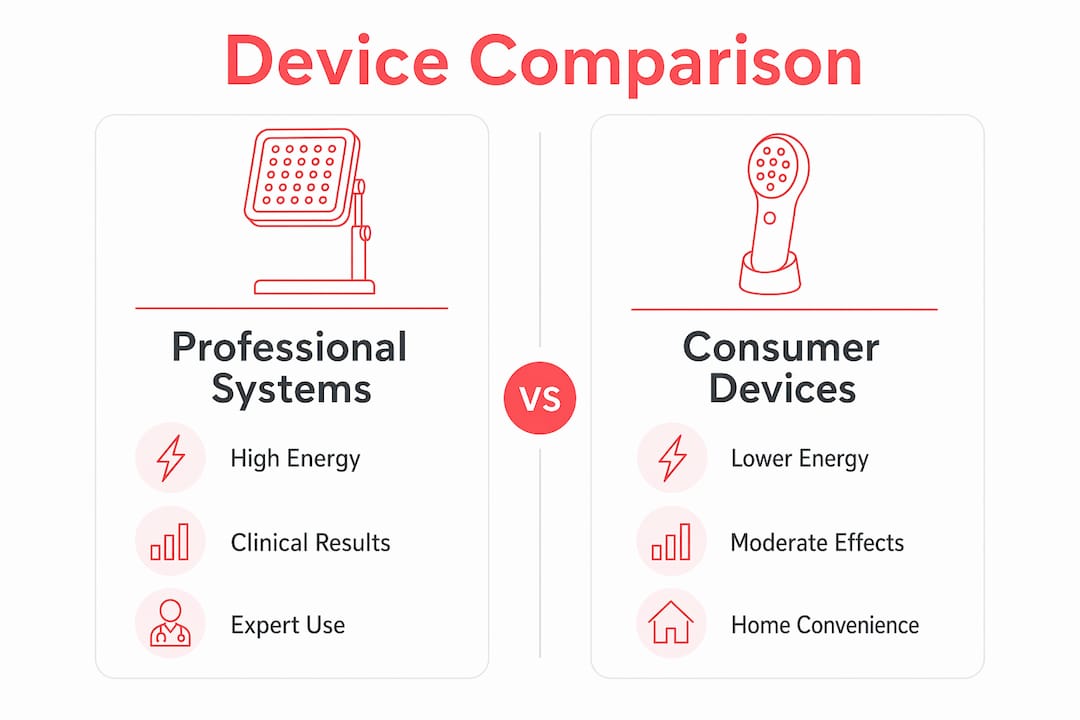
| Factor | Professional systems | Consumer devices |
|---|---|---|
| Energy output | High (above clinical threshold) | Low to moderate (5–35 mW/cm²) |
| Wavelength accuracy | Clinically verified | Often unverified or inconsistent |
| Treatment speed | Faster visible results | Requires 12+ weeks of daily use |
| Regulatory status | Medical-grade approval | FDA clearance (safety only) |
| Cost per session | High | Low after initial purchase |
What should you look for when choosing a home light therapy device?
Choosing an effective device starts with one non-negotiable: published wavelength and irradiance data. Effectiveness depends on matching the correct wavelength and energy to your specific skin concern. Mass-market devices often skip this documentation entirely, which is a red flag. If a brand cannot tell you the exact nanometer output and energy density of its device, you cannot know whether it will work.
Here is what to verify before buying:
- Wavelength range: Confirm the device targets 620–700 nm for surface skin concerns or 700–1070 nm for deeper collagen work
- Irradiance documentation: Look for mW/cm² values published by the brand or verified by a third party
- Treatment area: Larger panels cover more skin per session; small wands require more passes and more time
- FDA clearance status: Clearance confirms safety, not efficacy, but it does indicate the device met basic regulatory standards
- Return policy and clinical backing: Brands that publish clinical data and offer satisfaction guarantees stand behind their results
Marketing language is the biggest trap in this category. Many consumer devices differ greatly from medical systems in power and parameter stability, yet their packaging uses clinical-sounding language. Phrases like “clinically inspired” or “dermatologist-designed” carry no regulatory weight. Look for actual published data, not marketing copy.
Safety is straightforward but non-negotiable. Eye protection is recommended to avoid retinal risks from prolonged red or infrared light exposure. Wear protective goggles during every session. People who are pregnant, have photosensitive conditions, or take medications that increase light sensitivity should consult a dermatologist before starting.
Pro Tip: Pair your light therapy sessions with a high-quality serum applied immediately before treatment. Photobiomodulation increases cellular permeability temporarily, which may improve ingredient absorption. Always finish with SPF during daytime hours, since treated skin is more sensitive to UV.
Which skin conditions can at-home light therapy realistically address?
The evidence for home light therapy effectiveness is not equal across all skin concerns. Skin rejuvenation and androgenic alopecia have the strongest clinical support. Other applications, like acne and pigmentation, have limited or preliminary backing at the consumer device level.
Evidence is strongest for skin rejuvenation and pattern hair loss. For wrinkle reduction and texture improvement, multiple peer-reviewed trials show measurable results after 12 or more weeks of consistent daily use. For androgenic alopecia, the 630–800 nm range has enough clinical data that some dermatological guidelines now include low-level laser therapy as a recognized option. You can explore home treatment for wrinkles in more depth to see how light therapy compares to other at-home methods.
| Skin concern | Evidence strength | Recommended wavelength |
|---|---|---|
| Skin texture and wrinkles | Strong (12+ week trials) | 620–700 nm red light |
| Androgenic alopecia | Moderate to strong | 630–800 nm |
| Acne | Limited, preliminary | Blue light (not red/NIR) |
| Hyperpigmentation | Limited | 630–660 nm with caution |
| Wound healing support | Moderate | 630–850 nm |
Individual responsiveness varies. Skin tone, age, baseline collagen density, and device quality all influence how quickly you see results. Lighter skin tones tend to show faster surface improvements because red light penetrates more efficiently. Older skin with lower baseline collagen may take longer to respond but can still show meaningful change with sustained use.
The honest framing for at-home red light therapy devices that work is this: they are a long-term maintenance tool, not a quick fix. Pair them with sun protection, a consistent skincare routine, and realistic expectations. Reviewing LED light therapy devices for skin care side by side can help you match the right device type to your specific goals.
Key Takeaways
At-home light therapy devices produce real but modest skin improvements when used daily for at least 12 weeks with verified wavelengths and adequate energy output.
| Point | Details |
|---|---|
| Photobiomodulation is real science | Red and near-infrared light stimulate mitochondria to increase collagen and reduce inflammation. |
| Consumer devices have lower output | Most home LED devices deliver 5–35 mW/cm², below the clinical threshold for fast results. |
| FDA clearance is not efficacy proof | Clearance confirms safety only; it does not validate wrinkle reduction or rejuvenation claims. |
| Consistency is the deciding factor | Daily sessions over 12+ weeks are required to see statistically significant skin improvements. |
| Strongest evidence covers two areas | Skin rejuvenation and androgenic alopecia have the most clinical support for home device use. |
Why I think most people approach home light therapy the wrong way
Most people buy a light therapy device expecting results in two weeks, use it sporadically for a month, and then conclude it does not work. That is not a device failure. That is a consistency failure. The biology of photobiomodulation requires repeated stimulation to produce lasting collagen changes. You cannot shortcut a cellular process.
What I have found genuinely useful is treating home light therapy the way you treat exercise. You do not expect one workout to change your body. You commit to a schedule, track your skin over time with photos, and adjust based on what you observe. The people who see real results are the ones who treat their device like a daily habit, not a weekend experiment.
The regulatory gap in this market is the part that frustrates me most. Wellness industry growth has outpaced regulation, and that leaves consumers sorting through hundreds of devices with no reliable way to compare them. My practical advice: demand published irradiance data, ignore before-and-after photos on brand websites, and look for independent clinical references. If a brand cannot produce those, move on.
Light therapy is one tool in a broader skin health routine. It works best alongside quality skincare products, sun protection, and, where appropriate, professional treatments for more significant concerns. Treating it as a standalone miracle solution sets you up for disappointment.
— Customer
Sonedaskincare’s approach to science-backed home devices
Sonedaskincare builds professional-grade Korean beauty devices specifically for home use, combining technologies that go beyond standard LED therapy. The VividLift™ 2-in-1 HIFU+Sono device uses High-Intensity Focused Ultrasound and advanced sonophoresis to stimulate collagen production, lift skin, and improve hydration at a clinical level. Sonedaskincare reports a 175% increase in skin hydration in clinical testing and a 100% user satisfaction rate. If you are ready to move beyond entry-level light therapy into verified, professional-grade home treatment, the VividLift preorder page is the place to start. For a broader look at available options, the full device collection covers every technology Sonedaskincare offers.
FAQ
Do at-home light therapy devices actually work?
Yes, at-home light therapy devices produce modest but measurable skin improvements with consistent daily use over at least 12 weeks. Results are slower and less dramatic than professional clinic treatments due to lower energy output.
What wavelength should I look for in a home red light device?
For skin rejuvenation and wrinkle reduction, look for devices in the 620–700 nm red light range. For deeper collagen work or hair loss, near-infrared wavelengths between 700–1070 nm are more effective.
Is FDA clearance a guarantee that a device works?
No. FDA clearance under the 510(k) pathway confirms safety and substantial equivalence to existing devices only. It does not verify that a device reduces wrinkles or improves skin texture.
How long does it take to see results from home light therapy?
Most peer-reviewed studies show statistically significant skin improvements after 12 or more weeks of daily use. Sporadic or short-term use is unlikely to produce visible changes.
Are at-home light therapy devices safe to use daily?
The safety profile is generally favorable, with only mild transient effects reported. Always wear protective goggles during sessions to prevent retinal exposure, and consult a dermatologist if you take photosensitizing medications.