EMS Frequency Face Guide: Technical Parameters That Matter

The best-supported frequency range for facial neuromuscular electrical stimulation (fNMES) is 50 to 70 Hz, delivered through biphasic square pulses with a pulse width between 10 and 100 microseconds, according to a systematic review of fNMES protocols. Before you touch an intensity dial, check one number first: current density at the electrode must stay below an RMS threshold of 2 mA/cm2, and electrode contact area should be verified, not estimated, since the same amplitude delivered through a smaller pad multiplies current density fast.
That frequency band and safety ceiling form the foundation for the guide. Soneda’s EMS-enabled devices, including the Soneda Sculpt, are engineered around this researched mid-range band rather than using unverified higher-intensity settings.
“Increasing pulse width or frequency magnifies the effect of the same current,” according to research on NMES parameter interactions — which means every parameter on a facial EMS device is a dial connected to every other dial, not an isolated setting.
Run through this checklist before your first session:
- Confirm electrode area in cm2 before setting amplitude. A smaller pad at the same current delivers higher density and higher risk.
- Avoid stimulation directly over the eyes, the carotid triangle, or any open lesion.
- Skip EMS entirely if you have a pacemaker, implanted cardiac device, or are pregnant.
- Start at motor threshold, the lowest amplitude that produces a visible, localized contraction, and ramp from there.
- Stop immediately if you feel sharp pain, notice facial weakness, or see skin redness that doesn’t fade within minutes.
Key Takeaways
The best-supported approach to facial EMS combines a 50 to 70 Hz frequency, biphasic square pulses, and strict current density limits below RMS 2 mA/cm2 to balance visible results with safety.
| Point | Details |
|---|---|
| Optimal frequency band | Prefer frequencies in the 50 to 70 Hz range for smooth, comfortable motor contractions with manageable fatigue. |
| Current density ceiling | Never exceed RMS 2 mA/cm2; always verify actual electrode surface area before setting amplitude. |
| Session cadence | Start with one to two sessions per week, 10 to 20 minutes each, with 48 hours of rest between sessions. |
| Absolute stop conditions | Discontinue immediately for facial weakness, severe pain, or skin burns, and consult a clinician. |
| Device alignment | Soneda’s EMS devices, including Soneda Sculpt, default to the research-backed 50 to 100 Hz band rather than unverified high-intensity extremes. |
Table of Contents
- What Is EMS Frequency Face Stimulation and How Does It Work?
- Which EMS Frequencies Work Best for Facial Muscles?
- What Parameters Should You Set Alongside Frequency?
- What Are the Safety Rules and Contraindications for Facial EMS?
- What Does Clinical Research Say About EMS for Facial Skin?
- How Do At-Home EMS Devices Compare to Professional Systems?
- How Should You Structure a Facial EMS Session and Schedule?
- How Soneda Aligns Device Settings With Research-Backed Parameters
- Why I Trust Comfort Over Maximum Intensity for Facial EMS
- Where a Clinical-Grade At-Home Device Fits
- Sources
What Is EMS Frequency Face Stimulation and How Does It Work?
fNMES stands for facial neuromuscular electrical stimulation, and it’s worth separating from a term readers often confuse it with: microcurrent. Microcurrent devices operate at sub-sensory amplitudes that don’t produce visible muscle contraction. EMS, by contrast, is motor-level stimulation. It’s strong enough to depolarize motor neurons and generate an actual, visible twitch or contraction in the target muscle.
Four variables define an EMS waveform, and you’ll see all four referenced throughout this guide:
- Frequency (measured in hertz, Hz): how many electrical pulses fire per second.
- Pulse width (measured in microseconds, µs): how long each individual pulse lasts.
- Amplitude: the intensity or current strength of each pulse, usually reported in milliamps.
- Waveform: the shape of the electrical signal, with biphasic square pulses being the standard for facial applications because they balance charge and reduce skin irritation compared to monophasic waveforms.
Here’s the physiological mechanism in plain terms. An electrode placed over a motor point delivers a pulse that depolarizes the nerve fibers innervating that muscle. At low frequencies, each pulse produces a discrete twitch, since the muscle has time to relax between pulses. As frequency increases, those twitches begin to overlap. Above a certain threshold, they fuse into what’s called tetanic contraction, a smooth, sustained pull rather than a series of jerks. This fusion frequency is exactly why the choice of hertz matters for how a facial EMS session actually feels.
Sensory nerve fibers also activate alongside motor fibers, and they respond differently across the frequency spectrum. That’s part of why very low frequencies tend to feel like sharp, uncomfortable pinpricks rather than a smooth pull. If you’re picturing a diagram of this, imagine a graph with frequency on the x-axis and contraction smoothness on the y-axis: it starts jagged at low Hz, climbs into a plateau of smooth tetanic contraction through the 50 to 100 Hz range, and eventually plateaus or shifts character at much higher frequencies.
Pro Tip: Watch the muscle, not just the skin, during your first session at a new setting. A properly tuned facial EMS pulse produces a small, localized lift or pull you can see in the mirror, not just a tingling sensation. If you feel the current but see no movement, you’re likely below true motor threshold.
Which EMS Frequencies Work Best for Facial Muscles?
Frequency choice on a facial EMS device isn’t a matter of taste. It determines whether the muscle contracts smoothly or twitches uncomfortably, and it directly trades off contraction quality against fatigue.
At low frequencies below about 20 Hz, individual pulses tend to be perceived as twitches rather than a smooth pull. Research on NMES parameters associates such low frequencies with increased discomfort and poorer contraction quality, making them less suitable for facial motor-level work where smoothness and subtlety are important.
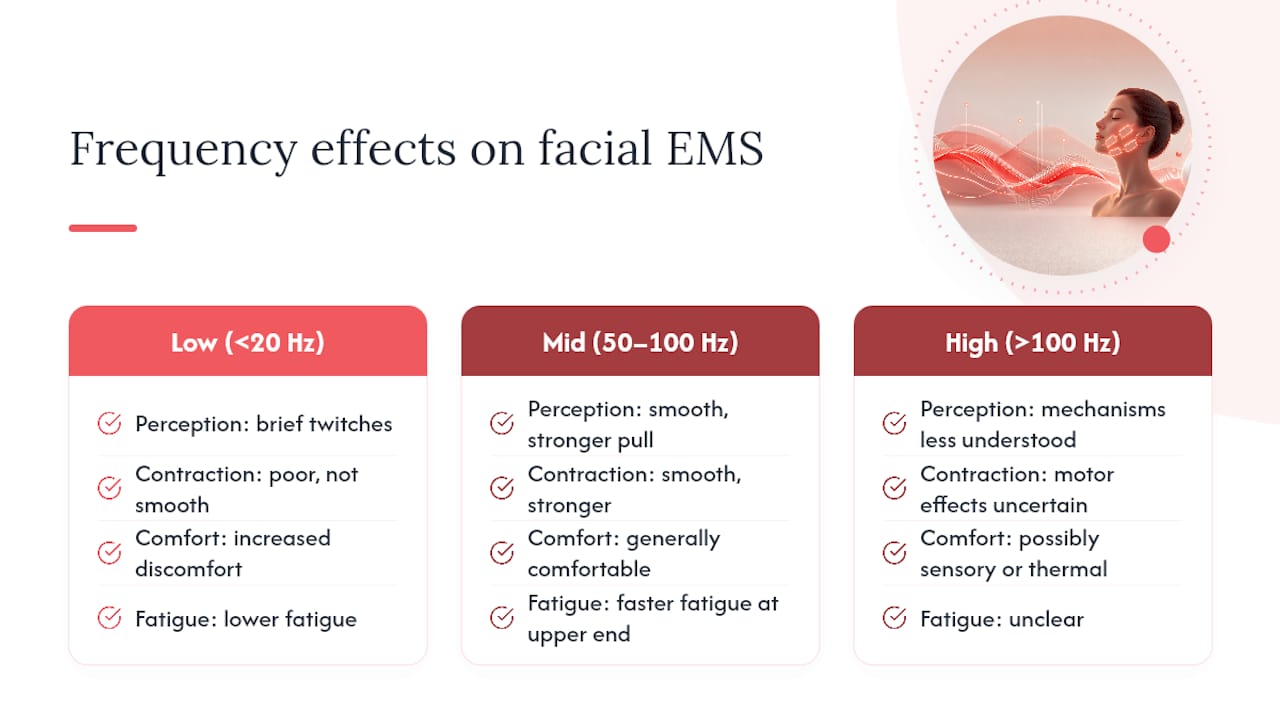
Between about 50 and 100 Hz, contractions become smoother and stronger; this range is widely recommended across fNMES literature. The trade-off is faster muscle fatigue compared to lower frequencies, as motor units reach near their sustained output limits. Systematic review authors generally converge on this band for facial applications because it reliably produces visible, comfortable contractions without the twitchiness of low-frequency stimulation.
At frequencies above 100 Hz and in the kilohertz range, mechanisms of effect may differ and are less understood. A small split-face clinical study using devices operating between 40 and 190 kHz found measurable improvements in skin elasticity, wrinkle degree, and jawline angle over eight weeks. However, this evidence is preliminary, and kHz-range device effects may rely more on sensory or thermal pathways than classical motor recruitment. The kHz claims remain an emerging area supported by limited data.
Practitioner experience and review authors converge on one point: mid-range frequencies between 50 and 100 Hz deliver the smoothest motor contractions on facial muscles, but you pay for that smoothness with faster fatigue at the upper end of that range, according to the fNMES systematic review.
Frequency never operates alone. A 50 Hz pulse at a wide pulse width and moderate amplitude can feel more intense than a 90 Hz pulse at a narrow pulse width and low amplitude. If a session feels too weak or too sharp, the fix isn’t always to change the hertz setting. Often it’s the pulse width or amplitude that needs adjusting first.
What Parameters Should You Set Alongside Frequency?
Every parameter on an EMS device interacts with every other parameter. Frequency sets the rhythm, but pulse width and amplitude determine how much charge lands with each pulse, and electrode size determines how concentrated that charge becomes on the skin. Get one wrong and the whole session either does nothing or hurts.
| Parameter | Recommended range | Why it matters |
|---|---|---|
| Frequency | 50 to 70 Hz (commonly cited up to 100 Hz) | Produces smooth, tetanic contraction without excessive fatigue |
| Pulse width | 10 to 100 µs | Determines how much charge each pulse delivers; wider pulses feel stronger at the same amplitude |
| Waveform | Biphasic square | Balances charge delivery and minimizes skin irritation versus monophasic pulses |
| Amplitude | Titrated to visible motor threshold, no higher than comfortable | The intensity that actually recruits motor units; more is not automatically better |
| Electrode surface area | Approximately 3 cm2 per pad | Smaller electrodes concentrate the same current into higher density |
| Current density | Below RMS 2 mA/cm2 | The hard safety ceiling; must be checked against actual electrode area, not assumed |
| Duty cycle | Device-dependent, typically intermittent (on/off cycling) | Allows brief rest between contraction bursts to manage fatigue |
| Session length | 10 to 20 minutes | Matches durations used in at-home device trials showing measurable results |
Duty cycle deserves a specific explanation since it’s often overlooked. Rather than delivering one continuous contraction for the full session, most EMS protocols cycle on and off, contracting the muscle for a few seconds, then resting it, then repeating. This mimics how the muscle would behave under voluntary exercise and helps manage the fatigue that builds faster at the 50 to 100 Hz band. A session running 10 to 20 minutes at this duty cycle pattern aligns with what small at-home device trials have actually tested, rather than pushing toward longer sessions with no evidence behind them.
For weekly cadence, a conservative starting point mirrors guidance from broader EMS training frequency recommendations: begin with one to two sessions per week, and leave at least 48 hours between sessions to let the muscle recover. Facial muscles are smaller and more delicate than the muscle groups typically targeted in whole-body EMS, so err toward the conservative end of any general guidance you find.
Pro Tip: When ramping intensity for the first time, increase amplitude in small increments and pause for three to five seconds at each step. You’re looking for the exact point where you see a localized contraction in the mirror without any sharp or burning sensation. That point is your motor threshold, and your working amplitude should sit just above it, not far beyond it.
Current density is the parameter most likely to get overlooked, and it’s the one with a hard numeric ceiling: RMS 2 mA/cm2, according to the fNMES systematic review. If you don’t know your electrode’s actual surface area, you can’t verify you’re under that ceiling. Always check the spec sheet, not just the intensity number on the display.
What Are the Safety Rules and Contraindications for Facial EMS?
Facial EMS carries a different risk profile than EMS applied to large muscle groups, mostly because of proximity to the eyes, major blood vessels, and nerve branches that control facial expression. Treat the face as a higher-caution zone even if you’ve used EMS elsewhere on the body without issue.
Absolute contraindications include any implanted cardiac device (pacemaker or ICD), active pregnancy, and seizure disorders. If you have an implanted neural stimulator of any kind, don’t add a second electrical device into the mix without medical clearance first.
Local facial cautions matter even for people with no systemic contraindications. Never place electrodes directly over the eyes or eyelids. Avoid the carotid triangle, the area on either side of the neck where the carotid artery runs close to the surface, and be mindful of trigeminal nerve branches when placing pads near the jaw and cheek. Skip any area with an open lesion, active acne, recent facial surgery, or visibly inflamed skin.
A simple monitoring routine catches most problems before they become serious:
- Check skin condition before and after every session for redness that doesn’t fade within a few minutes.
- Rate comfort on a simple scale during the session; anything past mild tingling toward sharp pain means stop and reduce amplitude.
- Confirm you’re seeing a localized, visible contraction rather than a diffuse buzzing sensation with no movement.
- Stop the session immediately if you notice unexpected facial weakness, asymmetry, or a burning sensation on the skin.
If you experience facial weakness, severe pain, or a skin burn during or after a session, discontinue use immediately and contact a healthcare provider rather than waiting to see if symptoms resolve on their own.
This article provides general technical information and isn’t a substitute for individualized medical advice. Confirm your specific health situation with a qualified clinician before starting any EMS regimen, especially if you have a pre-existing condition.
What Does Clinical Research Say About EMS for Facial Skin?
The evidence base for facial EMS is real but still developing, and the honest picture involves both encouraging results and meaningful limitations you should weigh before treating any single study as definitive.
A prospective split-face study conducted at Tokyo University Hospital, using a device in the 40 to 190 kHz range on roughly 24 women aged 30 to 59, reported statistically significant improvements over eight weeks in skin elasticity, wrinkle degree, jawline angle, and localized blood flow. Separate small trials using medium-frequency at-home devices applied for around 10 minutes nightly over four weeks found measurable gains in skin elasticity, reduced sagging, and improved double-chin lifting metrics, though these results were often reported alongside concurrent topical skincare use rather than EMS in isolation.
Reviewers consistently flag heterogeneity as the biggest problem with fNMES research: electrode size, waveform, frequency, and intensity are inconsistently reported across studies, which makes direct comparison between trials difficult, according to the systematic review of the fNMES literature.
Three limitations are worth keeping in mind whenever you read a headline claim about facial EMS:
- Sample sizes across most published trials remain small, often in the range of a few dozen participants at most.
- Split-face designs, where one side of the face serves as an internal control, are common and useful, but they don’t always generalize to whole-face treatment protocols.
- Many studies combine EMS with other modalities, such as topical serums or LED light, which makes it hard to isolate how much of the improvement came from electrical stimulation alone versus the paired treatment.
The takeaway isn’t that facial EMS doesn’t work. It’s that the timeline for visible change tends to run four to eight weeks in the studies available, and outcomes are best understood as a coherent but still-limited signal rather than settled proof for every claim marketers attach to the technology.
How Do At-Home EMS Devices Compare to Professional Systems?
Consumer devices and clinical systems both use the same underlying physiological principles, but they differ sharply in how much control they give you over the parameters that actually matter.
Professional systems typically expose granular control over frequency, pulse width, and amplitude independently, along with real-time feedback on contraction quality and built-in current density calculations based on the specific electrode attached. Consumer devices, by contrast, more often ship with preset programs, a fixed or limited range of frequencies, and simplified intensity dials that bundle several parameters into one number.
That doesn’t make consumer devices ineffective. It means the specs you should look for become more important, since you’re trusting the manufacturer’s engineering rather than tuning parameters yourself in real time.
- Adjustable frequency settings, ideally landing within or near the 50 to 100 Hz range rather than a single fixed high-kHz setting with no alternative.
- Documented biphasic square waveform, since this shape is the standard recommendation for facial applications.
- Stated electrode surface area, so you or a clinician can back-calculate current density at any given amplitude setting.
- Automatic safety cutoffs that prevent amplitude from climbing past a preset ceiling regardless of how far you turn the dial.
Manufacturer guidance on EMS session structure generally caps session minutes and enforces rest intervals between uses, a safeguard that professional clinical systems build in as standard but that varies widely across consumer products. When you’re comparing options, a detailed breakdown of face-lifting devices can help you see which specs different products actually disclose versus which ones hide behind a single “intensity level” number.
Pro Tip: If a consumer device’s marketing materials don’t specify frequency range, pulse width, or electrode area anywhere in the spec sheet, treat that as a red flag rather than an oversight. Reputable manufacturers publish these numbers because clinicians and informed buyers ask for them.
How Should You Structure a Facial EMS Session and Schedule?
A well-structured session follows a predictable arc: prepare the skin, place electrodes precisely, ramp intensity gradually, hold at a comfortable working level, then cool down. Here’s a protocol you can adapt for home or clinic use.
- Cleanse the treatment area and confirm skin is free of lesions, active breakouts, or irritation before applying any conductive gel or electrode.
- Place electrodes over motor points for your target muscles: frontalis (forehead), zygomaticus (cheek, for smile-related lift), and with extra caution around orbicularis oris (lips) and orbicularis oculi (eye area, always positioned away from the eye itself, never directly on the eyelid).
- Set frequency to 50 to 70 Hz, pulse width in the 10 to 100 µs range, and confirm the device is delivering a biphasic square waveform if that setting is available.
- Ramp amplitude slowly, increasing in small steps every few seconds until you observe a visible, localized contraction without sharp discomfort. This is your motor threshold.
- Hold the session at this working intensity for 10 to 20 minutes total, allowing the device’s duty cycle to manage on/off contraction timing.
- Cool down by removing electrodes gently and applying a hydrating serum or moisturizer to the treated skin.
For weekly scheduling, a conservative home plan starts at one to two sessions per week with at least 48 hours between sessions, adjusting downward if you notice unusual soreness or skin sensitivity the following day. Clinic-based plans supervised by a professional may progress faster, since a trained provider can monitor contraction quality and skin response in real time.
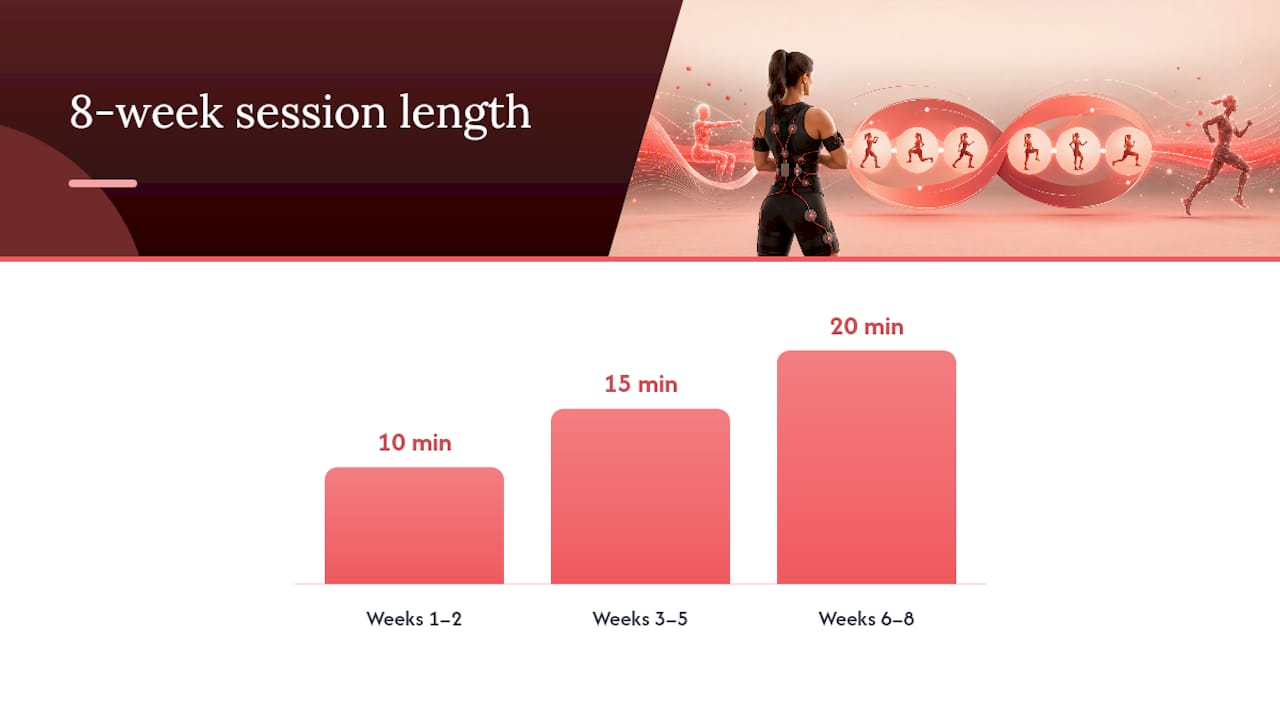
An eight-week progression might look like this: weeks one and two at the lower end of the amplitude range with sessions capped at 10 minutes, weeks three through five extending to 15 minutes as comfort improves, and weeks six through eight at 20 minutes with amplitude at your established working threshold, holding frequency steady at 50 to 70 Hz throughout rather than increasing it over time. Following a structured skin sequence designed around this kind of progression makes it easier to stay consistent without guessing at week-to-week adjustments.
Pro Tip: Keep a simple log of your settings and how your skin responded each session: amplitude level, session length, and a one-line note on comfort. Facial muscle tone, skin thickness, and sensitivity vary enough between individuals that what works at week two may need adjusting by week five, and a log makes that adjustment based on data rather than guesswork.
How Soneda Aligns Device Settings With Research-Backed Parameters
Soneda’s EMS-enabled devices are built around the same 50 to 100 Hz motor-level frequency band that systematic reviews identify as the sweet spot for smooth, comfortable facial contraction, rather than chasing marketing-driven extremes at either end of the spectrum. That design choice reflects the same trade-off this guide has walked through: enough frequency for a genuine, visible contraction, without tipping into the fatigue or discomfort that comes with pushing too high.
Device engineering matters because a facial EMS product is only as safe as its weakest safeguard, and Soneda builds several into its at-home lineup:
- Multiple intensity levels that allow gradual ramping toward motor threshold rather than a single fixed high setting.
- Documented electrode contact design intended to keep current density within safe operating ranges during normal use.
- Combined-modality delivery, pairing EMS with LED wavelengths in devices like Soneda Sculpt, reflecting how clinical studies on at-home devices often layer stimulation with complementary treatments rather than relying on EMS in isolation.
The broader point is one of alignment, not novelty: rather than inventing new parameter territory, Soneda’s engineering choices track the same frequency band, waveform preference, and safety logic that peer-reviewed fNMES research already supports.
Why I Trust Comfort Over Maximum Intensity for Facial EMS
Every EMS device lets you push the amplitude higher than you probably should, and the temptation to equate more intensity with more results is understandable but misguided when it comes to the face. I’d rather see someone run a smooth, well-tolerated 60 Hz session at verified motor threshold than max out a dial chasing a stronger sensation that current density math doesn’t support.
The research bears this out: contraction quality peaks in a specific mid-range band, not at the extremes, and the parameter that most deserves your attention isn’t frequency alone but current density, since that’s the number tied directly to tissue safety. Age, muscle tone, prior cosmetic procedures, and baseline skin condition all shift where an individual’s comfortable working threshold sits, which is exactly why a fixed, one-size protocol makes less sense than starting conservatively and adjusting based on your own skin’s response. The people who get the best long-term results from facial EMS aren’t the ones running the highest settings. They’re the ones who found their specific working range and stayed consistent with it.
Where a Clinical-Grade At-Home Device Fits
If everything above tells you that safe, effective facial EMS comes down to staying in a research-backed frequency band with verified current density, the next question is practical: which device actually delivers that without requiring you to calculate current density yourself. Soneda built its EMS technology around that exact problem, engineering devices that default to the 50 to 100 Hz motor-level range this guide describes rather than leaving you to guess at settings.
The Soneda Sculpt pairs EMS toning with triple-wavelength LED therapy, giving you a device where the frequency and safety parameters are built into the hardware rather than left to a manual dial you have to interpret. If you’re also interested in how EMS combines with other technologies like HIFU for a broader lifting and firming routine, the VividLift preorder page walks through the full technical specs of Soneda’s 2-in-1 HIFU and sonophoresis system. Review the specifications, compare them against the parameter ranges covered here, and decide which device matches the frequency and safety profile you’re looking for before you check out.
Sources
The parameter recommendations throughout this guide draw on a small set of peer-reviewed sources worth reading directly if you want the full methodology behind any specific figure.
- Application of facial neuromuscular electrical stimulation (fNMES) in psychophysiological research: Practical recommendations based on a systematic review of the literature | Behavior Research Methods | Springer Nature Link
- Pubmed
- Pubmed
- Effects of Medium Frequency EMS (Electrical Muscle Stimulation) At-home Beauty Device on the Facial Skin Improvement
This article is general information, not a substitute for advice from a qualified doctor. Consult a qualified healthcare professional about your own circumstances before acting on anything here.