The One Routine That Actually Firms Skin After 40

Firm skin after 40 starts with one non-negotiable stack: daily broad-spectrum SPF, a nightly retinoid (introduced gradually), and barrier hydration with ceramides and hyaluronic acid, applied consistently for months, not days. This foundation drives the biggest, most reliable improvement in skin texture and firmness available without a procedure.
- Morning: cleanser, optional antioxidant serum, moisturizer, SPF 30 to 50
- Night: cleanser, retinoid (start low, build slowly), ceramide-rich moisturizer
- Support: antioxidants, hyaluronic acid, and at-home devices can add measurable benefit once the basics are locked in
Pro Tip: Retinoids and sunscreen together produce more visible improvement than almost any other combination dermatologists recommend, according to Harvard Health. Expect topical changes in three to six months. Devices and in-office treatments generally show results in two to six months.
Key Takeaways
Firm skin after 40 depends on daily SPF, a nightly retinoid, and barrier hydration used consistently for months, with devices and procedures adding measurable but secondary gains.
| Point | Details |
|---|---|
| Foundation first | Daily SPF 30 to 50 plus a nightly retinoid outperforms almost any other combination for visible firmness. |
| Papillary dermis ages first | Superficial-targeted care and devices address the skin layer that degrades earliest in your 40s. |
| Set realistic timelines | Expect 3 to 6 months for topical results and 2 to 6 months for device or noninvasive treatment results. |
| Lifestyle compounds results | Sleep, resistance exercise, sun protection, and protein intake all support collagen synthesis directly. |
| At-home adjunct option | Sonedaskincare’s VividLift pairs HIFU and sonophoresis for mild-to-moderate laxity and hydration support alongside your core routine. |
Table of Contents
- Why Does Skin Lose Firmness After 40?
- What Should a Daily Skincare Routine for Aging Skin Include?
- Do At-Home Devices Help Tighten Skin Over 40?
- What In-Office Treatments Tighten Sagging Skin?
- What Lifestyle Habits Keep Skin Firm?
- How Long Until You See Firmer Skin?
- What Mistakes Undermine Firm Skin, and When Should You See a Dermatologist?
- Where Does the VividLift Fit Into Your Routine?
- Sources
Why Does Skin Lose Firmness After 40?
Skin firmness depends on collagen and elastin fibers holding the dermis taut. Both decline steadily through your 40s, and the drop isn’t uniform across skin’s layers.
Ex vivo mechanical testing on facial and mammary dermis found a sharp early decline in stiffness and elastic recoil in the papillary dermis, the layer just beneath the surface, starting in mid-adulthood. That’s notable because the papillary dermis is also the layer most reachable by topical ingredients and superficial devices, which is part of why dermatologists treat sunscreen, retinoids, and light energy-based treatments as strategically timed interventions rather than cosmetic extras.
Layer-by-layer analysis of facial dermis shows stiffness and elastic recoil dropping meaningfully in the 40 to 60 age range, with the papillary layer degrading earliest.
Photoaging accelerates all of this. Cumulative UV exposure breaks down collagen faster than chronological aging alone. Add perimenopause, which slows cell turnover and thins the skin further, and you get a compounding effect that NIA guidance links directly to increased fragility and reduced elasticity. That’s exactly why barrier support stops being optional in your 40s.
What Should a Daily Skincare Routine for Aging Skin Include?
A firm skin after 40 routine doesn’t need ten steps. It needs the right four, done in the right order.
Morning:
- Cleanse with a gentle, non-stripping formula.
- Apply an antioxidant serum (vitamin C is the best-studied option) if your skin tolerates it.
- Moisturize to lock in hydration before sunscreen.
- Apply a broad-spectrum SPF 30 to 50, using roughly a nickel-sized amount for the face and reapplying every two hours if you’re outdoors.
Evening:
- Cleanse again to remove sunscreen and pollution buildup.
- Apply your retinoid two to three nights per week for the first month, then increase frequency as tolerance builds.
- Follow with a ceramide-rich moisturizer to buffer irritation and rebuild the barrier.
Vitamin C and retinoids can both cause irritation if layered carelessly. The simplest fix: vitamin C in the morning, retinoid at night. If you want both in one session, apply vitamin C first, wait 15 minutes, then follow with a moisturizer before the retinoid to buffer its intensity.
Pro Tip: If your skin stings or flakes after starting a retinoid, don’t stop cold. Pulse it to once every three nights and always apply moisturizer both before and after until your skin builds tolerance.
Hyaluronic acid deserves a specific mention because it doesn’t rebuild collagen. It draws water into the skin’s surface, which temporarily plumps fine lines and improves the look of firmness within hours. That’s a cosmetic effect, not a structural one, but it’s a real and immediate one worth using daily. Eye and neck skin are thinner and often neglected. A dedicated, gentler formula for those areas, applied morning and night, prevents them from aging faster than the rest of your face.
For a full breakdown of how these steps evolve into a longer-term plan, this 40s-specific routine walks through the sequencing in more detail.
Do At-Home Devices Help Tighten Skin Over 40?
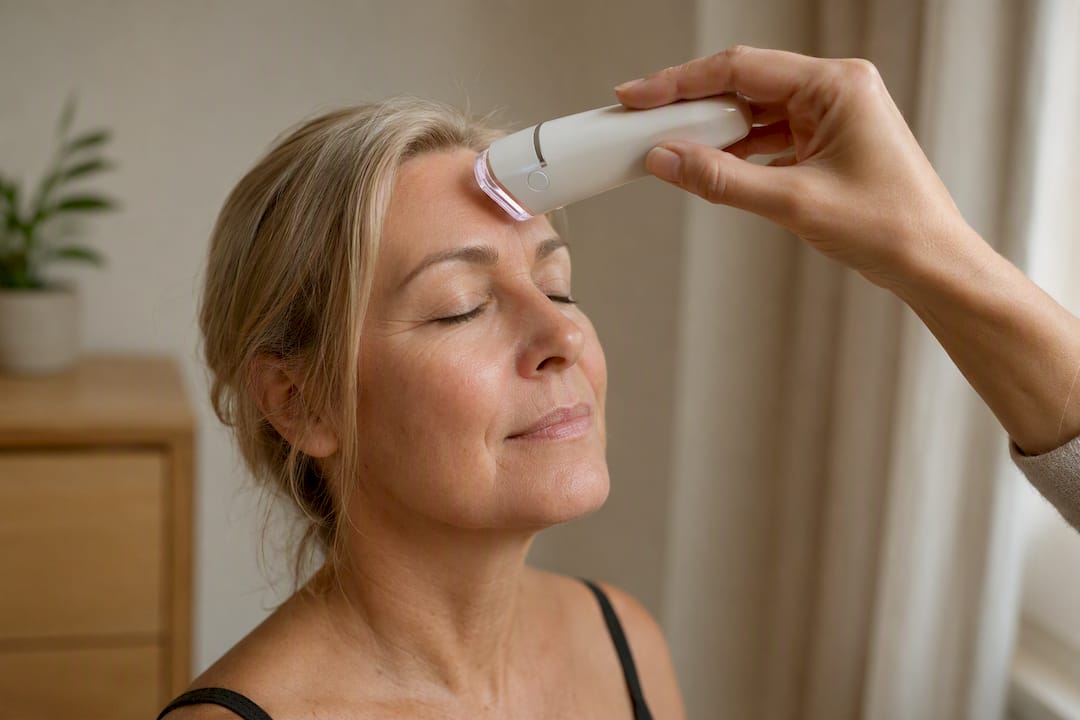
At-home devices work as adjuncts to the daily routine above, not replacements for it. Four technologies dominate the category, each with a distinct mechanism.
- Sonophoresis uses ultrasound waves to push active ingredients deeper into skin, improving absorption of serums you’re already using.
- HIFU (High-Intensity Focused Ultrasound) delivers focused energy to deeper tissue layers to stimulate collagen production over time.
- LED therapy uses specific light wavelengths for a biostimulatory effect on skin cells, with modest but real evidence for tone and texture, according to the Cleveland Clinic.
- Microcurrent produces temporary muscle toning, visible almost immediately but short-lived without repeat use.
These tools suit mild-to-moderate laxity and hydration concerns. They are not a substitute for surgery in cases of significant skin sagging. Sonedaskincare’s own VividLift device combines HIFU and sonophoresis specifically to target this early-intervention window, and the brand reports a 175% increase in skin hydration in its own clinical testing, along with a 100% user satisfaction rate in its user base.
Pro Tip: Most at-home HIFU devices are designed for two to three sessions per week initially, tapering to maintenance use. If skin feels persistently sore or discolored, stop and consult a dermatologist before continuing.
What In-Office Treatments Tighten Sagging Skin?
When topical care and at-home devices plateau, in-office treatments offer a stronger escalation path, roughly matched to how much laxity you’re dealing with.
- Noninvasive: Ultrasound, radiofrequency, and nonablative lasers deliver modest lifting, best suited for early-stage laxity, with visible results typically appearing two to six months after treatment, according to the American Academy of Dermatology.
- Minimally invasive: Radiofrequency microneedling, fractional lasers, and dermal fillers for structural support produce stronger tightening, with downtime that varies by procedure and depth.
- Surgical: Reserved for advanced laxity where nonsurgical options no longer deliver enough correction; the tradeoff is real downtime against longer-lasting results.
Choosing a provider matters as much as choosing a treatment. Confirm board certification, ask to review real before-and-after photos from patients with skin similar to yours, and be wary of anyone promising dramatic results from a single session.
What Lifestyle Habits Keep Skin Firm?
Skincare products only do part of the job. Sun protection, seven to eight hours of sleep, not smoking, and stable body weight all directly affect how well your skin holds its structure.
Resistance exercise supports the tissue tone and body composition that keep skin looking taut, according to research on lifestyle and biochemical contributors to skin aging. Diet matters too: protein and vitamin C are direct inputs your body needs to synthesize collagen, and antioxidant-rich foods (berries, leafy greens, citrus) help counter the oxidative stress that accelerates breakdown.
- Wear SPF daily, even indoors near windows.
- Prioritize consistent sleep over any single product.
- Quit smoking, which measurably speeds collagen loss.
- Lift weights or do resistance training two to three times a week.
- Eat adequate protein and vitamin C daily.
Collagen peptide supplements have some supporting evidence for skin elasticity, but results are modest and vary by formulation and dose. Treat them as a possible bonus, not a core strategy.
How Long Until You See Firmer Skin?
| Method | Typical time to visible results |
|---|---|
| Topical retinoids and antioxidants | 3 to 6 months of consistent use |
| At-home devices (HIFU, sonophoresis) | 2 to 6 months, often needing repeat sessions |
| Noninvasive office treatments | 2 to 6 months after treatment |
| Minimally invasive or surgical procedures | Faster, more durable, recovery varies by procedure |
Sunscreen and routine consistency are what preserve any gains you make, regardless of which method got you there.
What Mistakes Undermine Firm Skin, and When Should You See a Dermatologist?
The fastest way to sabotage progress is over-exfoliating, stacking too many active ingredients at once, or chasing a product that promises overnight lifting.
- Introduce one new active at a time, and give it several weeks before judging results.
- If your skin reacts with redness, burning, or peeling, pause all new actives for two weeks before reintroducing anything.
- See a dermatologist for persistent irritation, sudden unexplained skin changes, or any sign of infection following a device or in-office treatment.
A Note on Staying Consistent
Firm skin after 40 rewards consistency far more than complexity. Skip the 12-step routine chasing trends, master the fundamentals, and talk to a board-certified dermatologist before any procedural decision. If you’re curious about at-home devices, Sonedaskincare’s resources are a reasonable starting point.
Where Does the VividLift Fit Into Your Routine?
If your retinoid and SPF routine has plateaued and you’re not ready for an in-office procedure, an at-home HIFU device is the logical next step, not a replacement for the basics, but a way to extend what they can do. The VividLift 2-in-1 HIFU+Sono device combines focused ultrasound with sonophoresis specifically for mild-to-moderate laxity and improved product absorption, the exact window where the papillary dermis benefits most from superficial stimulation.
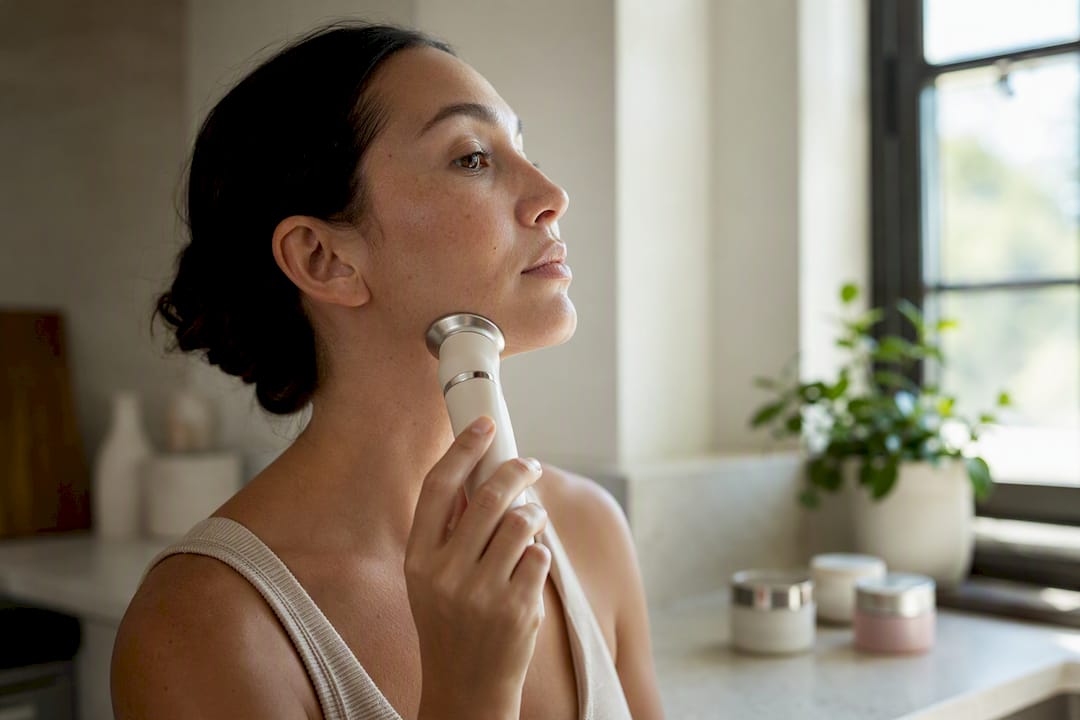
Sonedaskincare reports a 175% increase in skin hydration in its clinical testing and a 100% user satisfaction rate among its customers, figures the brand states clearly as its own results, not independent lab data. The device is Korea Institute of Dermatological Sciences tested and backed by a 100% money-back guarantee, so trying it carries no real risk to your routine or your budget. If you want to see how sonophoresis boosts absorption of the serums you’re already using, this explainer breaks down the mechanism in plain terms. Ready to add it to your regimen? Preorder VividLift here and start using it alongside your current routine within weeks.
Sources
- A mechanistic view on the aging human skin through ex vivo layer-by-layer analysis of mechanics and microstructure of facial and mammary dermis | Scientific Reports
- Many ways to firm sagging skin — American Academy of Dermatology (AAD)
- Skin care for aging skin — Harvard Health
- Skin care and aging — National Institute on Aging (NIA)