Wait 14 Days Before At Home HIFU After Botox: Safety Rules

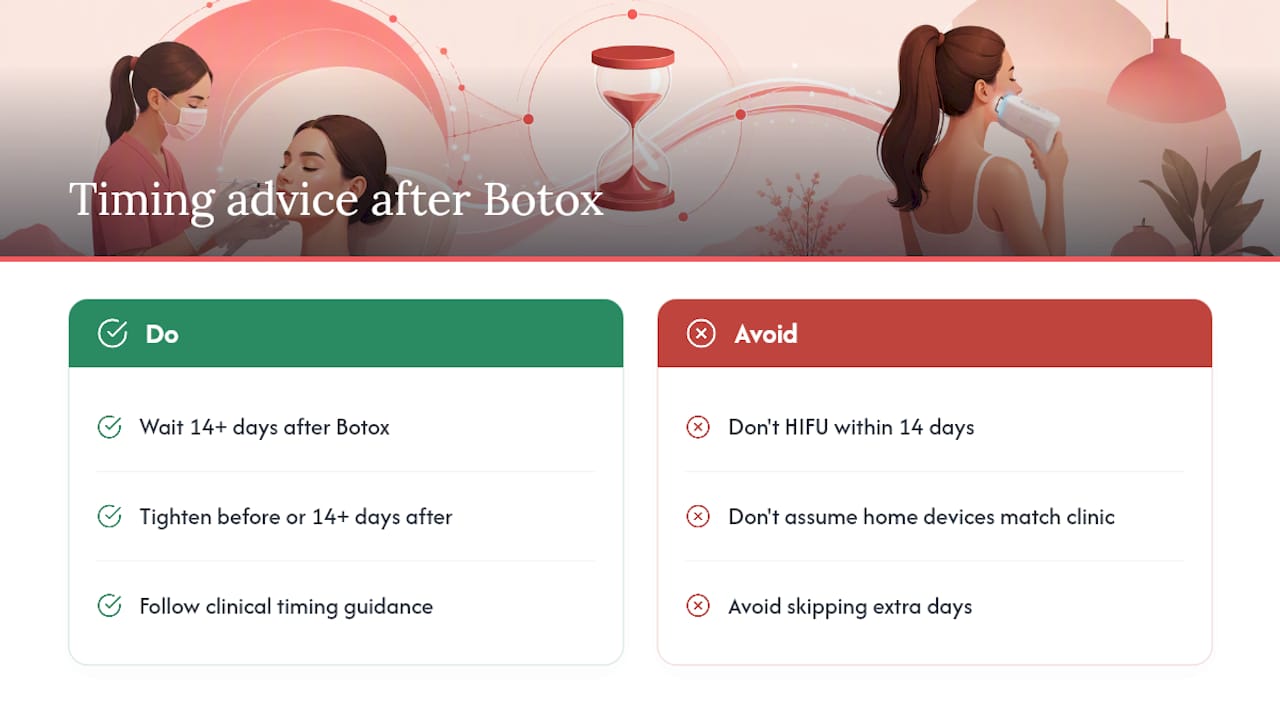
Wait at least 14 days after Botox before using an at-home HIFU or sonophoresis device, giving the neuromodulator time to bind fully and settle. In the meantime, keep your hands off the injection sites, skip heavy exercise and heat for the first 24 hours, and avoid strong actives for 72 hours. This timeline applies specifically to at-home HIFU/sonophoresis devices like VividLift™, not in-clinic microfocused ultrasound procedures.
TL;DR:
- Waiting at least 14 days after Botox minimizes risk of disrupting nerve binding and full effect development before using at-home HIFU devices.
- Longer delays, up to four weeks, are advised if bruising, swelling, multiple injection sites, or dermal filler were involved.
- Avoid direct contact, heat, exercise, and strong actives during the first 72 hours after Botox to prevent migration and irritation.
- Use at-home HIFU with caution by avoiding injection sites, starting at lower energy settings, and spacing sessions from other energy-based treatments.
- Certain conditions like active skin infections, blood thinners, or skin sensitivities require extended wait times or consultation before combining treatments.
Table of Contents
- How Long Should You Wait Before HIFU After Botox?
- Why Does Botox Need Time to Settle Before HIFU?
- What Should You Do in the First 72 Hours After Botox?
- How Do You Safely Use an At-Home HIFU Device After Botox?
- When Can You Restart Actives, EMS, or LED After Botox?
- What Symptoms Mean You Should Stop and Call Your Provider?
- What Contraindications Should You Know Before Combining Botox and HIFU?
- What Happens Long-Term When You Alternate Botox and HIFU?
- When Should You Talk to a Healthcare Professional?
- What Results Can You Realistically Expect From Combining Botox and HIFU?
- How Do Timing Recommendations Compare Across Aesthetic Authorities?
- A Practical At-Home Routine Worth Following
- Why VividLift™ Fits an At-Home Routine After Botox
- Sources
How Long Should You Wait Before HIFU After Botox?
A conservative minimum wait is generally recommended before combining an at-home HIFU device with a recent Botox appointment. That window gives the neuromodulator time to fully bind at the neuromuscular junction, according to clinical consensus recommending waiting after injectables. Some situations call for longer, closer to four weeks.
Push your timeline out if any of these apply:
- You had visible bruising or swelling that took more than a few days to resolve.
- You received Botox at several sites across the forehead, brows, and jawline in one session.
- You also had dermal filler injected, which requires a longer waiting period before ultrasound-based treatments.
That last point matters. A study on hyaluronic acid filler found that MFU performed too soon after injection increased the risk of filler breakdown, and researchers recommended waiting closer to a full month when treatment targets the same tissue depth as the filler.
If you already know you want both treatments, book Botox first and schedule your at-home HIFU session a few weeks out. Trying to squeeze a device session in beforehand almost never makes sense, since fresh HIFU stimulation can complicate how evenly Botox settles into the muscle.
Why Does Botox Need Time to Settle Before HIFU?
The 14-day rule isn’t arbitrary. Botox needs time to bind to nerve receptors and reach its full effect, a process that unfolds gradually rather than instantly after injection. Running ultrasound energy over the treated area too soon introduces mechanical and thermal disruption right when the toxin is still settling into place.
One retrospective chart review of 1,040 patients treated with microfocused ultrasound and cosmetic injectables together found a low overall complication rate, with rare events like eyelid ptosis and minor paradoxical bulging showing up only occasionally. That data, drawn from a retrospective safety review on microfocused ultrasound combined with injectables, supports a generally favorable safety profile, but only when proper timing was respected in the studied cases.
Experts generally favor sequencing treatments so that tightening procedures happen either before injectables go in or after the toxin has fully stabilized, roughly two weeks or more, so the final result reflects both treatments accurately rather than an unpredictable combination.
It’s worth being honest about what this evidence does and doesn’t show. Most of the data behind these timing recommendations comes from clinical settings using professional-grade MFU equipment, not from at-home devices operating at consumer energy levels. That gap is exactly why a conservative approach makes sense for home users. When the clinical literature itself urges caution among trained providers, stretching your own wait time by a few extra days costs you nothing and protects results you’ve already paid for.
What Should You Do in the First 72 Hours After Botox?
Your aftercare routine in the first three days after injection does more to protect your results than almost anything else you’ll do during the entire process. Here’s the breakdown:
- First 4 hours: Stay upright. Don’t lie down, bend over, or lean your face into a pillow. Avoid touching, rubbing, or massaging the treated areas, since pressure can encourage the toxin to spread beyond the intended muscle.
- First 24 hours: Skip strenuous exercise, saunas, hot yoga, and alcohol. All three raise blood flow to the face and can increase bruising or swelling. Hold off on intense skincare, including retinoids or exfoliating serums.
- First 72 hours: Avoid exfoliating actives, facials, and any treatment that involves pressure or heat on the face. If you notice bruising or swelling, take a quick photo so you can track how it resolves over the following days.
These steps track closely with practical Botox aftercare guidance used by clinics to minimize migration and irritation risk.
Pro Tip: Set a phone reminder for day 14. It’s an easy date to lose track of, and starting HIFU even a few days early undercuts the very results you’re trying to protect.
How Do You Safely Use an At-Home HIFU Device After Botox?
Once you’ve cleared the 14-day mark, safe use comes down to a few practical habits rather than complicated rules. At-home HIFU and sonophoresis devices operate at meaningfully lower energy and shallower depth than the professional MFU equipment used in the clinical studies referenced earlier, which is one reason home users can follow the same conservative timing with confidence rather than extra caution layered on top.
Keep these guidelines in mind for your first sessions back:
- Avoid direct passes over injection sites during your first treatment after Botox, even past the two-week mark.
- Keep the handpiece moving continuously rather than holding it in one spot, which limits localized energy buildup.
- Start at a lower energy setting than you might normally use, then increase gradually over subsequent sessions.
- Give your skin at least a few days of rest between any other at-home energy device and your HIFU session to avoid compounding trauma, a point echoed in clinic guidance on spacing procedures.
The mechanism-level explanation for how HIFU works on skin tissue is worth reading before your first post-Botox session if you’re new to the device, and the Getting Started guide walks through initial settings step by step.
When Can You Restart Actives, EMS, or LED After Botox?
Not every product or device carries the same 14-day requirement. Gentle actives, like hydrating serums or basic moisturizers, are typically fine again after about 72 hours. Stronger resurfacing ingredients need more patience.
- Gentle actives (hydrating serums, vitamin C): safe again around 72 hours post-injection.
- Stronger actives (retinoids, AHAs/BHAs, exfoliating treatments): wait at least two weeks to avoid compounding irritation on skin that’s still settling.
- EMS or LED devices: generally align with the same window as HIFU, since timing rules for light-based devices follow similar logic around injection-site protection.
- In-clinic energy procedures or additional filler: reserve for two weeks minimum, extending closer to a month if filler is involved, per aftercare guidance on facials and energy treatments.
If you’re ever unsure which category a product or device falls into, default to the longer wait. It costs you a few days and protects weeks of results.
What Symptoms Mean You Should Stop and Call Your Provider?
Most people sail through Botox and at-home HIFU without any issue, but knowing the warning signs matters more than memorizing every routine step.
Stop your device and reach out to your injector if you notice:
- Unexpected facial asymmetry that wasn’t present before your Botox session.
- Severe or worsening swelling, especially around the eyes.
- Eyelid droop or ptosis, which can develop days after injection.
- Persistent numbness that doesn’t fade within a day or two.
- Pain that intensifies rather than improves over time.
If any of these appear, stop treatment immediately, photograph the area for reference, and call your injector’s office. Severe swelling, vision changes, or difficulty moving part of your face warrant urgent care. These events remain uncommon; the same 1,040-patient review cited earlier for MFU combined with injectables recorded them only occasionally, which is exactly why timing recommendations exist in the first place.
What Contraindications Should You Know Before Combining Botox and HIFU?
A handful of situations call for skipping at-home HIFU altogether, at least temporarily, regardless of how much time has passed since your Botox appointment. Active skin infections, open wounds, or recent sunburn on the treatment area are hard stops for HIFU use in general, and that doesn’t change just because Botox is also in the picture.
Certain medications and conditions raise the stakes further. Blood thinners increase bruising risk from both Botox and any device that applies focused energy to the skin, so recovery from injection may take longer than usual, and that extended bruising window is itself a reason to push your HIFU timeline back further. Anyone with a neuromuscular condition, or currently pregnant or breastfeeding, should treat both Botox and at-home HIFU as topics for a healthcare provider conversation first, not a DIY decision made from a product manual.
Rosacea-prone or highly reactive skin deserves extra caution too. Combining the vascular response from Botox injection with the thermal effect of ultrasound energy can trigger more visible flushing or irritation than either treatment alone. If your skin runs sensitive, err toward the longer end of the wait window, four weeks rather than two, and start your first HIFU session at the lowest available energy setting.
None of this means Botox and at-home HIFU are incompatible. It means the combination rewards patience and a clear-eyed read of your own skin’s recent history before you pick up the handpiece.
What Happens Long-Term When You Alternate Botox and HIFU?
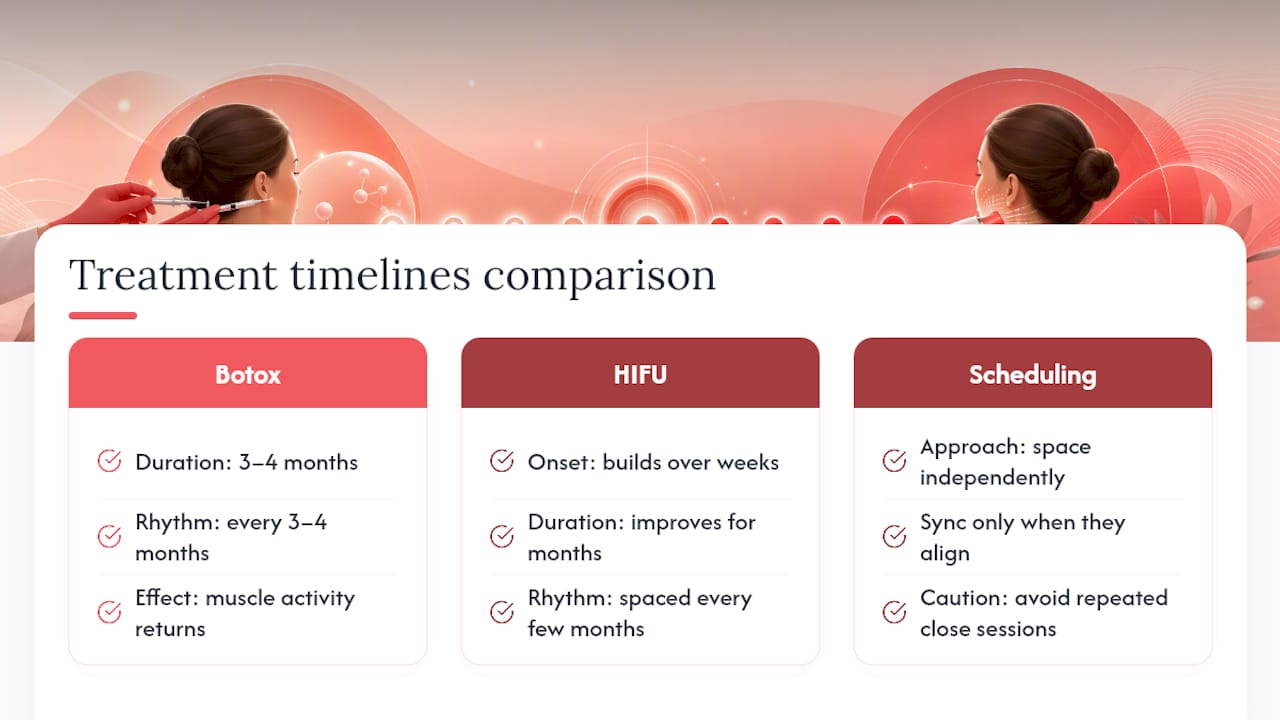
Botox and HIFU work on different timelines, and understanding that rhythm helps you plan smarter over months and years rather than session by session. Botox typically holds its effect for three to four months before muscle activity gradually returns. HIFU’s collagen-remodeling effect builds more slowly, often becoming visible over weeks and continuing to improve for a few months after a single session.
That mismatch means your two treatments rarely need to happen on the same schedule. A common long-term rhythm looks like Botox every three to four months, with HIFU sessions spaced further apart, often every few months depending on the device and your skin’s response. Rather than treating every Botox refresh as a trigger to immediately book HIFU, many people find it works better to let each treatment’s timeline run somewhat independently, syncing them only when a Botox appointment happens to line up near a planned HIFU session.
One consideration worth flagging: repeated cycles of Botox followed too closely by HIFU, session after session, could theoretically add up to more cumulative stress on the treated tissue than either treatment produces alone. There isn’t robust long-term data specifically tracking this pattern in at-home device users, which is another argument for the conservative spacing outlined earlier rather than compressing your schedule for convenience. Building in buffer time between treatments over the course of a year protects your skin and your results without meaningfully slowing your progress toward either goal.
When Should You Talk to a Healthcare Professional?
At-home HIFU devices are built for consumer use, but that doesn’t mean every situation is a solo decision. If you’re new to Botox, new to at-home HIFU, or combining both for the first time, a quick conversation with your injector before your next HIFU session can save you a lot of second-guessing.
Bring up your at-home device plans at your Botox appointment itself. Injectors see a wide range of patient responses and can flag anything specific to your case, like unusually placed injection points near a device-sensitive area, that generic timing advice can’t account for. This is especially worth doing if you experienced more bruising or swelling than expected, since that alone might justify pushing your HIFU date back beyond the standard 14 days.
It’s also worth checking in if you take any medication that affects clotting or wound healing, have a history of keloid scarring, or manage a skin condition like eczema or psoriasis in the treatment area. None of these automatically rule out at-home HIFU after Botox, but they’re exactly the kind of detail a quick message to your provider can clarify faster than searching further online.
Finally, if you notice anything that doesn’t match the recovery you expected, whether it’s before or after starting HIFU, treat that as your cue to call rather than wait it out. Providers would much rather field a quick question than address a preventable complication after the fact.
What Results Can You Realistically Expect From Combining Botox and HIFU?
Used together with proper timing, Botox and at-home HIFU address different layers of aging, which is exactly why so many people pair them rather than choosing one over the other. Botox relaxes the muscle movement that causes dynamic wrinkles, the lines that show up when you frown or raise your eyebrows. HIFU works on a structural level, using focused ultrasound energy to stimulate collagen production deeper in the skin, gradually improving firmness and lift.
Neither treatment substitutes for the other, and expecting HIFU to smooth out expression lines, or Botox to lift sagging along the jawline, sets you up for disappointment. Realistic expectations matter here. Botox results typically show up within days and last three to four months. HIFU results build more gradually, often becoming visible over several weeks as collagen remodeling continues.
When you respect the timing guidance covered earlier, the combination tends to deliver a more complete result than either treatment alone: smoother expression lines from Botox alongside firmer, more lifted skin texture from consistent HIFU use. Soneda’s VividLift™ device reports a 175% increase in skin hydration in clinical testing, a meaningful data point for anyone using HIFU partly for its hydration and sonophoresis benefits alongside the lifting effect.
Patience pays off more than intensity here. Rushing your first post-Botox HIFU session, or cranking the energy setting up too fast, doesn’t accelerate results. It just raises your risk of irritation for no real benefit.
How Do Timing Recommendations Compare Across Aesthetic Authorities?
Timing guidance across dermatology and aesthetic medicine sources converges more than it diverges, but the details differ enough to matter. The clinical consensus most frequently cited settles on 14 days as the baseline minimum between neuromodulator injection and ultrasound-based tightening treatment, a recommendation reflected in the clinical consensus source discussed earlier in this guide.
Where sources diverge is on filler. Guidance that addresses hyaluronic acid alongside neuromodulators tends to push the recommended wait closer to a full month, since filler behaves differently under ultrasound energy than Botox does. That distinction gets lost in a lot of general skincare advice, which treats “injectables” as one category when the timing science treats Botox and filler quite differently depending on tissue depth and energy overlap.
Clinic-published aftercare resources, meanwhile, tend to focus more narrowly on the first 72 hours, covering facials, exfoliation, and heat exposure rather than device-specific ultrasound timing. That’s useful information, but it’s not a substitute for the longer-range 14-day guidance that governs HIFU specifically. Reading clinic aftercare pages alongside the clinical timing literature gives you the fuller picture: short-term precautions for the first few days, layered under a longer 14-day (or longer, with filler) rule for anything involving focused ultrasound energy.
The takeaway across every source: nobody in the clinical literature recommends rushing. The variation is only in how conservative to be, not whether caution matters.
A Practical At-Home Routine Worth Following
If you want one routine to follow rather than juggling a dozen rules, here it is: wait a full 14 days minimum after Botox before your first HIFU session, and stretch that to four weeks if filler was involved too. Start that first session at your device’s lowest energy setting, and keep the handpiece away from injection sites entirely on the first pass. Take a photo of your skin before you begin so you have a baseline to compare against as results build.
This isn’t about being overly cautious for its own sake. It’s about giving two effective treatments the room they each need to work properly rather than letting one interfere with the other. Soneda’s own educational resource on HIFU mechanics walks through exactly how the energy interacts with skin layers, which helps explain why lower settings and controlled movement matter most in those first few sessions after Botox.
— Customer
Why VividLift™ Fits an At-Home Routine After Botox
Once you’ve cleared your waiting period, the question becomes which device actually supports safe, effective use going forward. VividLift™ 2-in-1 HIFU+Sono was built for exactly this kind of routine: it pairs HIFU energy for lifting and collagen support with sonophoresis to push hydration and active ingredients deeper into skin, all with adjustable energy settings that let you start conservative and build up as your comfort grows.

Soneda backs VividLift™ with a 100% user satisfaction rate and clinical testing showing a 175% increase in skin hydration, numbers that reflect what a device designed for careful, at-home use can actually deliver over time. If you’re ready to add HIFU to your post-Botox routine, the Getting Started guide walks through your first sessions step by step, and you can preorder VividLift today to have it ready the moment your 14 days are up.
Sources
- Clinical consensus recommending waiting after injectables (DOI source)
- Retrospective safety review on microfocused ultrasound combined with injectables
- Study on MFU timing after HA filler (histologic and clinical observations)
- Practical Botox aftercare guidance (clinic resource)