7 Point HIFU Safety Checklist for Patients & Providers, FDA Backed

If you’re pregnant or breastfeeding, have an active infection or cystic breakout in the treatment zone, carry a pacemaker or metal implant near the target area, have a known malignancy in that tissue, or manage an uncontrolled systemic illness or clotting disorder, HIFU is off the table right now. Most other conditions are relative, meaning a qualified provider needs to weigh your specific case. If any of this sounds like you, get a medical screening before booking anything.
TL;DR:
- Patients with active infections, recent surgeries, metal implants, or systemic illnesses should avoid HIFU until cleared by a healthcare provider.
- Deep tissue targeting and proximity to bones or nerves increase burn and neuropathy risks, especially without device visualization and correct depth control.
- Anticoagulants, autoimmune conditions, smoking, high BMI, or recent facial procedures require careful evaluation and often postponement.
- Clear disclosure of implants, medications, and health conditions at consultation is essential to determine safety and appropriate device settings.
- Unusual skin conditions like active psoriasis or eczema may pose unpredictable risks due to inflammation or abnormal tissue response.
Table of Contents
- What HIFU Is and Why Certain Conditions Make It Unsafe
- Absolute Contraindications: Do Not Treat Under These Conditions
- Relative Contraindications: When You Need a Case-by-Case Evaluation
- Device, Operator, and Anatomy Factors That Raise Complication Risk
- Your Pre-Treatment Screening Checklist
- Aftercare and the Red Flags That Need Prompt Attention
- At-Home HIFU: What Changes and What Still Matters
- Uncommon Conditions the Standard Lists Don’t Cover
- The Biology Behind Why These Contraindications Exist
- Relative Contraindications Aren’t All Equal Risk
- How Providers Should Approach Patient Selection
- The Checklist Everyone Skips (And Shouldn’t)
- Sources
What HIFU Is and Why Certain Conditions Make It Unsafe
High-Intensity Focused Ultrasound works by concentrating sound waves at a precise depth beneath the skin, heating that focal point enough to trigger collagen remodeling without burning the surface. That precision is the whole point, and it’s also where the risk lives.
When the energy lands exactly where it’s supposed to, at the depth it’s calibrated for, the outcome is controlled and predictable. But focal heating that drifts even a few millimeters off target can injure fat, muscle, or nerve tissue instead of the intended layer. Metal implants and electrical devices complicate this further. Ultrasound reflects and conducts differently through metal than through soft tissue, and that mismatch can re-focus or intensify energy in ways the device never intended, raising real burn risk near hardware.
Proximity to bone, major nerves, and the eyes multiplies the stakes, since those structures don’t tolerate misdirected thermal energy the way skin and fat do. Devices with real-time visualization improve targeting accuracy, but visualization narrows risk. It doesn’t erase it. That’s the physical reasoning behind nearly every contraindication on this list.
Absolute Contraindications: Do Not Treat Under These Conditions
Some conditions aren’t judgment calls. They’re hard stops, and any reputable provider will screen for them before you ever sit in the chair.
- Pregnancy and breastfeeding. There’s no established safety data on focused ultrasound exposure during pregnancy or lactation, so the standard is precautionary avoidance rather than proven harm.
- Active infection, open wounds, or severe cystic acne in the treatment area. Heating inflamed or infected tissue can worsen the infection and increase scarring risk.
- Implanted electrical devices or metal implants at or near the treatment site. Pacemakers, defibrillators, and metal hardware can distort how ultrasound energy travels through tissue, and the FDA’s special controls guidance for focused ultrasound aesthetic devices specifically flags this as a labeling requirement providers must screen for.
- Known or suspected malignancy in the target tissue. Thermal stimulation of cancerous or precancerous tissue is never appropriate outside a controlled medical context.
- Uncontrolled systemic disease. This includes unstable cardiovascular conditions, poorly managed diabetes, severe coagulopathy, and significant untreated psychiatric disorders that would interfere with informed consent or safe aftercare.
A systematic review of HIFU complications confirms this exact grouping as the accepted absolute contraindications list across clinical literature, alongside specific anatomical no-go zones like the temples and eye sockets.
Pro Tip: Bring a current medication and implant list to your consultation, written down. People routinely forget to mention an old surgical mesh or a distant pacemaker until a provider asks directly, and that’s exactly the detail that changes whether HIFU is safe for you.
Relative Contraindications: When You Need a Case-by-Case Evaluation
This is where most real-world screening decisions actually happen, and it’s also where the most confusion lives. A relative contraindication isn’t a ban. It’s a flag that changes the risk-benefit math and often just means “wait” or “proceed with modified settings.”
- Recent facial surgery, laser resurfacing, or injectable fillers. Providers commonly recommend waiting until tissue has fully healed and fillers have stabilized, since timing varies by procedure and product. Waiting a defined period after filler injections specifically helps protect your results.
- Anticoagulant or antiplatelet medication use. Blood thinners raise bruising and bleeding risk under focal heating, so dosage and timing often need coordination with your prescribing physician.
- Autoimmune or connective tissue disease, and a personal history of keloids or poor wound healing. These conditions can slow tissue recovery and increase the odds of an atypical healing response.
- Age extremes, high BMI, and active smoking. Each factor independently affects skin elasticity, blood flow, or collagen response, which changes both healing speed and how much visible improvement you can realistically expect.
- Epilepsy or other neurologic conditions. These don’t automatically disqualify treatment, but they warrant a conversation about how discomfort or unexpected sensations during treatment might interact with your condition.
A peer-reviewed review of HIFU outcomes lists recent surgery or laser within 12 months, smoking, connective tissue disease, and BMI above 30 as the most frequently cited relative factors affecting both safety and results. None of these should be volunteered casually. Disclose them in full, because the provider’s read on your risk depends entirely on accurate information.
Device, Operator, and Anatomy Factors That Raise Complication Risk
Not all HIFU risk comes from the patient’s health history. A meaningful share comes from the equipment and the hands operating it.
Devices with visualization, often called MFU-V systems, let providers see the tissue layers in real time before firing energy. Consensus research on energy-based device safety found that visualization and uniform thermal coagulation points correlate with fewer preventable complications than non-visualized systems, where the provider is essentially firing blind based on depth settings alone.
Depth itself matters enormously. A nationwide adverse-events survey tracking 165 documented incidents found that deeper transducer depths, which reach deeper facial tissue, were the settings most frequently implicated in burns and neuropathy. Shallower settings carry meaningfully less risk.
Other operator-dependent factors include:
- Poor coupling gel application, which scatters ultrasound energy and raises superficial burn risk instead of directing it to the intended focal depth.
- Inadequate operator training or skipped documentation, which the FDA’s device labeling requirements exist specifically to prevent.
- Treatment over anatomical no-go zones, including the temples, eye sockets, and areas directly over bone prominences or major nerve pathways.
Your Pre-Treatment Screening Checklist
Before any provider fires a single pulse, this information needs to be on the table. Walking in prepared protects you and speeds up your consultation.
- Disclose every implant and device, including pacemakers, defibrillators, metal plates, or cosmetic implants near the face or neck.
- List recent procedures with dates, especially fillers, laser treatments, or surgery within the last several months.
- Provide a full medication list, flagging anticoagulants, immunosuppressants, and photosensitizing drugs specifically.
- State your pregnancy or breastfeeding status clearly, even if you think it’s not relevant to a facial treatment.
- Mention any systemic or autoimmune conditions, including diabetes control, cardiovascular status, and connective tissue disorders.
- Bring implant documentation if you have it, since exact material and location affect the provider’s decision.
- Ask the provider directly whether their device uses visualization and what depth settings they plan to use on your treatment area.
A qualified clinic should walk through a physical exam and a verbal consent conversation covering exactly these points before treatment begins, not after.
Aftercare and the Red Flags That Need Prompt Attention
Expect some redness, mild swelling, and tingling for a day or two after treatment. That’s a normal thermal response, not a warning sign, and it typically resolves within 48 to 72 hours.
What isn’t normal: burns, persistent numbness or weakness in the treated area, severe or worsening pain, or any change in vision if the treatment was near the eyes. Any of those warrants contacting your provider immediately rather than waiting to see if it improves on its own. Distinguishing side effects from complications often comes down to timeline and severity: mild reactions fade quickly, complications tend to persist or worsen.
For home care, avoid direct heat exposure, skip retinoids and strong actives for the period your provider recommends, and keep the area cool if swelling appears. If numbness or weakness doesn’t resolve within a few days, ask about follow-up imaging or a referral to a specialist. Reviewing expected side effects and aftercare timelines before treatment helps you recognize the difference in the moment rather than guessing after the fact.
At-Home HIFU: What Changes and What Still Matters
At-home devices operate at lower energy output than clinical MFU-V systems, and you are your own operator instead of a trained provider. That shifts more of the screening responsibility onto you.
The same absolute contraindications apply regardless of setting: don’t treat over implants, active breakouts, or inflamed skin, and skip treatment entirely if you’re pregnant or breastfeeding. Sonedaskincare’s product safety information walks through how the VividLift 2-in-1 HIFU+Sono device is designed for lower-risk home use, but a patch test before your first full session, strict adherence to the labeled settings, and the same waiting period after fillers or facial surgery still apply.
Stop immediately and consult a clinician if you notice numbness, unusual pain, or a burn rather than typical warmth. Home use lowers stakes. It doesn’t eliminate them.
Uncommon Conditions the Standard Lists Don’t Cover
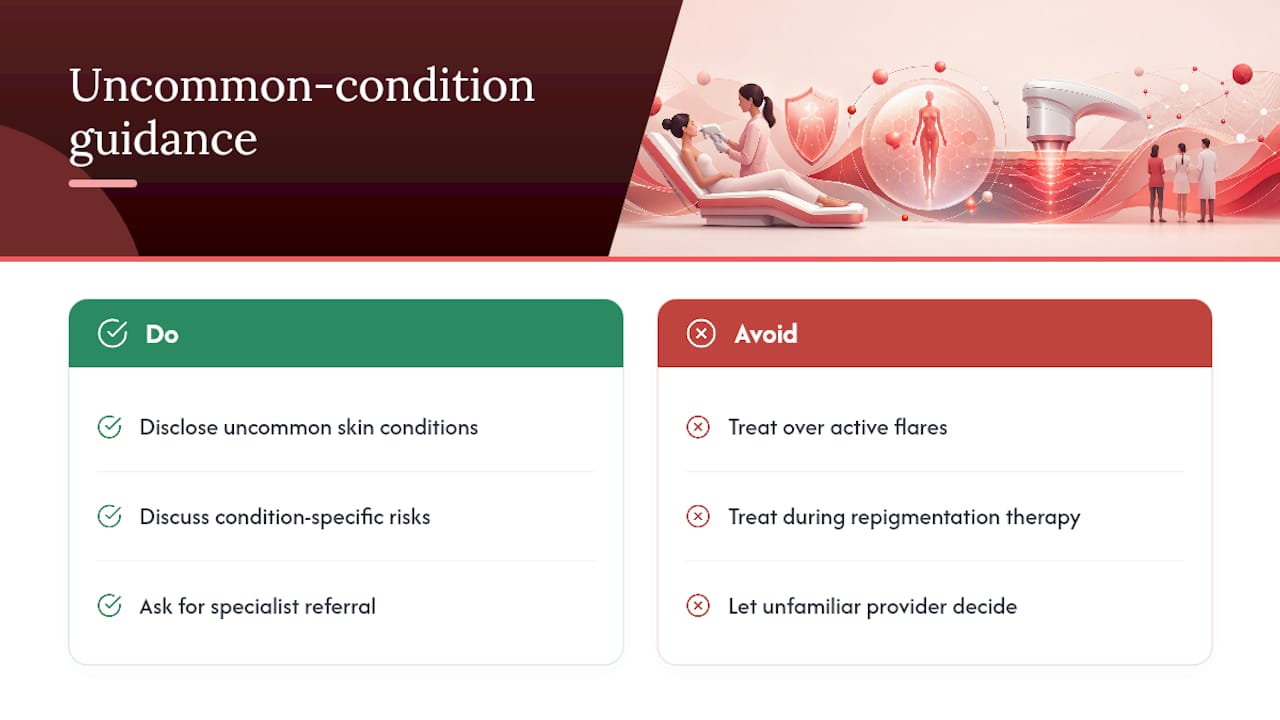
Most contraindication lists focus on the conditions clinicians see most often, but plenty of readers fall outside that neat framework. Certain dermatological diseases fall into this gap, including psoriasis flares, eczema in the active treatment zone, or vitiligo patches undergoing active repigmentation therapy.
None of these appear on standard absolute or relative lists because the research base is thinner. That doesn’t mean the risk is zero. Active psoriasis plaques and eczema flares involve compromised skin barrier function and heightened inflammation, both of which can respond unpredictably to focal heat. Treating over active vitiligo lesions during repigmentation treatment could theoretically interfere with that process, though direct evidence is limited.
The same caution extends to rarer connective tissue disorders, certain porphyrias, and skin conditions involving abnormal collagen structure, since HIFU’s entire mechanism depends on a predictable collagen remodeling response. If your skin doesn’t behave typically at baseline, the outcome becomes harder to forecast.
The honest answer for any condition not explicitly listed here is: it depends, and it needs a real conversation with someone who understands both your condition and how focused ultrasound behaves in tissue. A provider unfamiliar with your specific diagnosis should say so and refer you rather than guess. Uncommon shouldn’t mean unscreened.
The Biology Behind Why These Contraindications Exist
Every contraindication on this page traces back to how ultrasound energy interacts with living tissue at a cellular level. Focused ultrasound works by converting sound waves into localized heat at a specific depth, typically enough to reach the 43 to 45 degree Celsius range needed to trigger controlled collagen denaturation and subsequent remodeling.
That thermal threshold is deliberately narrow. Push past it, and you move from “controlled collagen response” into actual tissue necrosis. A review of ultrasound-mediated tissue effects describes how uncontrolled heat buildup or cavitation, the formation of tiny gas bubbles that collapse violently under ultrasound pressure, can cause burns and delayed tissue damage when parameters aren’t carefully managed.
This explains why metal implants matter so much: metal conducts and reflects ultrasound differently than soft tissue, concentrating energy unpredictably instead of dissipating it evenly. It explains why active infection is dangerous, since inflamed tissue already has compromised blood flow and heat clearance. And it explains why depth control is the single biggest safety variable, since a few millimeters of miscalculation moves the focal point from dermis into fat, muscle, or nerve tissue that responds to heat very differently than skin does.
Relative Contraindications Aren’t All Equal Risk
Lumping every relative contraindication into one category oversimplifies how providers actually think about risk. Smoking, for instance, primarily affects healing speed and collagen quality rather than posing an acute safety threat during treatment itself. A provider might proceed with a smoker but set realistic expectations about slower, less dramatic results.
Anticoagulant use sits higher on the risk gradient because it directly affects what happens if a blood vessel is disturbed during treatment, raising bruising and, rarely, more serious bleeding risk. Providers often coordinate directly with a prescribing physician here rather than making a unilateral call.
Autoimmune and connective tissue disease occupies the most cautious tier among relative factors, since these conditions can produce genuinely unpredictable healing responses, and a flare triggered by treatment could outlast any cosmetic benefit. Recent surgery or laser resurfacing falls into a time-limited category: the tissue itself will heal, and the contraindication resolves once it does, unlike a chronic condition that persists across every future treatment decision.
The practical management approach varies accordingly: some factors call for waiting, some for physician coordination, and some for simply adjusting expectations rather than declining treatment outright.
How Providers Should Approach Patient Selection
Good patient selection isn’t a single yes-or-no gate. It’s a layered assessment that starts with the absolute contraindications, moves through relative factors, and ends with a frank conversation about realistic outcomes given the patient’s specific tissue and health profile.
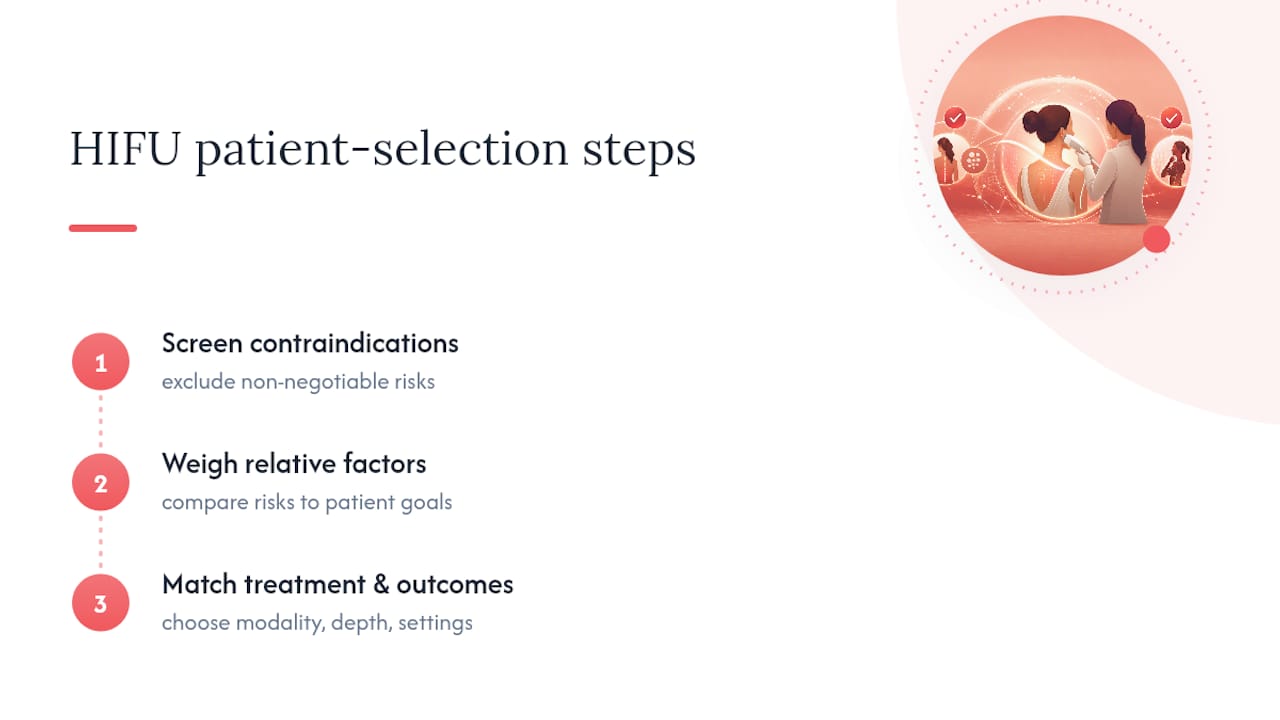
A responsible provider screens for the absolute list first, since those are non-negotiable regardless of how motivated the patient is. From there, relative factors get weighed against the patient’s goals: someone with mild connective tissue disease seeking subtle improvement carries a different risk calculus than someone with the same condition seeking dramatic lifting.
Skin type, treatment area, and prior energy-based treatments all factor into device settings and depth selection too. Selection criteria should also account for the difference between HIFU and other energy modalities like radiofrequency, since a patient who screens as borderline for HIFU might be a better candidate for a gentler alternative. The goal isn’t finding a reason to say yes. It’s matching the right treatment, or no treatment, to the right patient.
The Checklist Everyone Skips (And Shouldn’t)
Most contraindication guides treat this as a simple pass-fail list, and that framing undersells how much clinical judgment actually goes into a safe HIFU decision. The evidence here supports a layered read: a short list of true absolutes, a much longer list of relative factors that shift risk without eliminating candidacy, and a heavy dependence on device visualization and operator skill that most patients never think to ask about.
Where conventional advice falls short is treating every relative contraindication as equally cautionary. Smoking and severe coagulopathy do not belong in the same risk tier, and lumping them together either scares off patients who could safely proceed or, worse, understates real risk for patients who need physician coordination first.
If you take one thing from this: prioritize disclosure over self-diagnosis. Don’t decide for yourself that your medication or old surgery “probably doesn’t matter.” Tell the provider everything, and let device visualization and transducer depth guide the conversation about how, not just whether, treatment happens.
— Customer
This article is general information, not a substitute for advice from a qualified doctor. Consult a qualified healthcare professional about your own circumstances before acting on anything here.
Sources
- Complications and Risks of High-Intensity Focused Ultrasound (HIFU) in Esthetic Procedures: A Review
- Focused ultrasound stimulator system for aesthetic use: class II special controls guidance for industry and FDA
- Adverse Events Associated with High-Intensity Focused Ultrasound Treatment for Rejuvenation
- Microfocused ultrasound with visualization: Consensus on safety and review of energy‐based devices