12–18 Month HIFU Maintenance, 6 Month SMAS Safety Rule for Home Users

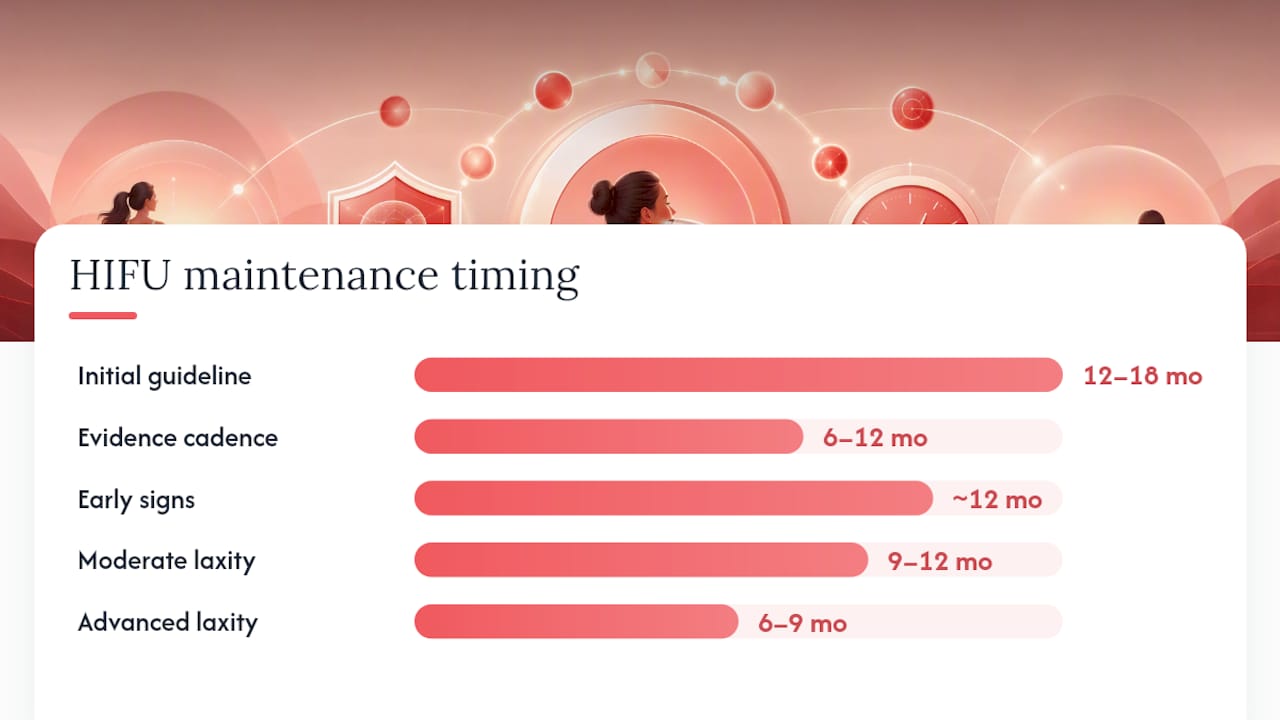
Most people should schedule a HIFU maintenance session every 12 to 18 months, with some clinics recommending 6 to 12 months for deeper treatments. A single session shows mild, immediate tightening, but full results build gradually over several months and need a top-up to last. Deeper, SMAS-level treatments carry a firmer rule: don’t repeat within about six months, which the safety section below covers in detail.
TL;DR:
- HIFU maintenance sessions should be scheduled every 12 to 18 months for most cases, with shorter intervals of 6 to 12 months for deeper treatments targeting the SMAS layer.
- Initial treatments typically involve one to three sessions, depending on the severity of laxity, with moderate laxity often requiring two, spaced 4 to 8 weeks apart.
- The optimal interval between sessions depends on factors like age, area size, treatment depth, device settings, practitioner skill, and whether combined with other skin-active products.
- Deep, SMAS-level treatments should not be repeated within about six months to avoid risks such as nerve irritation or skin changes.
- Results from HIFU develop gradually over 4 to 6 months, making photo documentation and timing of follow-up treatments critical for maintaining desired outcomes.
Table of Contents
- HIFU How Often Should You Repeat It for Maintenance?
- How Many HIFU Sessions Do You Need to Start?
- What Changes How Often You Should Get HIFU?
- How Long Should You Wait Between HIFU Sessions Safely?
- When Will You See HIFU Results, and What Does That Mean for Scheduling?
- Our Take on Realistic HIFU Scheduling
- How Soneda Fits Into a Realistic HIFU Maintenance Schedule
- Sources
HIFU How Often Should You Repeat It for Maintenance?
The 12 to 18 month window isn’t a marketing number. It comes from how collagen actually rebuilds itself after ultrasound energy triggers controlled micro-injury in the skin. Clinical guidance on optimal HIFU results points to this range as the point where most patients start losing enough lift to justify a repeat session, and a peer-reviewed review of HIFU complications and outcomes backs a similar six-month-to-a-year cadence, depending on how deep the energy targeted.
Why the wait? Collagen remodeling isn’t instant. Ultrasound energy heats tissue at a controlled depth, and your body responds by producing new collagen and elastin over weeks, not days. Retreating before that process finishes wastes energy on tissue that’s still actively rebuilding.
Some practical rules of thumb, grouped loosely by what you’re working with:
- Early signs of laxity (late 20s to mid-30s): a yearly touch-up session is often enough to stay ahead of sagging.
- Moderate laxity (mid-30s to 40s): many clinics suggest checking in every 9 to 12 months, since collagen turnover naturally slows with age.
- More advanced laxity (50s and beyond): shorter 6 to 9 month intervals are common, paired with realistic expectations about how much lift ultrasound alone can deliver.
One clinic resource on HIFU for jawline and sagging skin notes that some practices default to a straightforward yearly top-up regardless of age, adjusting only if a patient’s skin responds faster or slower than expected. Either approach works. What matters is not rushing the interval just because you’re impatient for more lift.
How Many HIFU Sessions Do You Need to Start?
Before you get to maintenance, there’s the starter series. Most first-time HIFU patients don’t need a single heroic session. They need a short course, spaced to let each treatment build on the last without overworking the same tissue.
- Mild laxity, early prevention: one session is often enough, since the goal is subtle tightening rather than correcting visible sag. Clinicians frequently monitor for 4 to 6 weeks before deciding whether a second pass is worth it.
- Moderate laxity: a two-session plan, spaced 4 to 8 weeks apart, is a common starting point. The second session reinforces collagen production while the first round is still remodeling.
- More pronounced sagging: some practitioners recommend a three-session series over 8 to 12 weeks, treating it as a cumulative course rather than three separate “fixes.”
Clinical guidance on how many HIFU treatments deliver optimal results generally lands on this 1 to 3 session range for an initial course, which lines up with what most reputable clinics recommend. A single session tends to satisfy people chasing a subtle refresh; multiple sessions make more sense when there’s real structural laxity to address.
What Changes How Often You Should Get HIFU?
There’s no universal number that fits everyone, and pretending otherwise is how people either overtreat their skin or waste money on sessions scheduled too soon. Several variables shift the right interval for you specifically.
- Age and baseline collagen turnover: younger skin regenerates faster and can sometimes handle slightly shorter intervals; skin over 45 usually needs more recovery time between sessions.
- Area and severity of laxity: a jawline with mild sag responds differently than a neck with significant looseness. Larger, more compromised areas often need more conservative spacing.
- Depth targeted: treatments focused on the SMAS layer (the deeper structural layer) require longer recovery than treatments targeting only the dermis.
- Device energy and settings: higher-intensity clinic devices demand longer gaps between sessions than lower-energy tools.
- Practitioner skill and aftercare: uneven technique or skipping aftercare guidance can extend how long your skin needs to fully settle before another round.
- Clinic-grade versus at-home devices: professional HIFU reaches deeper tissue at higher power, while at-home devices work at lower intensity and shallower depth, which is why their usage frequency differs meaningfully from what a med spa recommends.
Pro Tip: If you’re combining HIFU with other actives like retinoids or chemical exfoliants, build in a few extra recovery days around your session. Compounding two things that stress the skin barrier at once slows down how quickly you see results.
How Long Should You Wait Between HIFU Sessions Safely?
Most HIFU side effects are minor and short-lived: transient redness, mild swelling, and occasional tenderness that clear up within days. That’s the expected trade-off for the collagen-stimulating effect. Reviewing your own HIFU aftercare routine in the days after treatment helps you spot whether a reaction is normal or something to flag.
The rare risks are the ones that demand real caution. A peer-reviewed review of HIFU complications documents cases of fat atrophy, nerve irritation, and pigmentation changes, almost always tied to improper device settings, poor technique, or retreating too soon before tissue had time to recover.
Practitioners in the field put it plainly: more is not better with energy-based treatments. Repeating ultrasound sessions too frequently doesn’t accelerate results. It raises the odds of irritation or tissue changes that outlast any cosmetic benefit.
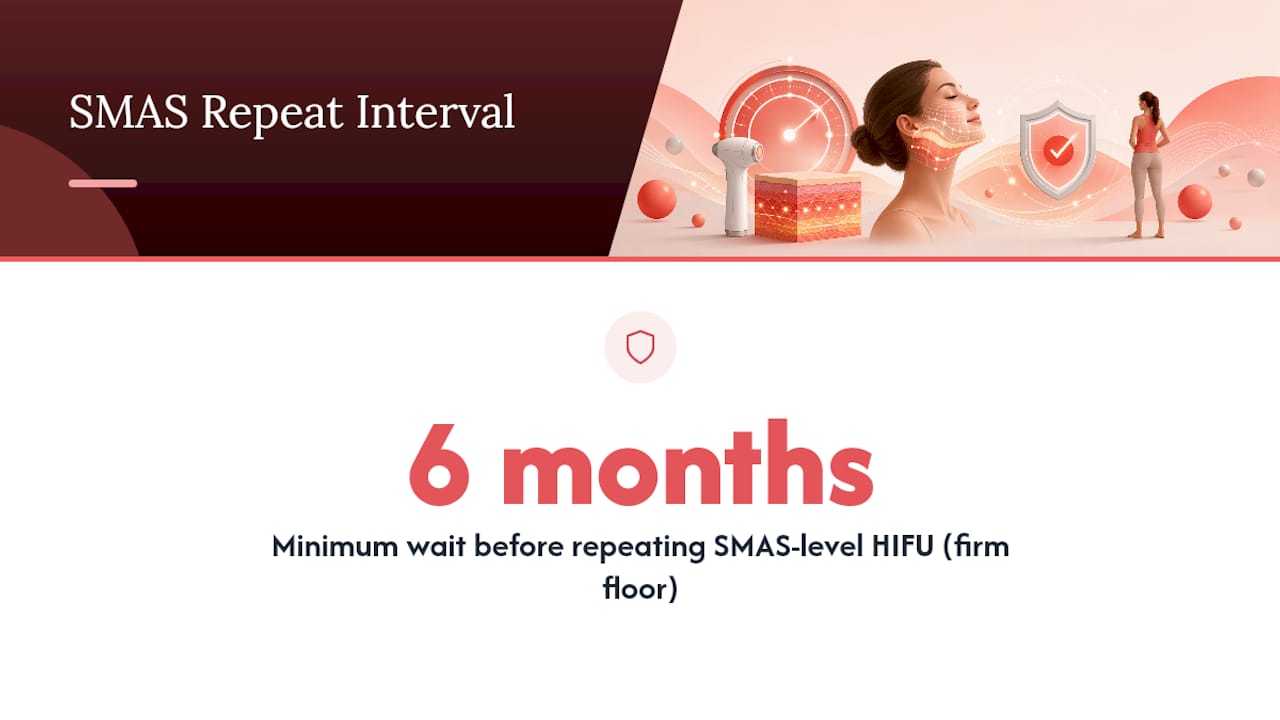
For SMAS-level treatments specifically, the same review of HIFU complications and risks recommends not repeating that deeper application within roughly six months. That’s a firm floor, not a suggestion. If you notice prolonged numbness, unusual dimpling, or skin that feels noticeably thinner in the treated area, hold off on rebooking and talk to your practitioner before scheduling anything else.
When Will You See HIFU Results, and What Does That Mean for Scheduling?
HIFU doesn’t work like a filler with an immediate, obvious payoff, and that’s exactly why so many people misjudge their own timeline. You’ll notice mild tightening right after a session, mostly from the temporary swelling and the initial heat response. The real transformation happens later.
Here’s the general timeline clinical sources describe:
- Immediately after treatment: slight, temporary tightening from swelling, not new collagen yet.
- 4 to 8 weeks in: visible improvement starts as new collagen fibers form.
- 3 to 6 months: peak results, as collagen remodeling reaches its full effect.
Taking consistent photos under the same lighting at these checkpoints is a far better gauge than judging in the mirror day to day, and clinical guidance on HIFU outcomes specifically recommends photo documentation to track real change rather than perceived change. This distinction also matters for scheduling: a cosmetic top-up (maintaining results you already have) is a very different call than a corrective retreatment (addressing an area that never responded well the first time). Don’t confuse the two when deciding it’s time to rebook.
Our Take on Realistic HIFU Scheduling
Clinic-grade HIFU and at-home HIFU are not the same treatment wearing different price tags. Clinic devices reach the SMAS layer at higher energy, which is why their retreatment windows run 6 to 18 months. At-home devices like Sonedaskincare’s VividLift work at lower intensity and shallower depth, which changes both the safety profile and the realistic schedule.
Our position: at-home HIFU is a maintenance and hydration tool, not a replacement for a corrective clinic series. We recommend conservative spacing, typically weekly during an initial few weeks and then monthly for upkeep, and we’d rather you under-treat than chase faster results by rushing sessions. If you’ve had clinic HIFU, an at-home device fits best in the months between professional appointments, not instead of them.
— Customer
How Soneda Fits Into a Realistic HIFU Maintenance Schedule
If your goal is sustaining collagen support and hydration between clinic visits, or you’re not ready for professional treatments yet, that’s precisely the gap Sonedaskincare’s VividLift is built to fill: consistent, lower-energy maintenance you control on your own schedule, without booking a clinic appointment every time your skin needs a boost.

Because at-home devices work at lower power than clinic systems, we recommend a conservative cadence: short sessions two to three times weekly during your first month, tapering to a maintenance rhythm of once or twice weekly after that. This keeps you working with your skin’s own remodeling timeline instead of against it. The VividLift 2-in-1 HIFU+Sono device pairs ultrasound with sonophoresis to help your serums absorb more effectively while supporting the same collagen pathways clinic treatments target, just at an intensity built for regular home use. If you want to see the mechanics behind the technology before committing, learn how VividLift works or explore the current bundle offer to get started on a maintenance routine that fits your actual skin, not a generic clinic average.
This article is general information, not a substitute for advice from a qualified doctor. Consult a qualified healthcare professional about your own circumstances before acting on anything here.