Is At-Home HIFU Painful? A Comfort-First Pain Level Guide

Most people rate at-home HIFU-style treatments as mildly uncomfortable, not painful. Clinical summaries put average facial HIFU pain around four out of ten on standard pain scales, and consumer devices like Soneda Skincare’s VividLift™ run at lower energy than clinic-grade systems, so sensations stay milder still. One safety rule matters above all else: stop the session if you feel persistent or worsening pain, swelling, or any unusual change in your skin, and check guidance from a source like Healthline before continuing.
Key Takeaways
At-home HIFU sensations run mild to moderate for most users, and technique, not tolerance, is what keeps sessions comfortable.
| Point | Details |
|---|---|
| Expect pulsed warmth, not pain | Sessions feel like brief buzzing or warmth in short pulses, not continuous discomfort. |
| Bony areas feel stronger | Forehead, jawline, and cheekbones carry more sensation than fleshier cheek areas. |
| Technique controls comfort | Smooth, continuous passes at low starting intensity prevent sharp, sudden sensations. |
| Know your red flags | Severe pain, spreading swelling, or blistering means stop and contact a professional. |
| Soneda’s VividLift™ prioritizes comfort | Built for repeatable, low-intensity sessions with a reported 175% hydration increase and 100% user satisfaction. |
Table of Contents
- Hifu Pain Level: What a Typical At-Home Session Feels Like
- Why Your Forehead Feels Different Than Your Cheeks
- How to Reduce Discomfort During Your Session
- Red Flags: When Discomfort Isn’t Normal Anymore
- Managing Discomfort Safely, If You Need To
- What to Expect With Soneda’s VividLift™
- A Calmer Way to Think About Your Sessions
- A Comfortable Path to Clinical-Grade Results at Home
- Frequently Asked Questions
- Sources
Hifu Pain Level: What a Typical At-Home Session Feels Like
Expect warmth, light tingling, and gentle pulsed buzzing rather than a steady ache. Each pulse lasts a fraction of a second, so the sensation comes in short bursts with quiet stretches in between rather than one continuous feeling. Practitioner write-ups describe this stop-start rhythm as a big reason at-home HIFU tends to feel more tolerable than people expect going in.
Consumer devices are built with that comfort ceiling in mind. Clinic guides note that at-home HIFU and MFU devices run at meaningfully lower energy than professional clinical systems, and most include adjustable intensity settings so you control how strong each pass feels.
Right after a session, you might notice:
- Mild flushing or redness, similar to a light sunburn
- Slight puffiness around the treated area
- A little tenderness to the touch
These effects are typically short-lived, easing within hours and rarely lasting more than a couple of days.
Pro Tip: Start every new session at your device’s lowest setting and run one full pass over the area before turning up intensity. Your skin gives you better feedback at a lower baseline, and you can always increase from there.
Why Your Forehead Feels Different Than Your Cheeks
Sensation varies a lot depending on where you’re treating, and that’s normal anatomy at work, not a malfunction. Areas with thinner skin and less padding over bone, like the forehead, temples, and jawline, tend to transmit more sensation because there’s less tissue to buffer the energy.
Fleshier zones behave differently:
- Cheeks and other padded areas often feel like a warm, gentle massage
- Bony areas (forehead, jaw, cheekbone ridges) tend to feel sharper or more noticeable
- Thin-skinned zones near the eyes need extra caution and lower settings
Pro Tip: Over bony areas, slow down less and glide through faster instead. Dwelling in one spot is what turns mild warmth into a sharp zing.
How to Reduce Discomfort During Your Session
Technique matters as much as the device itself. Moving in smooth, continuous passes prevents energy from pooling in one spot, which is the main cause of those sharp, unexpected sensations. Here’s a practical sequence to follow:
- Prep your skin. Cleanse thoroughly and apply the conductive gel your device recommends. Skipping gel is one of the most common reasons people report unnecessary sharpness.
- Start at your lowest intensity. Map out your treatment zones mentally before you begin so you’re not deciding on the fly.
- Move continuously. Keep the device gliding across the skin in slow, even passes. Never let it rest in one place.
- Progress gradually across sessions, not within a single one. If week one felt easy at your starting level, nudge up slightly in week two rather than jumping straight to a high setting.
- Plan rest days between passes over the same zone, and if you’re layering in sonophoresis or serum steps, sequence them so you’re not compounding sensation on already-treated skin.
Clinician-facing guidance also recommends short breaks during a session and real-time intensity adjustment if any spot feels more sensitive than the rest of your face. You’re not locked into one setting for the whole session.
Pro Tip: If a spot feels sharp, pause for 10 to 30 seconds, drop the intensity a notch, and resume with a wider, smoother motion. A brief reset almost always solves it.
Red Flags: When Discomfort Isn’t Normal Anymore
Ordinary HIFU sensations fade fast. What should send you to a mirror and then possibly a phone call is anything that escalates instead of settling down.
Watch for:
- Severe or continuous pain that doesn’t ease between pulses
- Swelling that keeps growing rather than leveling off
- Unusual bruising, blistering, or spreading redness
- Persistent numbness or muscle weakness in the treated area
Normal HIFU side effects are transient. They peak early and improve within days. Anything that worsens over time, rather than fading, is not a typical response and deserves professional attention.
If you notice any of these signs, stop using the device immediately, take a photo to track changes, and contact your dermatologist or the device’s customer support line. Seek urgent care if a reaction feels severe or spreads quickly.
Managing Discomfort Safely, If You Need To
Most people don’t need anything beyond good technique, but if a session leaves you sore, there are sensible options. Standard over-the-counter analgesics like acetaminophen or ibuprofen can ease brief post-procedure tenderness; Healthline notes both can help with bothersome discomfort when timed around your session. Check for contraindications with your own health history first, and don’t lean on them as a long-term habit.
- Acetaminophen or ibuprofen for short-term, occasional soreness
- Short-acting topical numbing creams, which reduce surface sensation but usually won’t erase the deeper pulses, so follow label directions or a clinician’s advice
- Skip anti-inflammatory medication if you have a known contraindication, and stop entirely if soreness doesn’t fit the “mild and temporary” pattern
Worth knowing: a small study found 25.3% of participants reported pain after an HIFU facial, though it typically improved without any intervention at all.
What to Expect With Soneda’s VividLift™
VividLift™ 2-in-1 HIFU+Sono was built around a simple idea: clinical-grade technology doesn’t need to feel like a clinical-grade ordeal. It pairs HIFU technology with sonophoresis for deeper serum absorption, and it’s designed for repeatable, comfortable sessions rather than one intense treatment you dread repeating.
Clinical Snapshot: Soneda reports a 100% user satisfaction rate and clinical results showing a 175% increase in skin hydration, numbers that reflect a device tuned for consistent, comfortable use rather than maximum intensity.
Before your first session, a quick checklist keeps things smooth:
- Start on the lowest setting and run a single test pass before going further
- Apply gel generously; dry contact is the fastest route to a sharp sensation
- Follow the VividLift protocol guide for intensity progression and the Sequence 2 lifting and sculpting routine for stepwise pacing
The myth that more pain equals better results doesn’t hold up for at-home devices. Consistent, comfortable sessions build collagen over time more reliably than rare sessions pushed to an uncomfortable intensity.
A Calmer Way to Think About Your Sessions
Treat your first few sessions as calibration, not a test of tolerance. Start low, breathe through the first pass, keep the device moving, and pause the second something feels sharp instead of pushing through it. Comfortable, repeatable sessions beat occasional high-intensity ones every time. That’s not a compromise. It’s the whole point.
A Comfortable Path to Clinical-Grade Results at Home
Sonedaskincare built VividLift™ around one goal: giving you the lift and hydration results of a professional treatment without the price tag or the discomfort that often comes with clinic-grade intensity settings. Full disclosure, this guide is published by Sonedaskincare, and we’re understandably biased toward the device we engineered for exactly this comfort-first approach.
Before you commit, it’s worth reading through the VividLift protocol guide and the How It Works page, both of which walk through intensity progression and session pacing in detail. If you’re ready to see what a comfort-tuned HIFU routine can do for your skin, you can preorder VividLift™ today and start with the lowest setting on day one.
Frequently Asked Questions
Is HIFU painful for most people at home? No. Most users describe at-home HIFU as mildly uncomfortable at most, with warmth and light tingling rather than sharp pain, especially compared to clinic-level treatments run at higher energy.
What does an HIFU pain assessment usually find? Clinical summaries place average pain scores around four out of ten, in the mild-to-moderate range, and at-home devices typically feel gentler than that because they run at lower energy settings.
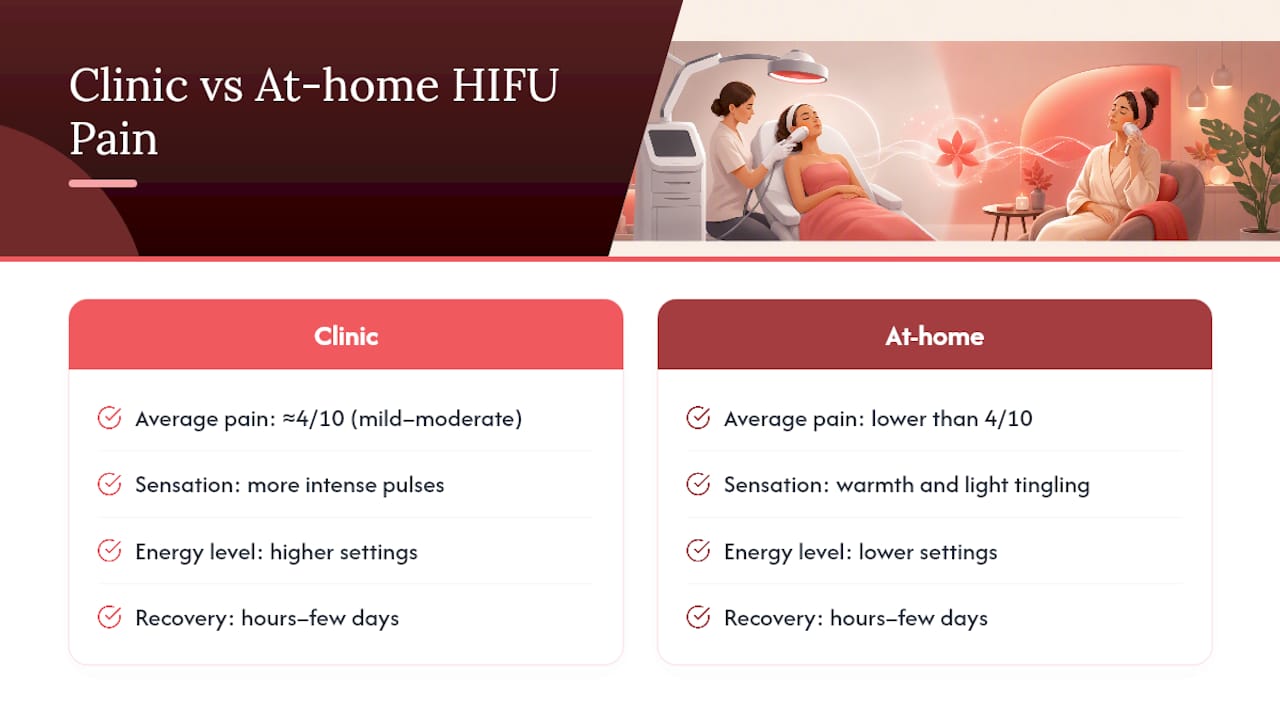
How long does HIFU recovery pain last? Redness, mild swelling, or tenderness usually resolve within hours to a few days. Anything that worsens instead of fading is a sign to stop and check in with a professional.
Can I use pain management during an HIFU session? Acetaminophen or ibuprofen can help with occasional soreness, and short-acting topical numbing creams may reduce surface sensation, though they won’t fully block deeper pulses. Check contraindications first.
Does a higher pain level mean better HIFU results? No. Consistent, comfortable sessions at a tolerable intensity build collagen more reliably over time than rare sessions pushed to an uncomfortable, high-intensity setting.
This article is general information, not a substitute for advice from a qualified doctor. Consult a qualified healthcare professional about your own circumstances before acting on anything here.