HIFU Results Duration for At-Home Users: What to Expect

With regular at-home HIFU and sonophoresis use, you can expect visible hydration and early firming within 2–4 weeks, peak collagen remodeling results around weeks 8–12, and improvements that hold for roughly 3–6 months before a maintenance session keeps them going.
Here is the quick-reference timeline:
- Immediate (hours–48 hours): Skin looks plumper and more radiant from sonophoresis-driven hydration
- Weeks 2–4: Early visible tightening as the first wave of collagen stimulation takes effect
- Weeks 8–12: Peak firming and contour improvement as collagen remodeling reaches its highest point
- Months 3–6: Results stabilize, then gradually soften without maintenance
- Months 6–12+: A maintenance session every 8–16 weeks sustains the improvement
Two numbers anchor this timeline. Sonedaskincare’s clinical testing of the VividLift™ device recorded a 175% increase in skin hydration and a 100% user satisfaction rate. Separately, peer-reviewed literature confirms that ultrasound-stimulated collagen remodeling is a delayed biological process measured in weeks to months, not days.
Key Takeaways
Consistent at-home HIFU and sonophoresis use produces visible results within 2–4 weeks, with peak collagen remodeling at weeks 8–12 and improvements that hold for 3–6 months with proper maintenance.
| Point | Details |
|---|---|
| Peak results window | Collagen remodeling peaks at weeks 8–12; judge the device then, not at week two. |
| Results duration | Visible improvements typically last 3–6 months before a maintenance session is needed. |
| Maintenance cadence | One session every 8–16 weeks, timed to the early decline phase around month 3, sustains results. |
| Hydration evidence | Sonedaskincare’s clinical testing recorded a 175% increase in skin hydration with VividLift™. |
| Sonedaskincare VividLift™ | Combines HIFU and sonophoresis in one home device, calibrated for the run-in and maintenance schedule above. |
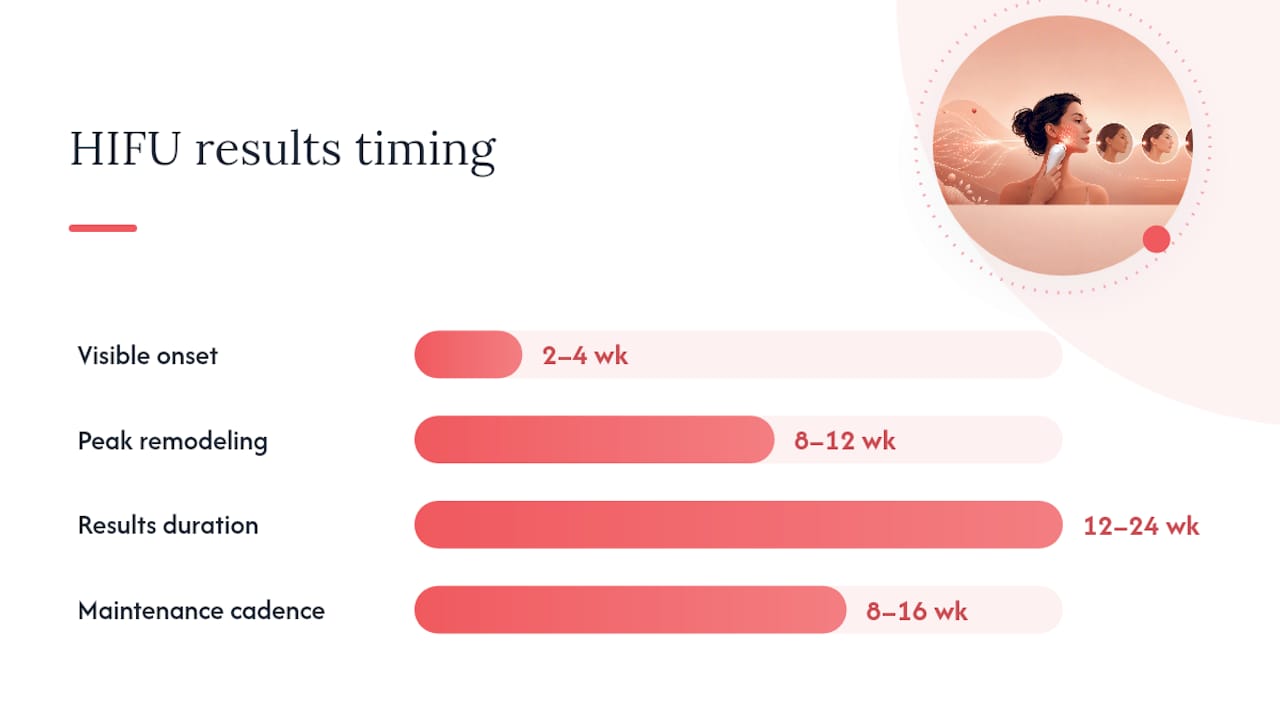
Table of Contents
- Why does at-home HIFU produce both instant and delayed results?
- What does the week-by-week timeline actually look like?
- What factors change how long your results last?
- What are realistic outcomes and safety considerations?
- How do you build a maintenance plan that extends results?
- What does the clinical and user evidence say about VividLift?
- How do you track your own results reliably at home?
- The honest case for patience with at-home HIFU
- VividLift fits the maintenance plan you just read
- Sources
Why does at-home HIFU produce both instant and delayed results?
The two effects come from two completely different mechanisms, and understanding them sets accurate expectations.
Immediate effects are driven by sonophoresis. Low-frequency ultrasound temporarily opens microscopic channels in the skin barrier, pushing active ingredients deeper and boosting surface hydration fast. You feel the glow within hours. This is a physical and hydration-based response, not a structural one.

Delayed effects come from focused ultrasound energy reaching the dermis and stimulating fibroblasts to produce new collagen and elastin. That process, called collagenogenesis, takes weeks to months to produce visible structural change. Home-use HIFU guides confirm that noticeable density and contour changes typically appear after 8–12 weeks of regular use because the biology simply cannot be rushed.
Home devices deliver energy at gentler depths and lower intensities than clinical equipment. That means results are real but more gradual. The sonophoresis component compensates by delivering hydrating and collagen-supporting serums more effectively into the skin, so the two technologies reinforce each other: immediate hydration improves appearance while the deeper ultrasound work remodels structure over time.
Pro Tip: Use a targeted peptide or EGF serum during your sonophoresis pass. The ultrasound-opened channels absorb active ingredients far more efficiently than topical application alone, amplifying both the immediate glow and the longer-term collagen support.
What does the week-by-week timeline actually look like?
Consumer guidance confirms initial visible firmness within 2–4 weeks, with fuller results over 2–3 months. Here is how that maps out in practice:
Individual results vary. Older skin with lower baseline collagen density tends to remodel more slowly. Consistent adherence to a session schedule matters more than any single treatment. Skin that is well-hydrated and supported by a good topical routine also tends to hold results longer.
Pro Tip: Schedule your first maintenance session around month 3, before you notice visible regression. Catching the early decline phase means you are reinforcing existing collagen rather than starting from scratch.
What factors change how long your results last?
Some variables are in your control; others are not. Knowing which is which helps you focus your effort.
Higher-impact factors:
- Device technique and adherence. Consistent, correct application of the device matters more than occasional intensive sessions. Skipping weeks breaks the cumulative collagen-building effect.
- Adjunct skincare. Daily SPF, a topical retinoid or peptide serum, and a solid hydration routine all support the collagen matrix that HIFU stimulates. Without them, results fade faster.
- Lifestyle habits. Chronic sun exposure, smoking, and poor sleep accelerate collagen breakdown. These factors can shorten your results window noticeably.
Moderate-impact factors:
- Skin age and baseline laxity. Younger skin with more collagen reserve responds faster and holds results longer.
- Device intensity settings. Using the correct energy level for your skin type matters; too low produces minimal effect, and too high risks irritation without proportional benefit.
Lower-impact but worth noting:
- Hormonal and medication influences can affect collagen metabolism, though this varies widely by individual.
One practical caution: inconsistent photo conditions (different lighting, angles, or times of day) can make results appear to fade faster than they actually have. Always compare photos taken under identical conditions before deciding a maintenance session is needed.
What are realistic outcomes and safety considerations?
At-home HIFU and sonophoresis produce real but subtle improvements. You are not going to see dramatic overnight change. What you will see, with consistent use, is gradual firming, improved skin texture, and sustained hydration that compounds over weeks.
Normal reactions after a session include temporary mild redness and a gentle warmth in the treated area. Both typically resolve within a few hours.
Stop treatment and consult a clinician if you experience blistering, persistent pain lasting more than 24 hours, unexpected discoloration, or any open skin reaction. These are not typical responses to a properly used home device and warrant professional evaluation.
Pause treatment entirely if you have active skin irritation, open wounds, or a sunburn in the treatment area. Home devices operate at gentler energy levels than clinical equipment, which makes serious adverse events uncommon with correct use, but no device is risk-free when misapplied.
Pro Tip: Always do a patch test on a small area when starting a new session sequence or increasing intensity. A 24-hour observation window before a full-face session is a simple habit that protects your skin.
How do you build a maintenance plan that extends results?
The most effective approach combines an initial run-in phase with a reduced-frequency maintenance schedule. One evidence-based schedule uses 1–2 sessions per week for 4–6 weeks as an initial phase, then spaces sessions to every 2–4 weeks or monthly for ongoing maintenance.
A practical plan for VividLift users:
- Weeks 1–6 (run-in phase): 1–2 sessions per week, following the device’s lifting and sculpting sequence.
- Weeks 7–12 (consolidation): Reduce to one session per week. Let collagen remodeling progress without overworking the skin.
- Months 3–6 (maintenance): One session every 8–16 weeks, timed to the early decline window.
Complementary daily habits that extend results:
- Apply SPF 30 or higher every morning. UV exposure is one of the fastest ways to degrade new collagen.
- Use a retinoid or peptide serum three to four nights per week to support fibroblast activity between sessions.
- Run your sonophoresis pass with a hydrating serum, such as an EGF or hyaluronic acid formula, to maximize absorption.
- Stay hydrated and prioritize sleep. Both directly affect skin repair and collagen synthesis.
- Avoid overuse. More sessions do not accelerate results and can cause unnecessary irritation.
Pro Tip: Pair your sonophoresis pass with a targeted hydrating serum to maximize ingredient absorption during each session. The ultrasound-opened channels make this the most efficient delivery window in your entire skincare routine.
What does the clinical and user evidence say about VividLift?
Sonedaskincare’s published clinical results for the VividLift™ device report a 175% increase in skin hydration and a 100% user satisfaction rate. Those are strong signals for a home device, particularly the hydration figure, which aligns with the sonophoresis mechanism’s well-documented ability to drive ingredient absorption.
Third-party home-device guidance supports the broader timeline: 8–12 weeks for meaningful density and contour changes, with results that can last several months depending on age and aftercare.
Limitations to keep in mind:
- Soneda’s clinical figures reflect the device’s hydration performance; long-term collagen remodeling data for consumer home devices generally comes from smaller studies without extended follow-up periods.
- Individual results vary based on skin age, baseline collagen density, and adherence to a consistent schedule.
- Peer-reviewed literature on at-home HIFU devices is still developing. The mechanistic evidence for ultrasound-stimulated collagen remodeling is well-established; long-term randomized trials specific to consumer home devices are more limited.
The practical takeaway: track your own outcomes with consistent photos and hydration checks rather than relying solely on population averages.
How do you track your own results reliably at home?
Use consistent photos, and take them under identical conditions every time. That single habit eliminates most of the measurement error that makes results seem to disappear faster than they do.
A reliable tracking checklist:
- Lighting: Natural daylight or a fixed ring light, same position every session.
- Angle: Front, left three-quarter, and right three-quarter views.
- Timing: Morning, before applying any products.
- Cadence: Baseline photo before your first session, then at week 2, week 8–12, and each maintenance checkpoint.
Optional objective measures include a consumer skin-hydration meter (corneometer-style devices are available for home use) or a periodic check at a dermatology clinic for objective skin density assessment.
Pro Tip: Keep a simple notes log alongside your photos: date, device sequence used, serum applied, and a 1–10 self-rating of firmness and glow. After three months, patterns become clear and you can fine-tune your schedule accordingly.
The honest case for patience with at-home HIFU
At-home HIFU and sonophoresis are genuinely effective tools, but they reward patience and consistency more than intensity. The most common mistake is judging results at week two, when collagen remodeling has barely begun, and concluding the device does not work. The biology requires 8–12 weeks to deliver its best output.
The convenience of a home device is real: no appointments, no downtime, and a maintenance cadence you control. The trade-off is subtlety. Results are gradual and cumulative, not dramatic. That is not a flaw; it is the nature of safe, home-calibrated energy delivery. Consistent use, paired with smart skincare and disciplined photo tracking, produces results that are both visible and sustainable.
VividLift fits the maintenance plan you just read
The VividLift™ 2-in-1 HIFU+Sonophoresis device from Sonedaskincare is built specifically for the at-home maintenance cadence described in this article. It combines calibrated HIFU energy delivery with sonophoresis in one device, designed for the run-in and maintenance sequences that produce cumulative improvement.
Key features that support the timeline:
- 2-in-1 HIFU + sonophoresis in a single handset, so you complete both the structural and hydration passes in one session
- Home-calibrated energy settings designed for safe, consistent use without clinical supervision
- Dedicated lifting and sculpting sequences aligned with the 8–12 week peak remodeling window
- Clinically tested: 175% increase in skin hydration and 100% user satisfaction rate
Ready to follow the plan? Preorder VividLift and start your first run-in phase with a device built for exactly this purpose.
Sources
- Checking your browser - reCAPTCHA
- HIFU device for home use. Advantages and limitations
- Your Mini HIFU Machine: How to Use It Safely and Effectively
- How often should I use a 3 in 1 Hifu Machine? - Blog - Benomi Electronics Tech