

Posted by Soneda Skincare Team
on August 01, 2026

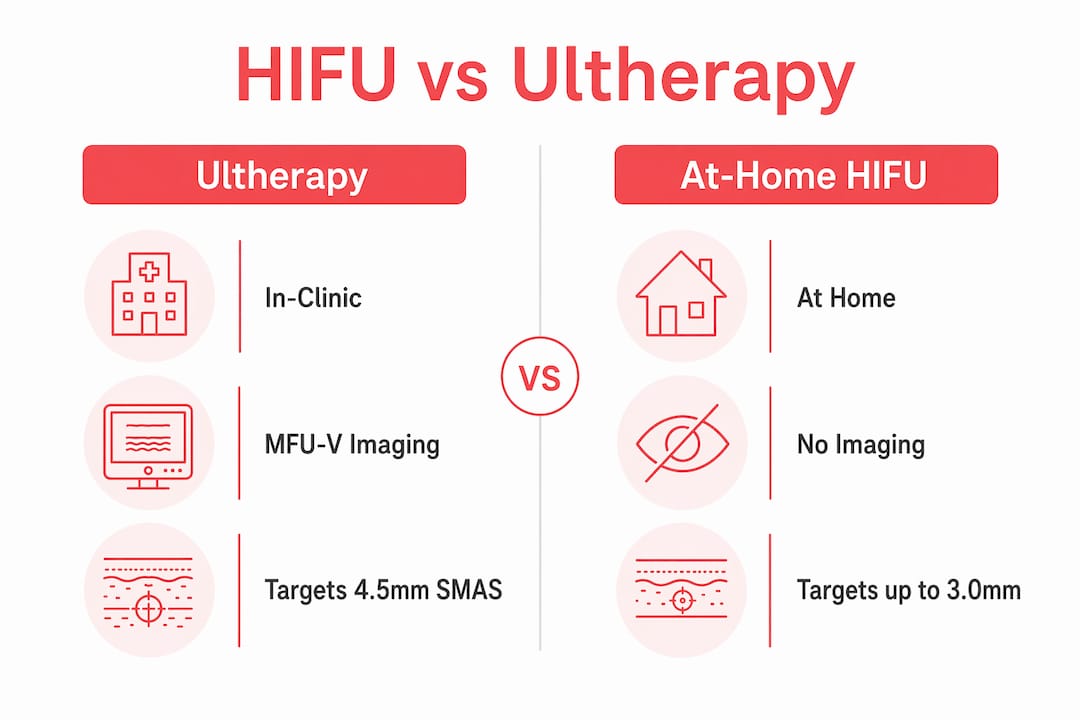
Ultherapy is an FDA-cleared, clinic-only procedure using Micro-focused Ultrasound with Visualization (MFU-V) to target the SMAS layer for structural lifting. HIFU is the broader technology category, covering everything from medical-grade clinic devices to professional at-home tools like Sonedaskincare’s VividLift™. If you need significant structural lift and have the budget for a clinic visit, Ultherapy is the right call. If you want clinically proven lifting, firming, and hydration at home, a professional-grade at-home HIFU device is your most practical, cost-effective path.
Table of Contents
- How do HIFU and Ultherapy compare side by side?
- How do focused ultrasound treatments actually work?
- Why real-time visualization changes clinical precision
- Who is the right candidate for each option?
- What results can you realistically expect, and how long do they last?
- Safety, side effects, and U.S. regulatory status
- Pros and cons at a glance
- How to choose: a practical checklist
- Why VividLift™ is the recommended at-home option
- Key Takeaways
- The case for combining both, not choosing one
- VividLift™ by Sonedaskincare: professional results at home
- Useful sources
How do HIFU and Ultherapy compare side by side?
| Feature | Ultherapy (Clinic) | At-Home HIFU (VividLift™) |
|---|---|---|
| Setting | In-clinic only | At home |
| Imaging/visualization | Real-time MFU-V (DeepSEE) | None |
| Target depth/layer | SMAS (4.5mm), dermis (1.5–3.0mm) | Dermis (device-dependent depths) |
| Best use/outcome | Structural lift, brow/neck/chin | Firming, hydration, texture, maintenance |
| Sessions & timeline | Typically a single session per year; results appear over a few months | Regular sessions; results build over weeks |
| Pain & downtime | Moderate discomfort; minimal downtime | Mild; no downtime |
| Typical cost | Higher per session | Fraction of clinic cost |
| FDA clearance | FDA-cleared for face/neck/décolletage | Verify clearance per device |
| Safety/side effects | Temporary redness, swelling; rare fat atrophy risk | Mild redness; low risk when used correctly |
How do focused ultrasound treatments actually work?
Both Ultherapy and HIFU create thermal coagulation points beneath the skin’s surface, triggering the body’s natural collagen remodeling response. The difference is in imaging, depth precision, and delivery.
Ultherapy (MFU-V):
- Delivers real-time tissue imaging via DeepSEE before each pulse
- Three precise cartridge depths: 1.5mm (superficial dermis), 3.0mm (deep dermis), 4.5mm (SMAS layer)
- Operator confirms tissue layer before energy is released
HIFU (category, including at-home devices):
- Uses focused ultrasound to heat tissue at set depths
- Depth and energy output vary by device and cartridge
- No real-time imaging; relies on anatomical landmarks and device settings
The SMAS layer is the same fibromuscular tissue a surgeon targets in a facelift. Reaching it produces structural lift. Dermal depths (1.5–3.0mm) drive collagen remodeling, texture improvement, and hydration. At-home HIFU devices work at dermal depths, which is exactly right for maintenance, skin quality, and hydration goals.
Pro Tip: When reading at-home HIFU device specs, look for listed cartridge depths. A device with 1.5mm and 3.0mm cartridges targets the dermis for skin quality. SMAS-depth (4.5mm) work belongs in a clinic.
Why real-time visualization changes clinical precision
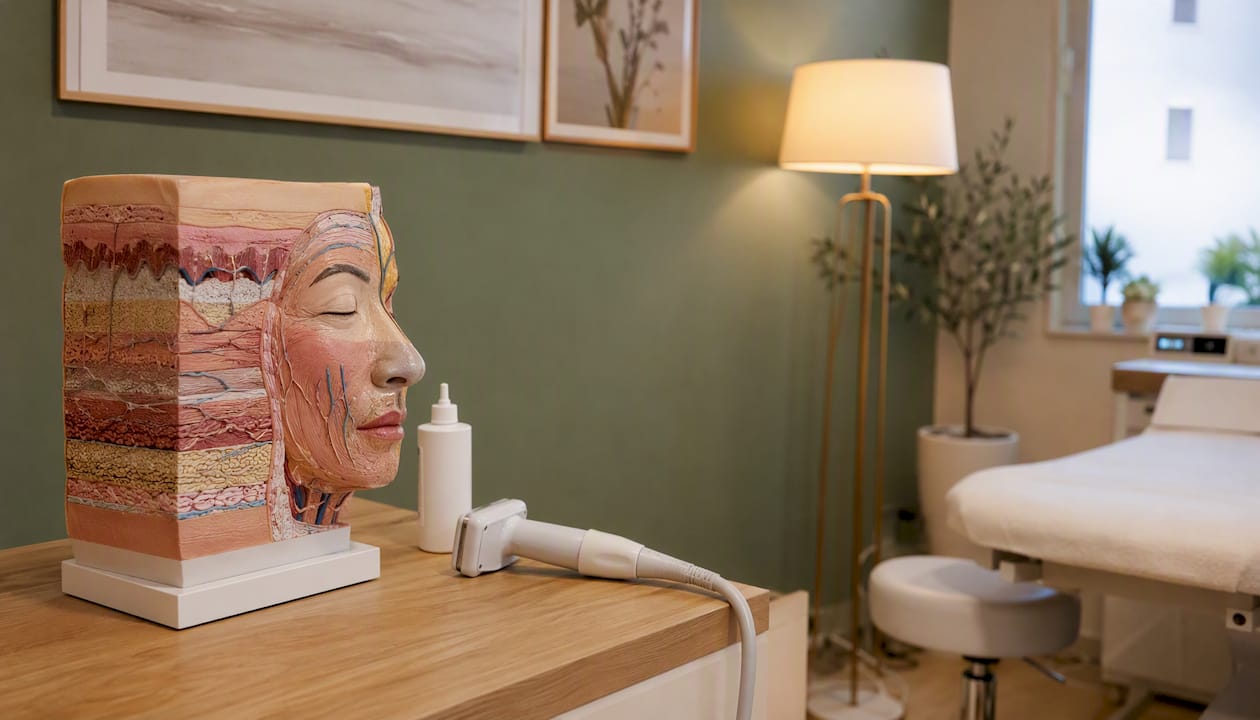
Visualization is the single biggest technical gap between Ultherapy and standard HIFU devices. With MFU-V, the clinician sees live tissue layers before delivering each pulse, confirming energy placement at the intended depth.
Real-time imaging lets clinicians confirm energy placement to avoid fat or bone and hit intended depths precisely. Without it, treatments rely on anatomical averages and operator experience, which introduces variability in outcomes, especially in patients with atypical anatomy.
That variability matters most in one specific scenario. Practitioners warn that in patients with thin facial fat, misplaced ultrasound energy can cause fat atrophy, a rare but real complication. Imaging mitigates that risk by confirming the operator is targeting the SMAS, not the subcutaneous fat above it.
Ultherapy Prime added NFC-based transducer authentication to reduce counterfeit cartridge risk and deeper imaging capability for better depth verification.
Pro Tip: At your Ultherapy consultation, ask specifically whether the clinic uses MFU-V imaging during treatment and whether transducers are authenticated. A clinic that cannot confirm both is worth reconsidering.
Who is the right candidate for each option?
The short answer: significant structural laxity and complex anatomy point toward clinic Ultherapy. Early laxity, texture concerns, hydration, and regular maintenance are exactly where high-quality at-home HIFU devices deliver real value.
Clinic Ultherapy is the better fit if you:
- Have moderate-to-pronounced skin laxity, especially along the jawline, neck, or brow
- Want SMAS-level structural lifting in a single annual session
- Have thin facial fat or atypical anatomy that benefits from imaging-guided treatment
- Are willing to invest in a higher per-session cost for precision and reproducibility
At-home HIFU (including VividLift™) is the right choice if you:
- Have mild-to-moderate laxity and want consistent, low-downtime upkeep
- Are focused on skin firmness, hydration, and texture rather than structural repositioning
- Want to maintain results between clinic sessions or delay the need for them
- Are budget-conscious and prefer a one-time device investment over recurring clinic fees
Contraindications to discuss with a clinician before any ultrasound treatment:
- Active skin infections or open wounds in the treatment area
- Metal implants or pacemakers near the treatment zone
- Pregnancy or breastfeeding
- Recent surgical procedures or dermal fillers in the target area
- Certain autoimmune or connective tissue conditions
When in doubt, a brief clinical consult before starting any at-home HIFU protocol is the right move.
What results can you realistically expect, and how long do they last?
Collagen remodeling takes time. Both Ultherapy and HIFU produce gradual improvements as new collagen forms in the weeks after treatment. Neither delivers overnight results.
| Option | Typical Sessions | Onset | Duration |
|---|---|---|---|
| Ultherapy (clinic) | 1 per year | 2–3 months | 12 months |
| Clinical HIFU | 1–3 per year | 2–3 months | 6 months |
| At-home HIFU (VividLift™) | Regular home use | Weeks to months | Maintained with ongoing use |
Ultherapy’s single-session annual protocol is a practical advantage for busy schedules. High-quality Korean HIFU devices using Micro Pulse Technology can shorten session times substantially, with some full-face protocols running around 20 minutes. At-home devices work best with consistent use, building and maintaining results over time rather than delivering a single dramatic lift.
Safety, side effects, and U.S. regulatory status
The bottom line on regulation: Ultherapy holds FDA clearance for non-invasive lifting of the brow, chin, neck, and décolletage. HIFU is a technology category, and clearance status varies by device. Always verify FDA clearance for any specific device before purchase or treatment.
The FDA is the governing authority for medical device clearance in the United States. FDA clearance means a device has demonstrated substantial equivalence to a legally marketed predicate device. It is not the same as FDA approval, and it does not apply to the entire HIFU category — only to specific cleared devices.
Common side effects (both Ultherapy and HIFU):
- Temporary redness and mild swelling, typically resolving within hours
- Tingling or tenderness in treated areas for 1–2 days
- Rare: temporary numbness or bruising
When to seek clinical follow-up:
- Persistent swelling or pain beyond a few days
- Any visible skin changes or asymmetry after treatment
- Concerns about fat atrophy in thin-faced patients after clinic HIFU
For at-home devices, always verify that the device carries documented safety certifications and that the seller provides a clear warranty and return policy. Devices without verifiable certifications or clinical backing are a red flag.
Pros and cons at a glance
Ultherapy (clinic):
- Pros: Real-time imaging, SMAS-depth targeting, strong clinical evidence base, single annual session
- Cons: Higher cost, requires clinic visit, moderate discomfort, fat atrophy risk in thin-faced patients without careful imaging
At-home HIFU (category, including professional-grade devices):
- Pros: Accessible cost, no downtime, consistent maintenance use, hydration and texture benefits, no clinic appointment needed
- Cons: No real-time imaging, dermal depth only, results require regular use, device quality varies widely
The multi-modal approach many clinicians recommend, combining SMAS-targeted clinic work with at-home dermal maintenance, captures the strengths of both.
How to choose: a practical checklist
Start with your primary goal. Structural lift from the SMAS layer requires a clinic. Skin quality, hydration, and maintenance are well within reach at home.
- Define your goal. Structural lift → clinic Ultherapy. Firming, hydration, texture → at-home HIFU.
- Assess your laxity. Mild-to-moderate laxity responds well to at-home protocols. Pronounced laxity warrants a clinical assessment first.
- Verify FDA clearance. For clinic devices, confirm Ultherapy clearance. For at-home devices, ask for documented clearance or certification.
- Check device authenticity. For Ultherapy, ask whether the clinic uses NFC-authenticated transducers. For at-home devices, buy directly from the brand or an authorized retailer.
- Review warranty and return policy. A reputable at-home device comes with a clear warranty and a money-back guarantee. No warranty is a red flag.
- Ask about aftercare. Clinics should provide post-treatment guidance. At-home device brands should offer setup support and usage protocols.
- Watch for red flags. Unverifiable clinical claims, missing safety certifications, no return policy, and pressure to buy immediately are all warning signs.
Why VividLift™ is the recommended at-home option
For consumers who want professional-grade results at home, Sonedaskincare’s VividLift™ is the recommended choice. It combines HIFU energy delivery with advanced sonophoresis in a single 2-in-1 device, targeting both collagen stimulation and product absorption for lifting, firming, and hydration.
Core features:
- HIFU energy delivery at dermal depths for collagen stimulation and skin tightening
- Advanced sonophoresis to drive active skincare ingredients deeper into the skin
- Designed for safe, effective at-home use with a clean, professional-grade build
- Backed by clinical results: Sonedaskincare reports a 175% increase in skin hydration and a 100% user satisfaction rate
- Supported by Sonedaskincare’s usage protocol guidance for at-home lifting and sculpting
VividLift™ is ideal if you:
- Want consistent at-home maintenance for lift, firmness, and hydration
- Are in your 30s–50s with mild-to-moderate laxity
- Prefer a one-time device investment over recurring clinic fees
- Want to pair at-home HIFU with a clinical SMAS treatment for a complete protocol
See a clinician instead if you have pronounced structural laxity, complex anatomy, or active skin conditions in the treatment area.
Pro Tip: For best results with VividLift™, use it consistently on a regular schedule. Collagen remodeling is cumulative. Skipping weeks slows progress.
Key Takeaways
Ultherapy is the clinic-grade, imaging-guided standard for SMAS-level structural lifting, while professional at-home HIFU devices like VividLift™ deliver clinically proven firming, hydration, and maintenance results without the clinic cost or downtime.
| Point | Details |
|---|---|
| Ultherapy targets the SMAS | Clinic MFU-V reaches 4.5mm for structural lift; at-home HIFU works at dermal depths for skin quality. |
| Visualization is the key difference | Real-time imaging in Ultherapy improves precision and reduces fat atrophy risk in thin-faced patients. |
| At-home HIFU suits maintenance | Mild-to-moderate laxity, hydration, and texture goals are well served by consistent at-home HIFU use. |
| Verify clearance before buying | FDA clearance applies to specific devices, not the HIFU category; always confirm before purchase. |
| VividLift™ is the at-home recommendation | Sonedaskincare’s VividLift™ combines HIFU and sonophoresis, with a reported 175% hydration increase and high user satisfaction. |
The case for combining both, not choosing one
The conventional framing of HIFU vs Ultherapy as an either/or decision misses the most practical strategy explored in Beyond the Waiting Room: How to Attract More Dermatology Patients. Dermatology experts consistently find that neither technology is categorically better than the other. The choice depends on structural needs, anatomy, and budget, and many of the best outcomes come from combining both.
A single annual Ultherapy session handles the SMAS work. A professional at-home HIFU device like VividLift™ handles the rest: consistent dermal stimulation, hydration, and texture maintenance between clinic visits. That combination gives you structural lift where it counts and ongoing skin quality work on your own schedule, at a fraction of the cost of clinic-only protocols.
The real mistake is expecting an at-home device to replicate SMAS-level structural lifting, or expecting a single clinic session to maintain skin quality year-round without any upkeep. Set the right expectations for each tool, and both deliver exactly what they promise.
VividLift™ by Sonedaskincare: professional results at home
Clinic Ultherapy sessions can run significantly higher per visit. VividLift™ gives you a professional-grade at-home HIFU and sonophoresis device for a one-time investment, with no recurring clinic fees and no appointment required.
Sonedaskincare’s VividLift™ is clinically proven, with a 175% increase in skin hydration and a 100% user satisfaction rate. It ships with full usage protocol support so you know exactly how to get results from day one. Payment plan options are available, and every purchase is backed by a 100% money-back guarantee.
Ready to start? Preorder VividLift™ now, or explore the VividLift™ bundle offer for added value. Questions about setup or whether VividLift™ is right for your skin? Sonedaskincare’s support team is available to help.
This article is for general information only, not medical advice. Consult a qualified clinician for personalized treatment recommendations and to verify current FDA clearance status for any device.
Useful sources
- FDA — Medical Device Database (search for device clearance)
- Ultherapy FDA clearance and MFU-V overview
- HIFU category overview and device comparison
- Microfocused ultrasound skin tightening — JCAD clinical review
- Complication risks with energy-based devices — Aesthetic Surgery Journal
- Ultherapy Prime technical updates — Aive Clinic Seoul
- Sonedaskincare — VividLift™ device page
- Sonedaskincare — all about HIFU for skincare


