LED and Hyperpigmentation Risk: How to Use Light Safely

LED light can affect pigmentation, but the wavelength, the dose, the heat and your skin tone decide how. Red light at controlled doses has not been shown to darken skin in most research, while blue light is the wavelength linked most clearly to dark spots, especially on deeper skin tones. Heat and overuse matter too, particularly if you have melasma. Here is how to use an at-home device with confidence.
TL;DR
- Blue and violet visible light is the wavelength most clearly tied to pigment darkening. Red light at moderate doses has not shown the same effect in the studies below.
- Very high red-light doses caused temporary hyperpigmentation in skin-of-color volunteers in clinical trials, and it cleared within three months.
- Melasma, heat-triggered discoloration and deeper skin tones call for a dermatologist’s input before you start.
- Follow the device directions, keep sessions short and consistent, protect skin from the sun and avoid irritating products around treatment.
- Dose, heat and skin sensitivity matter more than the word “LED” on the box.
Table of Contents
- Does LED light cause hyperpigmentation?
- How different LED wavelengths affect pigment
- Why skin tone changes the risk
- Melasma and heat: the special case
- What the evidence does and does not show
- What raises the risk of dark spots
- How to use an at-home LED device safely
- Our perspective
- Choosing a device with confidence
- Meet VividLift
- FAQ
- Sources
Does LED light cause hyperpigmentation?
It can, under specific conditions. “LED” is a technology, not a single type of light. A diode can emit blue, green, yellow, red or near-infrared wavelengths, and each interacts with pigment cells differently.
A 2023 review of visible light and melanocyte biology describes blue light as able to stimulate melanin production. The same review reports that 630 nm red light did not promote melanogenesis and inhibited melanin synthesis. It also notes that yellow light was reported to inhibit melanogenesis.

So the honest answer to “can red light cause hyperpigmentation?” is: at typical doses, the evidence leans toward no, but high doses, heat and individual sensitivity are real variables. The rest of this guide covers each one.
How different LED wavelengths affect pigment
| Wavelength | What research reports about pigment | Who should be most careful |
|---|---|---|
| Blue/violet (about 415 to 470 nm) | Can stimulate melanin production and darken skin | Darker phototypes, melasma-prone skin |
| Green and yellow | Yellow reported to inhibit melanogenesis; a 590 nm trial reported improved melasma-related redness and pigmentation | Follow device directions |
| Red (about 620 to 750 nm) | 630 nm and 660 nm showed no promotion of melanogenesis and a depigmenting effect in studies | Very high doses, heat sensitivity, deeper skin tones |
| Near-infrared | Generates more heat on skin | Heat-triggered discoloration, melasma |
Blue light is the wavelength to understand first
In a 2014 clinical and histological study by Duteil and colleagues, 415 nm blue-violet light produced dose-dependent hyperpigmentation in skin types III and IV that lasted up to three months. Red light at 630 nm did not induce hyperpigmentation at any tested dose.
A 2025 review in Our Dermatology Online adds the mechanism. Blue light acts through Opsin-3 in melanocytes, which triggers signaling that increases melanin synthesis. Red light does not activate those same pathways.
If you want a plain-language comparison of what each color is used for, our guide on red vs. blue light therapy walks through it.
Red light: low concern at moderate doses, with a ceiling
Red light has the better pigment profile. The 2023 review reports that 630 nm red light at 10 to 150 J/cm² inhibited melanin synthesis, and that 660 nm red light showed a depigmenting effect with downregulation of tyrosinase and MITF. A 633 nm LED at 96 J/cm² significantly decreased melanin levels in acne patients after treatment.
The ceiling is dose. In two phase I trials (STARS 1 with 60 participants, STARS 2 with 55), published as safety research on LED red light, red light was considered safe up to 320 J/cm² for skin of color and 480 J/cm² for non-Hispanic Caucasian participants. Mild adverse events included transient redness and hyperpigmentation. Blistering and prolonged redness occurred only at the dose-limiting levels, 480 J/cm² in one trial and 640 J/cm² in the other.

Those doses are far above a typical home session, but the finding shows why following device directions matters.
Why skin tone changes the risk
The same trials found that hyperpigmentation was more prominent in darker skin, and that skin of color was more photosensitive to red light. Hyperpigmentation seen at 320 J/cm² in those subjects resolved within three months.
The American Academy of Dermatology says research shows people with darker skin tones are more sensitive to visible light such as red light. That sensitivity can lead to hyperpigmentation, and the dark spots can be more intense and longer-lasting than those caused by invisible light like sunlight.
A study by Mahmoud and colleagues, cited in a 2026 review in Forum Dermatologicum, found that visible light induced darker and more persistent pigmentation in Fitzpatrick phototypes IV to VI than UVA1. Pigment persisted for up to 14 days, and higher doses produced more darkening. The effect was absent in phototype II.
The takeaway is not “avoid light.” It is: the lower your skin’s tolerance for visible light, the more your dose, session length and wavelength choice matter.
Melasma and heat: the special case
Melasma is the condition where caution is strongest, and the reason is not only wavelength.
The 2026 Forum Dermatologicum review says current guidance urges caution or avoidance of visible-light LED therapy in people with melasma, especially darker phototypes. It adds that LED therapy cannot currently be recommended as a melasma treatment. A 2023 review reports that blue light induced melanogenesis in lesional and neighboring skin in 22 melasma patients, and that low-energy indoor visible light was enough to induce hyperpigmentation in melasma patients.
Heat is the second trigger. In Harper’s Bazaar, New York dermatologist Dendy Engelman said melasma is highly sensitive to both UV and thermal triggers. She said some LED devices, especially those with infrared light, can generate enough heat to activate pigment cells, and that the risk comes from cumulative heat and overuse rather than the wavelengths themselves. In the same piece, Chicago dermatologist Morayo Adisa said people with a personal or family history of melasma, sun- or heat-induced discoloration, or medium to darker skin could be at risk.
If any of that describes you, talk to a board-certified dermatologist before you begin. Our guide to red light therapy contraindications is also a good checklist of situations where red light needs a professional’s input first.
What the evidence does and does not show
The evidence is still developing, and that is worth knowing as you plan your routine.
- A 2024 review by Gan and Rodrigues says LED use for melasma, particularly red or infrared, has low evidence, red light has been used to both increase and decrease pigmentation depending on the indication, and blue light seems to worsen melasma hyperpigmentation.
- The 2026 Forum Dermatologicum review notes that reporting of irradiation parameters is often incomplete and that “dose” is used inconsistently, which makes it hard to compare devices. That is why clear energy and timing guidance from a manufacturer is useful.
- On general safety, the AAD says red light appears safe in the short term and, unlike ultraviolet light, research has not found that it causes cancer. Side effects are usually mild, such as temporary discomfort or irritated skin. FDA-clearance means the agency considers the device low risk, but it says nothing about effectiveness.
A useful frame: pigment problems with LED are mostly a question of the right wavelength, a controlled dose and a skin type that tolerates it. They are not a reason to guess.
What raises the risk of dark spots
Most pigmentation problems trace back to a short list of factors you control.
- Overuse. Sessions that run longer or happen more often than the instructions say raise the cumulative dose and heat.
- Distance and positioning. Holding a device closer than intended changes how much energy reaches the skin.
- Heat buildup. Warm devices, hot rooms and stacking heat sources can matter for heat-sensitive skin. If you pair light with a sauna, our guide to red light before or after sauna covers the order.
- Irritation. Lab Muffin Beauty Science notes that irritating products used alongside light could cause inflammation and raise the chance of post-inflammatory hyperpigmentation, and that abrasive scrubs may aggravate melasma. In its summary of a small pilot, five of six melasma subjects with type VI skin improved on 633 nm and 830 nm LED, and the one who darkened seemed to be using abrasive scrubs at home.
- Sun exposure. Sunlight is a pigment trigger on its own. Our piece on LED for sun damage explains how light fits into a routine that already protects against UV.
How to use an at-home LED device safely
These steps reflect AAD guidance and the research above.
- Check your starting point. The AAD advises seeing a board-certified dermatologist before using red light at home if you have darker skin, an existing skin condition or take medication that may increase light sensitivity.
- Read the directions first. Follow the stated session length and frequency. Use eye protection if the device instructs you to.
- Start with the shortest recommended session. Watch how your skin looks over the next day before increasing frequency.
- Keep the surface calm. Skip abrasive scrubs and strong exfoliants around treatment days, and use gentle cleansing.
- Protect against UV every morning. Broad-spectrum sunscreen is a baseline for anyone concerned about dark spots.
- Stop and get advice if you see new darkening. Persistent redness or any new patch of discoloration is a reason to pause and ask a dermatologist.
If you want a post-session routine, our 72-hour LED aftercare plan lays out what to do after each session.
Our perspective
We build Soneda devices for people who want professional-grade results at home, and pigment safety is part of that conversation. Our VividLift device combines HIFU, sonophoresis, EMS toning and multi-wavelength LED, and it was independently tested in Korea and manufactured in a South Korean facility that also produces professional medspa equipment.
The research is clear on one thing: wavelength, dose and heat decide how skin responds to light. That is why we favor clinically grounded, well-specified devices over novelty gadgets, and why we encourage every customer to follow the directions that come with the device, protect skin from the sun and ask a dermatologist first if melasma or deeper skin tones are part of the picture.
A controlled, professional-grade device gives you a defined way to use light. That is the standard we hold ourselves to.
Customer
Choosing a device with confidence
When you compare at-home devices, look for details that let you control dose and keep your routine consistent:
- Clearly stated wavelengths, so you know whether a device emits blue light.
- Written guidance on session length and frequency.
- Independent testing and quality manufacturing.
- Support for multiple technologies in one routine, so you are not stacking several heat-producing gadgets.
Our guide to spotting red light myths gives a shopper’s checklist for sorting solid claims from vague ones.
Meet VividLift
VividLift is our 2-in-1 HIFU and sonophoresis device, built to bring professional technology home. It supports lifting, firming, hydration and product absorption, with EMS facial toning and multi-wavelength LED therapy for skin tone. In our clinical testing, we saw a 175% increase in skin hydration. VividLift is $1,399, and payment plan options are available at checkout.
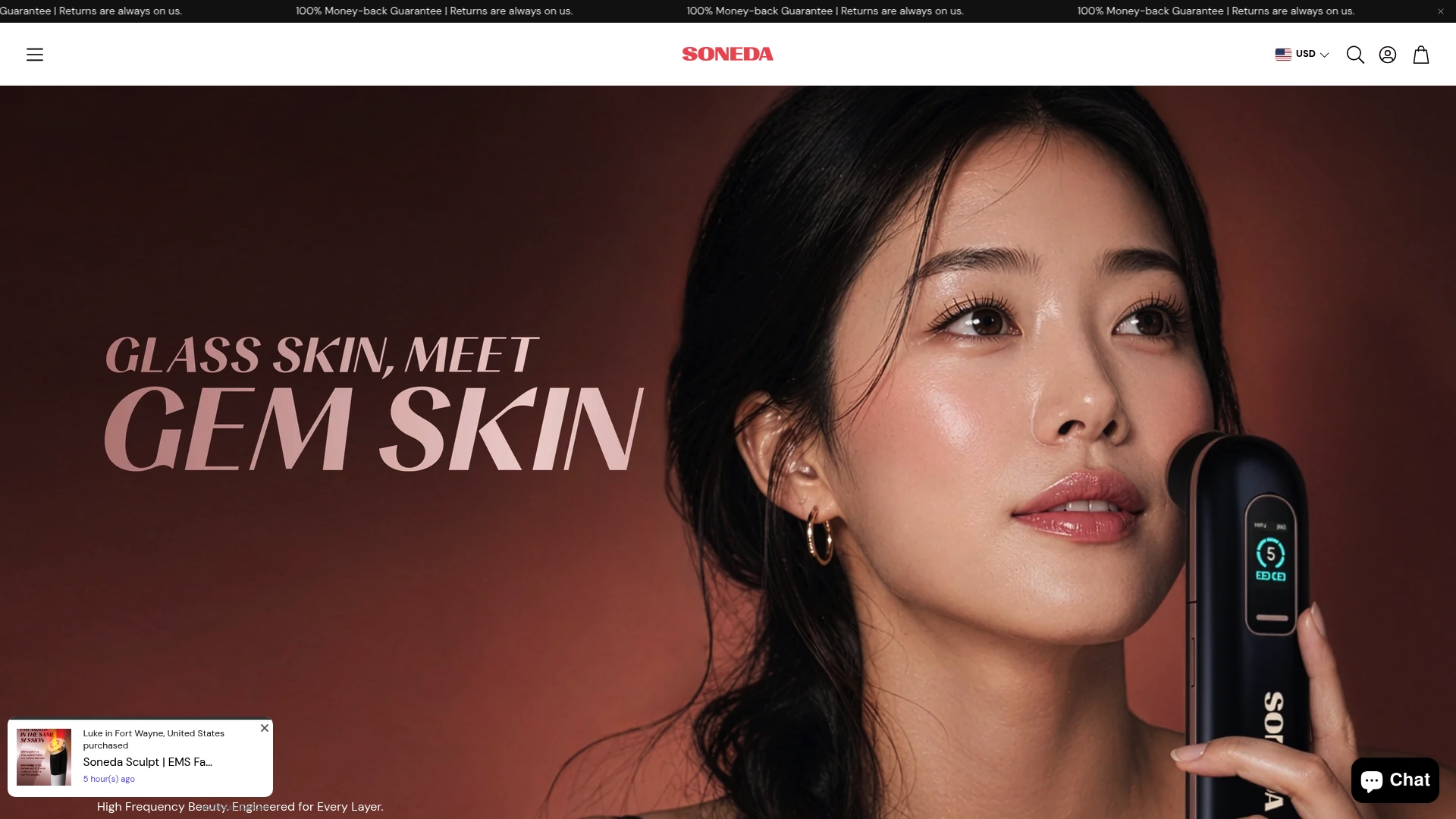
If you are ready to bring a professional-grade routine home, shop VividLift or explore our full range on the Soneda site.
FAQ
Can red light cause hyperpigmentation?
At very high doses, yes. In clinical trials, hyperpigmentation appeared in skin-of-color participants at 320 J/cm² and resolved within three months. At moderate doses, studies of 630 nm and 660 nm red light found no promotion of melanin production. Follow your device’s directions to stay within its intended dose.
Is blue LED light worse for dark spots than red?
Research points that way. Blue-violet light at 415 nm produced dose-dependent pigmentation lasting up to three months in one study, and red light at 630 nm did not. Blue light is also the wavelength most often flagged for darker phototypes and melasma.
Is LED therapy safe for dark skin?
It can be used, but dose matters more. The AAD notes that people with darker skin tones are more sensitive to visible light and can develop longer-lasting dark spots. Talk to a board-certified dermatologist before starting, use the shortest recommended sessions and follow the device instructions.
Should I use LED if I have melasma?
Speak with a dermatologist first. A 2026 review reports that current guidance advises caution or avoidance of visible-light LED therapy in melasma, especially on darker phototypes, partly because heat and visible light are both triggers. Your dermatologist can tell you whether any light-based routine suits your skin.
How do I lower the chance of dark spots from an at-home device?
Keep to the recommended session length and frequency, avoid abrasive scrubs, use daily sunscreen and watch for heat or irritation. Stop and see a dermatologist if you notice new darkening.
Sources
- Safety of light emitting diode-red light on human skin: two randomized controlled trials
- The Emerging Role of Visible Light in Melanocyte Biology
- Differences in visible light-induced pigmentation, Duteil et al. (2014)
- LED photobiomodulation, Our Dermatology Online (2025)
- American Academy of Dermatology: Is red light therapy right for your skin?
- Harper’s Bazaar: Can red light therapy masks make dark spots worse?
- An Update on New and Existing Treatments for the Management of Melasma
- Lab Muffin Beauty Science: Is red light safe for hyperpigmentation and melasma?
- Red light therapy contraindications