LED for Sun Damage: What It Can Do for Your Skin

LED light therapy can improve the look of sun-damaged skin, mainly its texture, tone, fine lines and redness, when you use it consistently over weeks. It is not a spot eraser. Established brown sun spots respond best to dermatologist-led treatments, and no light device replaces daily sunscreen. Here is what the evidence supports, how to use red light well, and how to fit it into a routine that covers the whole picture.
TL;DR
- Red and near-infrared LED has clinical evidence for improving signs of photoaging, including texture, elasticity and fine wrinkles.
- Results are gradual. Plan on at least four to six weeks of regular sessions before judging, and longer for lasting change.
- Established sun spots (solar lentigines) are the weakest area for red light. Pair LED with sunscreen and ask a dermatologist about proven spot treatments.
- Have any new, changing or irregular spot examined by a dermatologist before you treat it with anything.
- Choose a device built for facial skin care, with proper wavelengths and clear directions, and follow them.
Table of Contents
- What sun damage actually is, and where LED fits
- What the research shows
- Realistic expectations
- Red light for sun spots: where it helps and where it doesn’t
- Which LED colors matter for sun-damaged skin
- How often and how long to use LED
- Safety: who should check first
- Does LED protect against future sun damage?
- A complete routine for sun-damaged skin
- Our perspective
- What to look for in an at-home LED device
- Add professional-grade care to your routine
- FAQ
- Sources
What sun damage actually is, and where LED fits
Sun damage, or photoaging, is the cumulative effect of ultraviolet exposure: rough texture, fine lines, uneven tone, redness and brown spots. Photodamage cannot be completely reversed, but some treatments can help rejuvenate skin. That list includes retinoids, vitamin C and other antioxidants, exfoliating acids, peels, lasers and more.
LED sits in the supportive, low-downtime part of that list. It uses visible and near-infrared wavelengths, with no UV. Cleveland Clinic notes that because LEDs contain no UV, LED therapy is not a source of sun damage itself and it lists sun damage and wrinkles among the things LED can help treat. The key idea: LED works on the skin’s repair and renewal signals, so it suits the broad, gradual signs of sun exposure better than a single dark patch.
What the research shows
The strongest data for LED and photoaging comes from red and near-infrared light.
- Skin tone and smoothness. In a 2007 trial of 13 people with moderate photodamage, nine 20-minute sessions combining 633 and 830 nm light over five weeks led to 91% reporting improved skin tone and 82% reporting enhanced smoothness at the 12-week follow-up.
- Wrinkles and collagen. A study of 36 people who received nine combined 633 nm and 830 nm treatments over five weeks found a statistically significant improvement in wrinkles, and electron microscopy showed thicker collagen fibers afterward.
- Patient-reported improvement. The American Academy of Dermatology (AAD) describes a study in which 90 patients had eight red-light facial treatments over four weeks, and more than 90% noticed some improvement, including smoother skin, less redness and lighter dark spots.
- Measured skin changes. A 2023 study using a 630 nm red LED mask twice a week for three months reported a 15.6% decrease in crow’s feet depth and a 26.4% increase in dermal density, with benefits lasting up to a month after stopping.
A 2026 review concluded that red and near-infrared LED shows consistent improvement in photoaging signs. It also points out that results depend on wavelength, fluence and device quality. That last point is the practical takeaway: the device you pick matters as much as the light color.
Realistic expectations
Dermatology sources describe LED as modest and gradual. A 2026 review in the Journal of Drugs in Dermatology describes red light as a safe adjunctive therapy for select indications, including mild photoaging, where improvements come with consistent, maintenance-based use.
In plain terms:
- Expect subtle, cumulative changes in glow, smoothness and tone, not an overnight transformation.
- Dermatologists quoted by Today say you need a minimum of four to six weeks, probably longer, to see anti-aging changes.
- LED does not help with acne cysts, blackheads or whiteheads, according to Cleveland Clinic.
- The AAD adds that scientists have not yet pinned down the optimal dose, which is why following a device’s own directions matters.
That is the honest frame, and it is a good one. A routine you can keep up at home, with no downtime, is what makes modest-but-real results add up.
Red light for sun spots: where it helps and where it doesn’t
Many people searching this topic want to fade brown spots. Here the picture is more nuanced.
The AAD’s summary of research says red light may lighten dark spots, and in that 90-patient study lighter spots were among the improvements people reported. But a 2026 clinical evidence review concluded that red light has minimal direct benefit for established sun spots, and that treatments like IPL, Q-switched lasers, cryotherapy and chemical peels are more appropriate for them.
The way to read this: LED helps the overall canvas, including tone, texture and redness, which makes spots look less stark in context. For a distinct, dark, long-standing spot, treat LED as a supporting player.
Options dermatologists use for age spots include prescription retinoids, IPL, laser resurfacing, microdermabrasion, chemical peels and cryosurgery. Mayo Clinic notes that prescription retinoids and hydroquinone can be used alongside or instead of light therapy to fade sunspots. Home LED fits well beside these, since it is gentle and can be used between professional visits.

Get new or changing spots checked first
Most sunspots are harmless, but a spot that is new or changing needs a dermatologist, not a device. Seek prompt evaluation if a spot grows quickly, has an irregular border, contains more than one color, feels raised or rough, or itches or bleeds. These can be signs of early melanoma or another skin cancer. Mayo Clinic likewise says to be evaluated by a health care provider experienced in skin conditions before starting treatment.
Which LED colors matter for sun-damaged skin
| Light | What it is used for | Fit for sun damage |
|---|---|---|
| Red (about 630 to 660 nm) | Fine lines, texture, redness, skin renewal | Core wavelength for photoaging |
| Near-infrared (about 830 nm) | Deeper tissue signaling, often paired with red | Used alongside red in photoaging studies |
| Blue | Blemish-prone skin | Not a sun damage tool |
| Green and yellow | Tone and redness, depending on the device | Less clinical data for photoaging |
The photoaging trials above used 633 nm and 830 nm together, and 630 nm on its own. Pigment research is still early: lab work shows that similar light parameters can lighten or darken skin depending on the setup, which is another reason to use a device designed for skin care rather than improvising. For a full breakdown of red and blue, see our guide on red vs. blue light therapy.
How often and how long to use LED
There is no single universal schedule, because devices differ in power. A systematic review of home-based devices, covering 37 clinical trials, suggested red-light power densities of 8 to 80 mW/cm², two to three times weekly for three to six weeks. That review focused on acne, so treat it as a guide to how home devices are studied rather than a prescription for sun damage.
A practical approach:
- Follow your device’s directions for session length and weekly frequency. They are set for that device’s output.
- Stay consistent for at least four to six weeks before judging results.
- Take photos in the same light every two weeks so you can see gradual change.
- Keep going for maintenance. The 2023 study saw benefits last up to a month after stopping, which suggests ongoing use helps you hold results.
- Start gentler if you have a deeper skin tone (see safety below).
Cleanse your skin before a session and follow with moisturizer afterward. Our 72-hour LED aftercare plan walks through what to do the day of, the next day and the day after.
Safety: who should check first
Red light is considered safe, with minimal side effects that may include temporary skin redness. Still, a few situations call for a dermatologist’s input before you start:
- Medications that increase sun sensitivity. Cleveland Clinic says LED is not appropriate for people taking certain medications such as isotretinoin and lithium, or with a history of skin cancer or inherited eye diseases.
- Deeper skin tones. The AAD warns that people with darker skin are more sensitive to visible light, which can lead to hyperpigmentation that is more intense and long-lasting. Harvard Health quotes a dermatologist advising lower starting doses for these skin types.
- Long-term use. LED seems safe in the short term, and there is less information about long-term safety.
The AAD’s guidance for choosing a device has five steps: see a board-certified dermatologist first, pick a device made for your specific concern, choose an FDA-cleared device, follow the directions, and wear eye protection if the directions say so. The AAD also notes FDA clearance means a device is considered safe, which is a different question from how well it performs.
Does LED protect against future sun damage?
No. LED can support skin repair and the skin barrier, but it does not block UV. The AAD is clear that sun protection is what prevents further damage, and it recommends daily sun protection to get the best results from treatment. Use broad-spectrum sunscreen every morning, and treat your LED sessions as the repair step on top of it.
A complete routine for sun-damaged skin
The best results come from layering approaches that work in different ways:
- Morning: gentle cleanser, antioxidant serum such as vitamin C, broad-spectrum SPF.
- Evening: moisturizer, and a retinoid if your dermatologist recommends one.
- Several times a week: an LED session on clean skin.
- As advised: professional treatments for stubborn spots, such as IPL, lasers or peels.
- Yearly: a skin check with a dermatologist.
If you also want to address the neck and hands, which show sun damage early, read our guides on LED for hands and red light on the neck.
Our perspective
We build Soneda around one belief: skin that has had years of sun deserves professional-grade technology, used consistently at home. Light therapy is one part of that. Red and multi-wavelength LED supports tone, smoothness and a more even look, and it fits a daily routine because it asks for minutes, not appointments.
The research agrees on what matters most: device quality and consistency. That is why VividLift combines several technologies in one device: HIFU, sonophoresis, EMS facial toning and multi-wavelength LED. Each addresses a different sign of aging skin, from firmness to hydration to tone. VividLift is manufactured in South Korea, in a facility that also produces professional medspa equipment, and has been independently tested in Korea.
Our view is simple. Pair a well-made device with daily sunscreen, a sensible skincare routine and regular skin checks, and give it the weeks it needs. That is how at-home care delivers visible results you can feel confident about.
Customer
What to look for in an at-home LED device
Use the research as your checklist:
- Skin-care purpose. The AAD recommends choosing a device created for your specific concern.
- Red and near-infrared wavelengths. These are the ones studied in photoaging.
- Clear directions. Session length and frequency should be spelled out, since the best dose is still being defined.
- FDA clearance. A safety baseline, as the AAD notes.
- Versatility. Sun-damaged skin usually shows several signs at once: laxity, dehydration, dullness. A device that treats more than one of them gives you a more complete routine.
Add professional-grade care to your routine
VividLift is our 2-in-1 HIFU and sonophoresis device, with EMS toning and multi-wavelength LED, designed to bring spa-level technology home for lifting, firming and hydration. In our clinical testing, users saw a 175% increase in skin hydration. It is priced at $1,399, with payment plan options available at checkout.
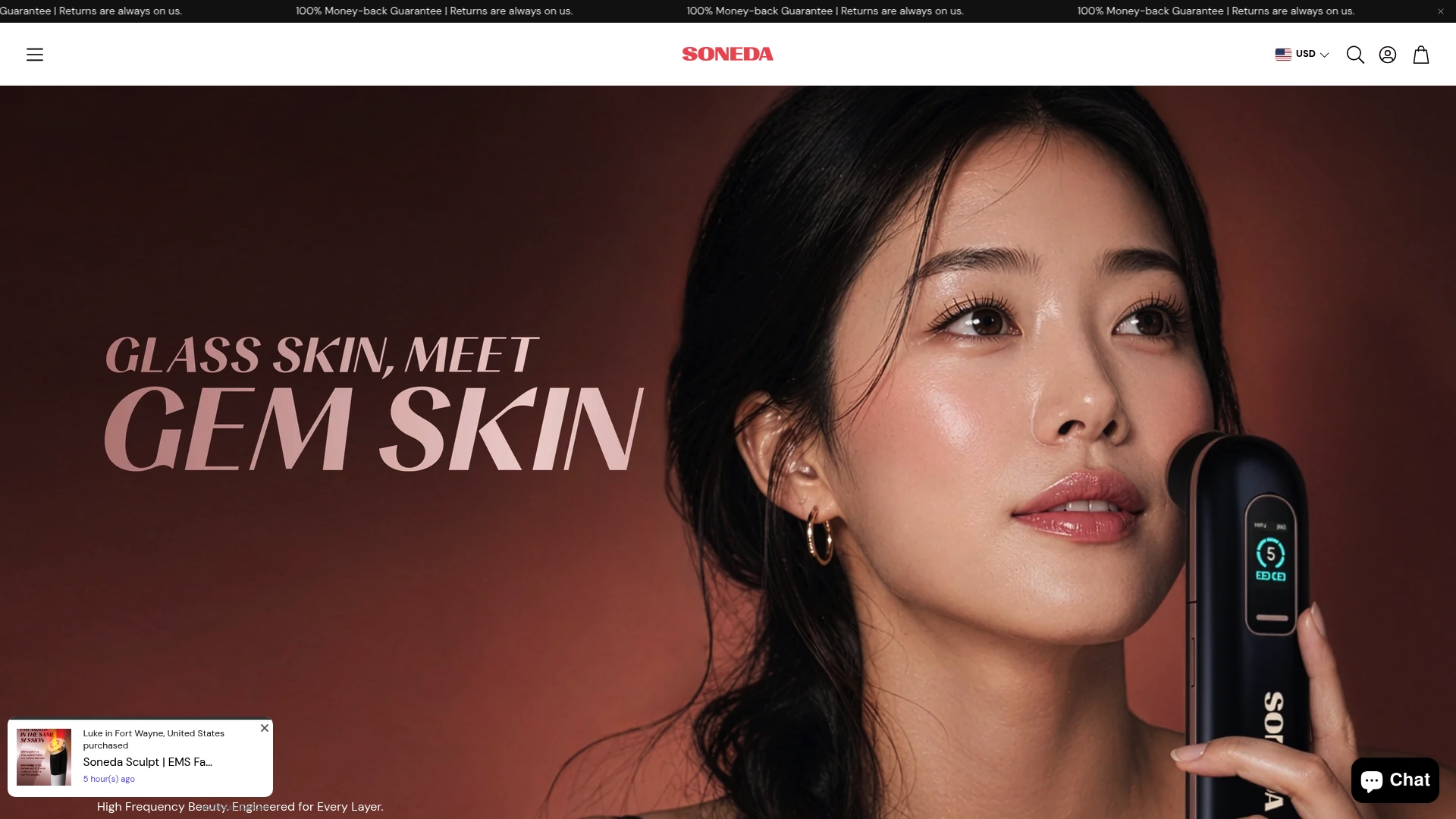
See the full details on the VividLift product page, or explore the rest of the range on our home page.
FAQ
Can LED light therapy reverse sun damage?
It can improve the look of sun-damaged skin, but it cannot fully reverse it. Cleveland Clinic states that photodamage cannot be completely reversed, though treatments can help rejuvenate skin. LED works best as one part of a routine that also includes sunscreen and, where appropriate, dermatologist-guided treatments.
Does red light fade sun spots?
It may help lighten dark spots modestly and improve the overall evenness of your skin. For distinct, established sun spots, dermatologists more often use IPL, lasers, peels or prescription creams. Have any new or changing spot examined before you treat it.
How long until I see results?
Plan on at least four to six weeks of consistent use, and longer for anti-aging changes, according to dermatologists quoted by Today. Study results in the research above appeared over five weeks to three months.
Can I use LED before sun exposure instead of sunscreen?
No. LED does not block UVA or UVB rays. Wear broad-spectrum sunscreen daily, and use LED as a separate repair step.
Is LED safe for darker skin tones?
Yes, with care. The AAD notes that people with darker skin can be more sensitive to visible light and may develop dark spots, so start with lower doses and talk to a board-certified dermatologist first.
Sources
- Is red light therapy right for your skin? (AAD)
- Red light therapy: choosing a device (AAD)
- How dermatologists treat sun-damaged skin (AAD)
- LED Light Therapy: How It Works, Colors, Benefits & Risks (Cleveland Clinic)
- Sun-Damaged Skin: Photoaging, Signs, Causes & Treatment (Cleveland Clinic)
- Red light therapy for skin care (Harvard Health)
- Mayo Clinic Q and A: Treating sunspots
- LED therapy in photodamage, 2007 clinical trial (PubMed)
- Combined 633-nm and 830-nm LED Treatment of Photoaging Skin (JDD)
- Red Light Therapy in Cosmetic Dermatology: Marketing Claims (JDD)
- Reverse skin aging signs by red light photobiomodulation (PMC)
- Photobiomodulation for Skin Pigmentation Disorders (PMC)
- Home-based devices in dermatology: a systematic review (PMC)
- Do LED masks work for acne, wrinkles? (Today)
- Can Red Light Therapy Treat Hyperpigmentation?
- Sunspot Treatment (Advanced Dermatology, P.C.)