2–5 Sessions A Week: Evidence Based LED Mask Schedule

For most people, the right LED mask frequency is 2 to 5 sessions per week, with each session lasting anywhere from 3 to 20 minutes depending on your device and goal. Anti-aging routines typically land on 2 to 3 sessions weekly, while acne-focused blue light protocols can go up to daily use. Always default to your device’s programmed cycle, and dial back if you notice irritation.
TL;DR:
- Most controlled trials recommend using LED masks two to three times per week, with visible results typically appearing between weeks 8 and 12.
- Higher-frequency blue light treatments for acne can be safe when supervised by a dermatologist, often running three to five times weekly or daily for short periods.
- Results depend heavily on the device’s irradiance and wavelength, with red and near-infrared light targeting collagen and blue light focusing on bacteria, requiring different schedules.
- Overuse signs include persistent redness, sensitivity, peeling, or pigment changes, and users should pause and consult a dermatologist if such reactions occur.
- Matching your LED treatment schedule to your device’s documented protocols ensures the best outcomes, as unsupported guesses can hamper effectiveness.
Table of Contents
- How Often Should You Use an LED Mask, According to the Evidence?
- Building a Weekly LED Mask Schedule for Your Goal
- Why Irradiance and Wavelength Change Your Ideal Frequency
- Can You Overuse an LED Mask, and What Are the Warning Signs?
- How to Track Whether Your LED Mask Schedule Is Working
- What Soneda’s Devices Show About Getting This Right
- Building an LED Habit That Actually Sticks
- Match Your Schedule to a Device Built for It
- Sources
How Often Should You Use an LED Mask, According to the Evidence?
Clinical trials don’t leave much room for guesswork on this. Most controlled photoaging studies settled on two to three sessions per week, with measurable improvement showing up between weeks 8 and 12. That cadence isn’t arbitrary. Researchers tested it against other schedules and it kept winning.
A 2025 randomized, sham-controlled trial makes the point well. Ninety-five women used a 660 nm red LED device at 8.05 J/cm² per session for 21 minutes, split into two groups: one treating twice a week, the other three times a week. Both active groups improved wrinkle measures significantly more than the sham group, but the twice-weekly group didn’t fall meaningfully behind the three-times-weekly group. In other words, more sessions per week didn’t buy extra results once the per-session dose was adequate.
That finding lines up with how photobiomodulation actually behaves in the body. Light therapy follows a biphasic dose response: too little light does nothing, but too much can blunt the very effect you’re chasing. The research on photobiomodulation is consistent on this point. Consistency over weeks matters more than cranking up any single session, and skin cells don’t reward a heavier hand the way muscle fibers might reward an extra rep at the gym.
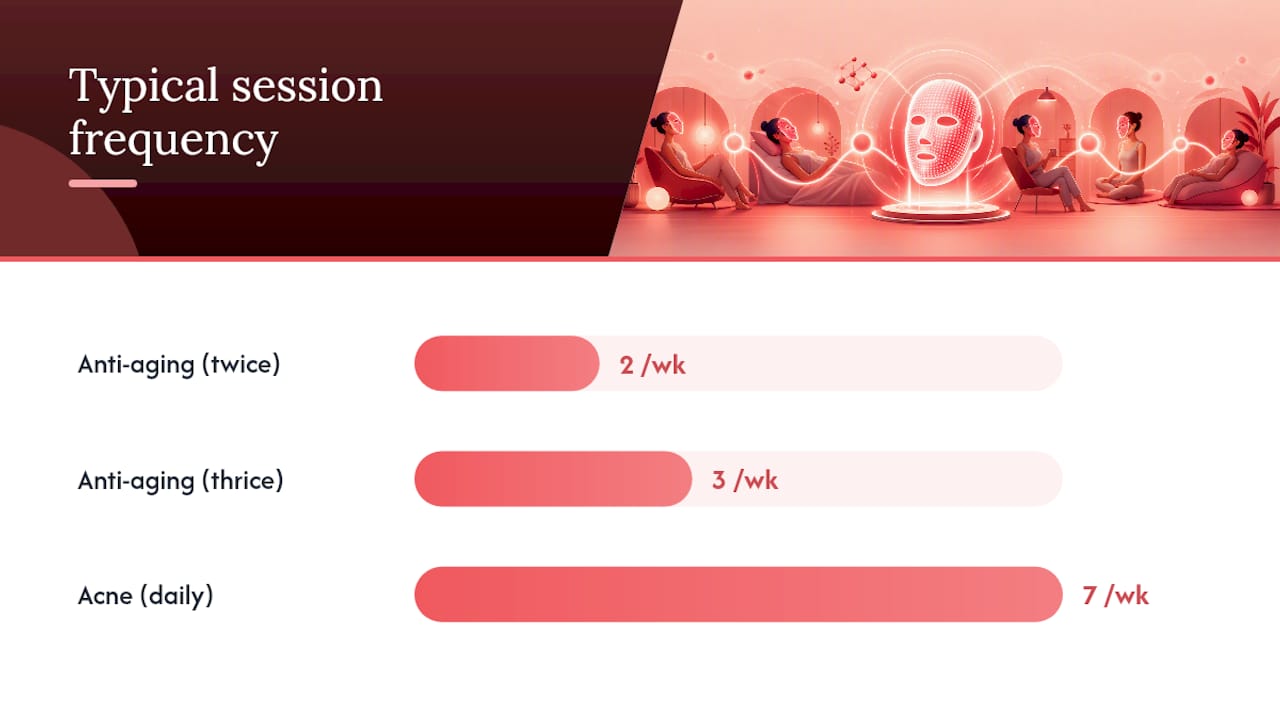
Acne protocols play by different rules. Because blue and blue-red combination light targets the bacteria and inflammation behind breakouts rather than collagen synthesis, some published trials used daily 15-minute sessions for 12 weeks and reported sizable lesion reductions. That’s a far more aggressive cadence than anything used for anti-aging, and it’s not something to self-prescribe without reading your device’s actual tested schedule.
Here’s the honest timeline you should expect, regardless of which goal you’re chasing:
- Weeks 1 to 4: Little to no visible change. Skin cells are responding at a cellular level, but you won’t see it yet.
- Weeks 4 to 8: Early signals start to appear, often subtle improvements in tone or texture.
- Weeks 8 to 12: This is where most clinical endpoints land, and where you should expect your clearest before-and-after difference.
Pro Tip: If you’re not seeing anything by week 6, don’t panic and don’t add extra sessions. Wait for the full 8 to 12 week window before deciding your routine isn’t working.
Building a Weekly LED Mask Schedule for Your Goal
The frequency that works for tightening skin around the jawline is not the frequency that works for clearing a breakout. Matching your schedule to your actual goal is what separates people who see results from people who quit after three weeks and call LED therapy a scam.
Here’s how to structure your first 8 to 12 weeks, then how to taper into maintenance:
- Anti-aging and collagen support. Start with 2 to 3 sessions per week, 10 to 20 minutes each, for a full 8 to 12 week course. This mirrors the schedules used in most red-light photoaging trials, and it gives collagen remodeling enough time to show up in the mirror.
- Acne management. Blue or blue-red combination protocols can run 3 to 5 times weekly, and some tested regimens go daily at shorter durations. Because higher-frequency blue light use carries more risk of dryness and irritation, it’s worth getting a dermatologist’s input before committing to an aggressive daily regimen.
- Maintenance, once you’ve hit your goal. Step down to the lowest frequency that holds your results, often 1 to 3 sessions per week. Track progress with photos taken in the same lighting and at the same angle every two weeks, and bump frequency back up only if you see real regression.
A sample anti-aging week might look like Monday, Wednesday, and Friday sessions after cleansing, paired with your regular moisturizer once the mask cycle ends. A maintenance week might drop to just Wednesday and Saturday. There’s no prize for adding a fourth or fifth session once your skin has already responded. Our guide on LED therapy for wrinkles walks through the evidence behind these anti-aging timelines in more depth.
Why Irradiance and Wavelength Change Your Ideal Frequency
Two devices marketed for the same purpose can require completely different schedules, and irradiance is usually why. Irradiance is measured in milliwatts per square centimeter (mW/cm²) and describes how much light power hits your skin per second. Session energy, measured in joules per square centimeter (J/cm²), is irradiance multiplied by time. Change either number and you change how long you need to sit under the mask.
A practical at-home irradiance target sits around 20 to 50 mW/cm². Devices below that range may need longer sessions or higher weekly frequency to deliver an effective dose, while devices above it can achieve the same result faster, sometimes in as little as three minutes.
Wavelength changes the calculation too:
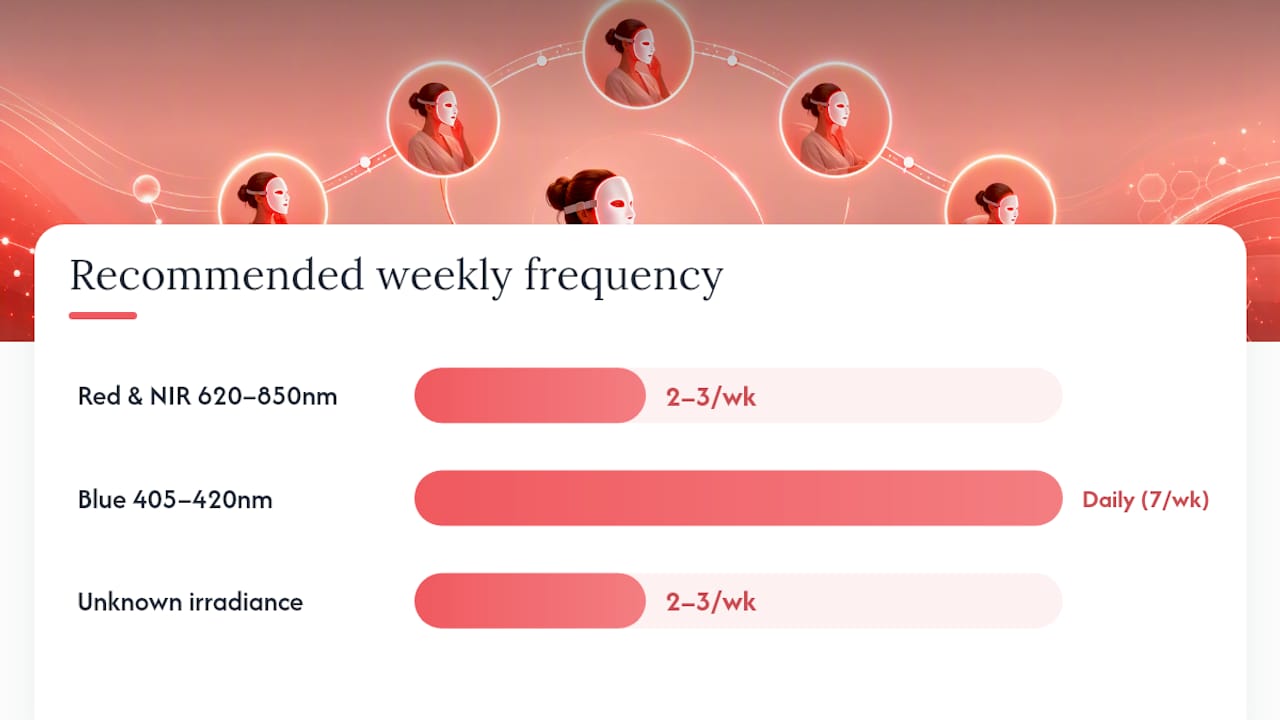
- Red and near-infrared light (620 to 850 nm) penetrate deeper for collagen stimulation and tissue repair, and trials in this range typically used 2 to 3 sessions per week.
- Blue light (405 to 420 nm) works on the skin’s surface to target acne-causing bacteria, and protocols here often run more frequently, sometimes daily.
If your mask doesn’t list irradiance anywhere on the box or in the manual, treat that as a signal to stay conservative. Stick to 2 to 3 sessions per week, watch how your skin responds over a month, and adjust from there rather than guessing your way to a higher dose. Our breakdown of LED wavelengths for skin covers which colors do what in more detail.
Can You Overuse an LED Mask, and What Are the Warning Signs?
Yes, and the signs are usually obvious if you’re paying attention. LED therapy is gentle compared to chemical peels or lasers, but “gentle” doesn’t mean “unlimited.”
Watch for these signals that you’ve pushed frequency or duration too far:
- Redness that lingers for hours rather than fading within 20 to 30 minutes
- Peeling, tightness, or unusual dryness after sessions
- Increased sensitivity to your regular skincare products
- Headaches or eye strain during or after use
- Pigment changes, especially darkening in areas with existing discoloration
- Disrupted sleep if you’re using bright devices close to bedtime
If redness or sensitivity persists beyond that, pause entirely until your skin recovers, and talk to a dermatologist if the reaction is severe or doesn’t resolve. Certain skin conditions and medications also change the calculus. A partner resource on red light therapy contraindications covers who should be more cautious or avoid it altogether, including people on photosensitizing medications.
Scheduling around actives matters just as much as scheduling the LED sessions themselves. If you use retinoids, acids, or recently had a professional peel, alternate nights rather than layering everything at once. Combining strong actives with LED sessions on the same night, especially if your barrier is already reactive, raises your irritation risk without adding benefit.
Two more habits worth locking in: wipe your mask down after every use to prevent bacterial buildup against your skin, and use the built-in eye shields or supplied goggles if your device includes them. LED light, particularly blue light, isn’t something you want hitting your eyes directly and repeatedly.
Pro Tip: Apply serums after your LED session, not before. A clean, product-free face lets light penetrate without interference, and you’ll get more out of whatever you apply afterward.
How to Track Whether Your LED Mask Schedule Is Working
Consistency is only useful if you’re actually measuring the outcome. Most people either give up too early or convince themselves nothing changed because they never established a real baseline.
The most reliable trials measured results at weeks 4, 8, and 12, and that’s a solid template to borrow at home. Expect no visible change before week 4. By weeks 4 to 8, look for early signals, slightly smoother texture or a subtle brightening. By weeks 8 to 12, you should see the difference your trial protocol was designed to detect.
To track progress objectively:
- Take photos in the same spot, same lighting, and same time of day every two weeks
- For acne, count visible lesions weekly rather than relying on a general impression
- For firmness or smoothness, use a simple 1 to 10 self-rating scale and stay consistent with your criteria
If 8 to 12 weeks pass with zero change, the fix usually isn’t more sessions. Check your device’s irradiance and wavelength specs first, since an underpowered mask won’t deliver measurable results no matter how often you use it. If specs check out and you still see nothing, a dermatologist consult is a better next move than doubling your frequency out of frustration.
What Soneda’s Devices Show About Getting This Right
Manufacturer documentation is where the frequency question actually gets answered for your specific mask, and it’s worth treating that documentation as your primary reference rather than a general rule you found online. The Soneda Lumira LED Face & Neck Mask uses four wavelengths with programmed cycles, giving you a built-in schedule rather than a guess. Soneda’s VividLift 2-in-1 HIFU+Sono device similarly ships with documented protocols, and Soneda reports a 175% increase in skin hydration in its own clinical testing, a figure worth verifying against the device’s own product page before you build expectations around it.
Before starting any new device, read the included instructions for use and check resources like Soneda’s pregnancy and LED mask guidance if that applies to you. Matching your schedule to your device’s actual documented dose, not a generic internet number, is the single biggest factor in getting results.
Building an LED Habit That Actually Sticks
Most people don’t fail at LED therapy because the science is wrong. They fail because they treat it like a sprint instead of a maintenance habit. Pick a fixed night or two, pair the mask with your evening cleanse, and treat the programmed cycle as the entire session, nothing added, nothing repeated back to back.
The mistakes I see most often: skipping the instructions that came with the box, running two cycles in one sitting to “speed things up,” and expecting a visible difference inside two weeks. None of that works, and all of it raises your irritation risk for no real gain.
Moderation beats intensity here. A device used consistently at 2 to 3 sessions weekly for three months will outperform one used aggressively for ten days and then abandoned out of impatience.
— Customer
Match Your Schedule to a Device Built for It
Getting your LED frequency right is only half the equation. The other half is using a device that actually tells you what schedule to follow instead of leaving you to guess. Soneda’s Lumira mask and VividLift 2-in-1 HIFU+Sono device both ship with programmed cycles and documented specs, so you’re not stuck estimating irradiance or session length on your own.
Read the included instructions for use before your first session, and reach out to Soneda support directly if you have questions about your specific schedule. If you’re ready to build your routine around a device designed with clear, tested presets, you can preorder the VividLift today and start your first 8 to 12 week course with a clear plan instead of a guess.
Sources
- How Often to Use an LED Mask: What Trials Actually Used | GlowUpGuides
- How often to use a red light mask (CNET)
- PMC article on photobiomodulation / light therapy
- How Often Should You Use an LED Face Mask? | WakeLifeBeauty
This article is general information, not a substitute for advice from a qualified doctor. Consult a qualified healthcare professional about your own circumstances before acting on anything here.