Best Home Treatment for Wrinkles: What Actually Works

The best home treatment for wrinkles is a consistent routine built on two clinically proven pillars: a topical retinoid and daily broad-spectrum sunscreen. These two steps address both the cause and the progression of visible aging. Natural remedies like aloe vera, bakuchiol, and facial massage add meaningful support but work best as complements, not replacements. If you are over 30 and want real results without a clinic visit, this guide gives you the evidence and the plan.
What are the best home treatment ingredients for wrinkles?
Retinoids are the gold standard for topical wrinkle treatment. No other ingredient class has consistent clinical evidence for both preventing and reversing fine lines over 12–24 months of use. Prescription tretinoin delivers the strongest results, but over-the-counter retinol is a practical starting point for most people.
Here are the key active ingredients ranked by evidence strength:
- Tretinoin (prescription retinoid): The most studied topical for wrinkle reversal. Improves skin elasticity and fine lines with consistent use over several months.
- Retinol (OTC): A weaker retinoid that converts to retinoic acid in the skin. Slower results than tretinoin but widely available and effective with patience.
- Bakuchiol: A plant-derived alternative. Systematic reviews confirm bakuchiol decreases wrinkle surface area comparably to retinol with fewer side effects, making it the top choice for sensitive skin.
- Vitamin C: A powerful antioxidant that supports collagen synthesis and brightens skin tone. The catch is instability. Vitamin C oxidizes quickly and loses potency fast. Always choose formulations in opaque, airless packaging. If the serum has turned orange or brown, it is no longer effective.
- Peptides: Short amino acid chains that signal the skin to produce more collagen. Evidence is promising but less robust than retinoids.
- Hyaluronic acid: Draws moisture into the skin and temporarily plumps fine lines. It does not rebuild collagen but improves skin texture and comfort.
Pro Tip: If you are new to retinoids, start with retinol two nights per week. Add a fragrance-free moisturizer immediately after to reduce dryness and peeling. Gradual introduction is the single most important factor in sticking with the treatment long enough to see results.
The biggest mistake people make is ingredient hopping. Switching products too soon undermines retinoid effectiveness entirely. Retinoids need months of consistent use before visible improvement appears. Patience is not optional here.
How does daily sun protection reduce wrinkles at home?
Sun protection is the most cost-effective at-home anti-aging treatment available. UV damage causes up to 80% of visible skin aging. That number makes sunscreen less of a skincare step and more of a non-negotiable daily habit.
The single most effective thing you can do for your skin today is apply a broad-spectrum SPF 30 or higher every morning, rain or shine, indoors or out. UV rays penetrate windows and cloud cover. Skipping sunscreen on “cloudy days” is one of the most common and costly mistakes in any anti-aging routine.
Choosing and applying sunscreen correctly matters as much as using it at all. Follow these guidelines:
- Choose broad-spectrum SPF 30 or higher. Broad-spectrum means protection against both UVA (aging) and UVB (burning) rays.
- Apply generously. Most people apply less than half the amount needed for full SPF protection. Use about a quarter teaspoon for your face alone.
- Reapply every two hours if you are outdoors or sweating.
- Use it year-round. UVA rays are consistent throughout the year and penetrate glass.
- Layer it last in your morning routine, after moisturizer and before makeup.
Sunscreen also protects your retinoid investment. Retinoids increase skin sensitivity to UV light. Using a retinoid at night without sunscreen during the day actively works against your results.
What natural and DIY remedies can complement wrinkle treatment safely?
Natural remedies for wrinkles work best as supportive additions to a retinoid and sunscreen routine. They rarely produce dramatic results on their own, but several have genuine evidence behind them.
-
Aloe vera: Aloe vera modestly supports collagen production and skin hydration with consistent use over 90 days. A study in women aged 47 showed improved skin moisture and collagen markers after regular aloe vera application. Use a pure gel or a product with aloe as a primary ingredient.
-
Jojoba oil: Closely mimics the skin’s natural sebum. It absorbs without clogging pores and provides a gentle moisture barrier. Suitable for most skin types, including combination skin.
-
Facial massage: A daily five-minute facial massage improves microcirculation, oxygenation, and lymphatic drainage. This reduces puffiness and softens tension-based wrinkles over time. Use upward strokes and gentle pressure. Consistent facial relaxation is more effective than aggressive facial exercises for reducing expression lines.
-
Bakuchiol oil: Available as a standalone serum or oil. Works well for people who cannot tolerate retinol. Use it in the same step as you would retinol, at night, on clean skin.
-
Petrolatum-based moisturizer: A sealing moisturizer like petrolatum locks in moisture and supports overnight skin repair. It does not add hydration on its own but prevents water loss while your skin works through its nightly repair cycle.
One important warning: DIY treatments that disrupt skin pH can worsen wrinkle appearance. Your skin’s natural acidity sits between pH 4.5 and 5.5. Alkaline or abrasive home treatments, including lemon juice, baking soda, or harsh scrubs, cause micro-tears and chronic irritation that accelerate visible aging.
Pro Tip: Before adding any new natural ingredient to your routine, patch test it on your inner arm for 48 hours. This is especially important if you are already using a retinoid, since your skin barrier may be more reactive during the adjustment period.
How to build an effective at-home wrinkle routine step by step
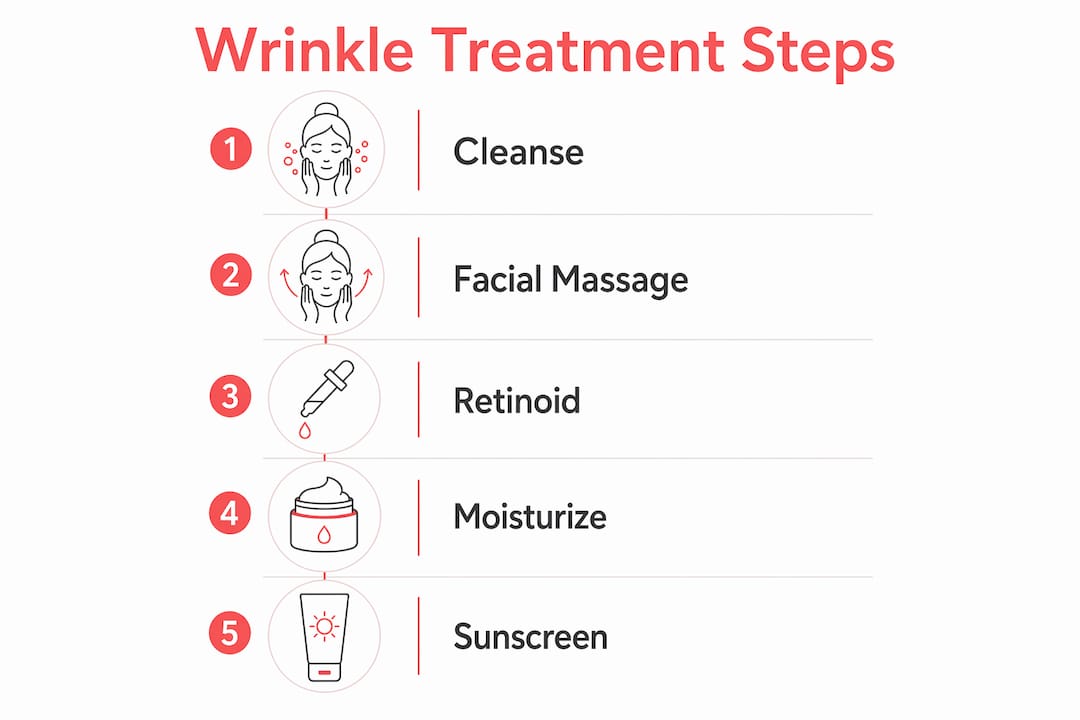
A consistent daily routine produces better results than any single product. Here is how to structure yours:
| Step | Product | Timing |
|---|---|---|
| 1. Cleanse | Gentle, pH-balanced cleanser | Morning and evening |
| 2. Vitamin C serum | Stable, airless-packaged formula | Morning only |
| 3. Moisturize | Lightweight hydrating moisturizer | Morning and evening |
| 4. Sunscreen | Broad-spectrum SPF 30+ | Morning only |
| 5. Retinoid | Retinol or tretinoin | Evening only |
| 6. Seal | Petrolatum or barrier cream | Evening only (optional) |
Follow this sequence for building the routine over time:
- Weeks 1–2: Use your retinoid once per week. Apply a generous layer of moisturizer immediately after. Monitor for dryness or peeling.
- Weeks 3–4: Increase to twice per week if your skin tolerates it well.
- Month 2 onward: Work up to every other night, then nightly if your skin adjusts without significant irritation.
- Month 3–6: This is when most people begin to see visible improvement in fine lines and skin texture. Side effects like dryness and peeling are common early on and cause many people to quit. Staying consistent through this phase is what separates results from frustration.
For anti-aging and collagen support, the sequence of application matters as much as the products themselves. Applying retinoid to damp skin increases absorption and irritation simultaneously. Apply it to dry skin for better tolerance.
Facial massage fits naturally into your evening routine. After cleansing and before applying your retinoid, spend three to five minutes using upward, outward strokes across your forehead, cheeks, and jaw. This primes circulation and relaxes muscle tension before your active ingredients go on.
Key Takeaways
The most effective home treatment for wrinkles combines a topical retinoid, daily broad-spectrum sunscreen, and consistent barrier support to reduce fine lines and prevent further UV-driven aging.
| Point | Details |
|---|---|
| Retinoids are the top active | Tretinoin and retinol are the only topical ingredients with consistent clinical evidence for wrinkle reversal. |
| Sunscreen prevents most aging | UV damage causes up to 80% of visible skin aging; daily SPF 30+ is non-negotiable. |
| Bakuchiol suits sensitive skin | Bakuchiol matches retinol’s wrinkle reduction with fewer side effects, making it a strong alternative. |
| DIY remedies carry real risks | Alkaline or abrasive DIY treatments disrupt skin pH and can worsen wrinkle appearance. |
| Patience drives results | Retinoids require 3–6 months of consistent use before visible improvement appears. |
What I have learned about at-home wrinkle treatment after years of watching routines succeed and fail
The most common reason at-home wrinkle treatment fails is not the wrong product. It is unrealistic expectations combined with impatience. People start a retinoid, experience two weeks of dryness, and switch to something gentler. Then they wonder why nothing works.
Homecare is the foundation of skin health. It maintains your baseline and makes clinical treatments more effective when you choose them. But it cannot replace professional interventions for deep lines or significant laxity. That is not a failure of homecare. That is just the honest boundary of what topical products can do.
The mindset shift that actually changes outcomes is moving from correction to prevention. People in their 30s who start a retinoid and sunscreen routine now will have measurably better skin in their 50s than those who wait for visible damage before acting. Prevention is always cheaper and more effective than correction.
One thing I rarely see discussed: consistent facial relaxation matters more than most people realize. Habitual tension in the forehead, jaw, and around the eyes deepens expression lines faster than sun damage in some cases. Becoming aware of where you hold tension in your face, and consciously releasing it, is a free and underused tool.
The people who get the best results from at-home care are not the ones with the most products. They are the ones who pick three to four evidence-backed steps and do them every single day without exception.
— Customer
Sonedaskincare’s VividLift device takes at-home results further
A solid retinoid and sunscreen routine builds the foundation. For people who want to go further without a clinic visit, Sonedaskincare’s VividLift™ HIFU+Sono device adds a clinically meaningful layer on top of that foundation.

The VividLift™ uses High-Intensity Focused Ultrasound (HIFU) and advanced sonophoresis to stimulate collagen production and improve skin hydration at home. Sonedaskincare reports a 175% increase in skin hydration and a 100% user satisfaction rate with the device. It delivers the kind of collagen-boosting results that typically require a professional treatment, at a fraction of the cost and from your own bathroom. If your at-home routine is solid and you are ready to add a device-level upgrade, the VividLift™ is worth a close look.
FAQ
What is the most effective home treatment for wrinkles?
The most effective home treatment for wrinkles is a topical retinoid used consistently at night, combined with a broad-spectrum SPF 30 or higher every morning. These two steps address both collagen production and UV-driven aging, which are the two primary causes of visible wrinkles.
How long does it take for retinol to reduce wrinkles?
Most people see visible improvement in fine lines after 3–6 months of consistent retinol use. Prescription tretinoin typically produces faster results, but both require patience and gradual introduction to avoid irritation.
Is bakuchiol as effective as retinol for wrinkles?
Bakuchiol reduces wrinkle surface area comparably to retinol with fewer side effects. It is the best retinol alternative for people with sensitive skin or those who cannot tolerate standard retinoids.
Can natural remedies alone reduce wrinkles?
Natural remedies like aloe vera and facial massage offer modest benefits for skin hydration and tension-based lines, but they cannot replace retinoids or sunscreen for meaningful wrinkle reduction. They work best as additions to a clinically supported routine.
Why does my DIY wrinkle treatment make my skin worse?
Many DIY treatments disrupt the skin’s natural pH range of 4.5–5.5. Ingredients like lemon juice or baking soda are either too acidic or too alkaline, causing micro-tears and chronic irritation that accelerate visible aging rather than reducing it.