Is HIFU FDA Approved for Cosmetic or At-Home Use?

No HIFU device has received FDA approval or clearance specifically for cosmetic skin lifting or at-home consumer use. The FDA regulates individual medical devices and their labeled indications, not technologies in the abstract. A device using High-Intensity Focused Ultrasound (HIFU) may carry FDA authorization for a specific medical procedure, such as prostate tissue ablation, without that authorization extending to cosmetic skin tightening or unsupervised home use. If you see a device marketed as “FDA approved for skin lifting,” that claim warrants immediate verification.
Sonedaskincare publishes this article as the maker of the VividLift™ 2-in-1 HIFU+Sono device, an at-home collagen-support tool. We address our own product’s regulatory context transparently in the sections below.
Pro Tip: If a device claims “FDA approved,” search the exact product name in the FDA’s 510(k) database before you buy. A real clearance number takes under two minutes to verify.
Table of Contents
- What does FDA clearance vs. approval actually mean for a device?
- Which HIFU devices actually have FDA authorization, and for what?
- What the FDA says about cosmetic and at-home aesthetic devices
- Is at-home HIFU legal and safe? A practical pre-use checklist
- How to verify a device’s FDA status step by step
- Does a medical HIFU clearance mean the device is safe for skin lifting?
- Safer alternatives for non-invasive skin tightening
- Key Takeaways
- Sonedaskincare’s perspective on at-home HIFU and responsible marketing
- VividLift™ by Sonedaskincare: clinically supported, transparently positioned
- Useful sources and official references
What does FDA clearance vs. approval actually mean for a device?
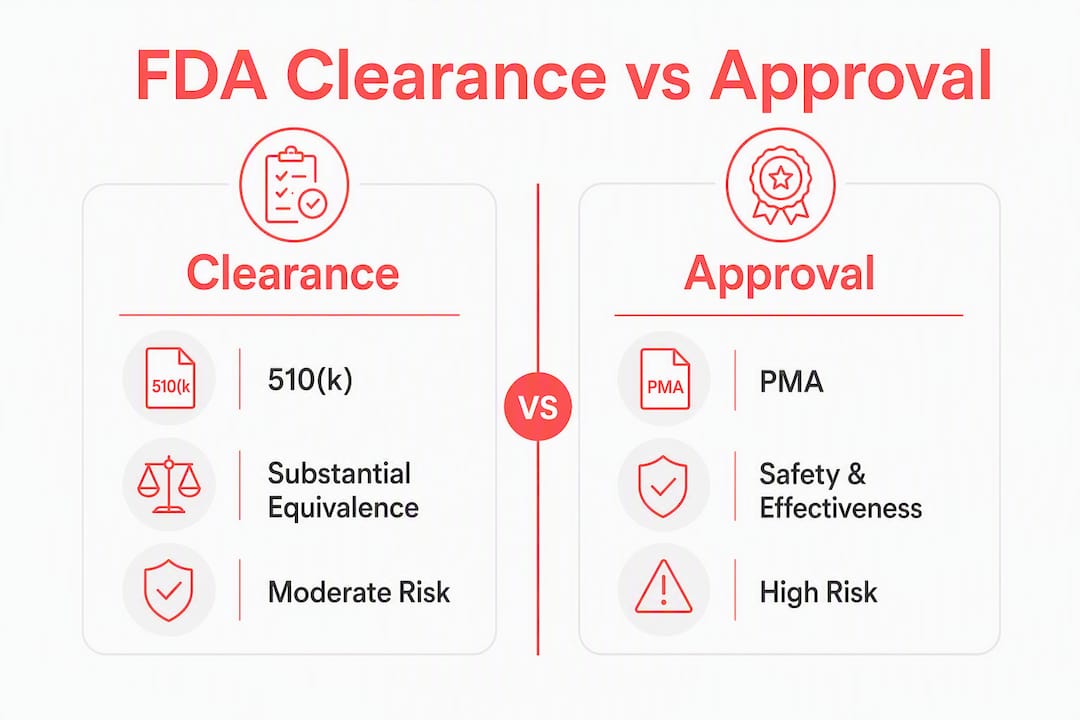
The FDA uses three main regulatory pathways for medical devices, and each one means something different.
| Pathway | What It Means | Risk Level | Common Use |
|---|---|---|---|
| 510(k) Clearance | Device is “substantially equivalent” to a legally marketed predicate device | Low to moderate | Most consumer and clinical devices |
| PMA Approval | Rigorous clinical evidence required; highest scrutiny | High | Implants, life-sustaining devices |
| De Novo | Novel device with no predicate; FDA creates a new classification | Low to moderate | First-of-kind devices with limited risk |
510(k) clearance is the most common pathway. It does not mean the FDA tested the device itself; it means the manufacturer demonstrated the device performs like an already-cleared one. PMA approval requires clinical trial data and is reserved for higher-risk devices. De Novo sits between the two, used when a novel device has no predicate but poses only moderate risk.
Here is the part most marketing copy skips: clearance or approval applies to the labeled indication only. A 510(k) for “prostate tissue ablation” does not authorize the same device for “facial skin tightening.” The FDA clears specific devices for specific uses, not technologies broadly.
For consumer-facing devices, the precedent is clear. The FDA requires 510(k) clearance before a product can legally be marketed for consumer use, as it does for EMS facial devices. The same logic applies to any at-home energy device, including HIFU.
- Look for a clearance number (format: K######) on the product listing.
- Confirm the labeled indication matches your intended use.
- Treat “FDA registered” as meaningless for safety claims. Registration is not clearance.
Which HIFU devices actually have FDA authorization, and for what?
Several HIFU systems have received FDA authorization in the U.S., all for medical tissue-ablation indications. None of those authorizations cover cosmetic skin lifting.

| Device | Indication | FDA Pathway | Source |
|---|---|---|---|
| Sonablate 450 | Prostate tissue ablation | De Novo | OncLive |
| Ablatherm Integrated Imaging | Prostate tissue ablation | 510(k) Clearance | BioSpace / EDAP TMS |
| ExAblate (InSightec) | Uterine fibroid treatment; palliative bone metastasis pain | PMA Approval | Medica Coverage Policy |
| Sonalleve MR-HIFU (Profound Medical) | Osteoid osteoma | HDE Approval | Children’s National / Medica |
| TULSA-PRO | Prostate tissue ablation | FDA Clearance | Medica Coverage Policy |
The Ablatherm received 510(k) clearance specifically for prostate tissue ablation, not for any cosmetic indication. The Sonalleve MR-HIFU received HDE approval for osteoid osteoma treatment in a pediatric setting. The ExAblate series holds PMA approvals for uterine fibroid treatment and bone metastasis pain management.
Key points:
- Every FDA-authorized HIFU device targets internal tissue ablation, not surface skin.
- The American Cancer Society notes that even prostate-focused HIFU devices were not always approved specifically “for prostate cancer” as a treatment outcome, and long-term comparative effectiveness remains under study.
- Medical authorization does not transfer to cosmetic or at-home use by default.
What the FDA says about cosmetic and at-home aesthetic devices
The FDA’s position on consumer aesthetic devices is direct. The agency states it is not aware of scientific information to support many promotional claims made for numerous consumer-marketed aesthetic devices.
The FDA has also warned that consumer energy devices that have not met premarket requirements are illegal and may not be safe or effective. That enforcement posture applies to any high-energy at-home device, not just EMS.
Pro Tip: When a brand cites “clinical studies,” ask whether those studies were conducted on the specific device model, at the specific energy settings, and for the specific indication being marketed. General HIFU research does not validate a specific consumer product.
Is at-home HIFU legal and safe? A practical pre-use checklist
Before you use or purchase any HIFU-labeled device for home use, work through this checklist.
Verification steps:
- Search the exact product name or manufacturer in the FDA 510(k) database.
- Confirm the labeled indication matches cosmetic skin use, not a medical procedure.
- Search the MAUDE database (FDA.gov/MedWatch) for adverse event reports on that device.
- Check the FDA recall database for the manufacturer name.
- Confirm the device instructions include user training requirements and safety protocols.
Red flags to walk away from:
- No verifiable clearance number anywhere in the product listing or manual.
- Marketing claims referencing “FDA approved” with no K-number or PMA number.
- Clinical study citations that link to general HIFU research, not the specific device.
- No visible safety warnings, contraindications, or usage limits in the documentation.
- No return policy or warranty, which often signals limited accountability.
Pro Tip: A legitimate device manufacturer will provide the exact 510(k) or PMA number on request. If a company cannot or will not supply it, treat that as a red flag, not a minor omission.
When in doubt, consult a board-certified dermatologist or plastic surgeon before using any high-energy device at home. Professional supervision changes the risk profile significantly.
How to verify a device’s FDA status step by step
Here is the exact sequence to confirm whether a device is legitimately authorized.
- Get the exact device name and manufacturer. Check the product box, manual, or website listing.
- Search the 510(k) database at FDA.gov/510k. Enter the manufacturer name or device name. A real entry shows the K-number, clearance date, device classification, and labeled indication.
- Search the PMA database at FDA.gov/PMA for higher-risk devices. Entries include approval order number, indication, and clinical summary.
- Search De Novo records at FDA.gov/DeNovo if the device is described as a first-of-kind or novel technology.
- Search MAUDE (Manufacturer and User Facility Device Experience) for adverse event reports tied to that device or manufacturer.
- Check the recall database at FDA.gov/recalls. Filter by device type or manufacturer.
| Database | What It Contains | What to Look For |
|---|---|---|
| 510(k) | Clearance records for moderate-risk devices | K-number, labeled indication, clearance date |
| PMA | Approval records for high-risk devices | PMA number, clinical evidence summary, indication |
| De Novo | Novel device classifications | DEN number, device classification, intended use |
| MAUDE | Adverse event and injury reports | Reports tied to your specific device model |
| Recalls | Voluntary and mandatory recall records | Active recalls for the manufacturer or model |
A mismatch between what the marketing says and what the labeled indication states is a red flag. Document what you find before purchasing.
Does a medical HIFU clearance mean the device is safe for skin lifting?
No. A clearance for prostate tissue ablation or fibroid treatment tells you the device is safe and effective for that specific procedure, performed by trained clinicians in a controlled medical setting. It says nothing about cosmetic skin lifting.
Off-label use is legal for physicians, who can apply clinical judgment to adapt a cleared device for a related purpose. That same latitude does not extend to consumers using a device at home without training or supervision. The tissue depths, energy parameters, and anatomical targets for prostate ablation are entirely different from those for facial skin lifting.
- Energy levels safe for deep tissue ablation can cause burns, nerve damage, or scarring at skin depth.
- Cosmetic skin lifting targets the SMAS layer at 1.5–4.5 mm depth; medical HIFU targets tissue at significantly greater depths.
- No published clinical trial has validated a consumer HIFU device for at-home cosmetic use under FDA standards.
Pro Tip: If a clinic offers HIFU for skin tightening, ask specifically which device they use and whether it holds any FDA clearance for aesthetic indications. In-office use under a trained provider is a different risk category than at-home use.
Safer alternatives for non-invasive skin tightening
Several non-invasive technologies have established FDA clearances for cosmetic indications and a longer clinical track record in professional settings.
- Radiofrequency (RF) devices: Multiple RF platforms hold 510(k) clearances for non-invasive skin tightening. RF energy heats the dermis to stimulate collagen without the tissue-ablation risks of focused ultrasound. Sonedaskincare’s guide to HIFU vs. radiofrequency covers the clinical and safety differences in detail.
- Microfocused ultrasound with visualization (MFU-V): Some professional systems in this category have received FDA clearance for lifting the brow, neck, and submental area. These are clinical devices, not consumer products.
- LED therapy: Multi-wavelength LED panels have received 510(k) clearances for skin conditions and are among the lower-risk at-home options.
- EMS facial toning: Consumer EMS devices with verified 510(k) clearance are a lower-energy option for muscle toning. Confirm the clearance number before purchasing.
For readers who want a vetted at-home option that combines collagen-support technology with transparent buyer protections, the VividLift™ 2-in-1 HIFU+Sono device from Sonedaskincare is designed for at-home use with a structured protocol guide and a 100% money-back guarantee. Sonedaskincare is transparent about the device’s regulatory context: it is an at-home collagen-support and lifting device, not a medical treatment.
Pro Tip: When choosing an in-office clinic for energy-based treatments, ask the provider to name the specific device, show you the FDA clearance number, and confirm their training certification for that device. A reputable clinic provides all three without hesitation.
Key Takeaways
No HIFU device holds FDA clearance or approval for cosmetic skin lifting or at-home consumer use, and every existing FDA-authorized HIFU system targets internal medical tissue ablation performed by trained clinicians.
| Point | Details |
|---|---|
| FDA authorizes devices, not technologies | “HIFU” cannot be FDA-approved in the abstract; only named devices with specific indications can be cleared or approved. |
| Medical clearances don’t cover cosmetic use | Devices cleared for prostate ablation or fibroid treatment carry no authorization for skin lifting or at-home use. |
| Verify before you buy | Search the FDA 510(k), PMA, or De Novo database for the exact device name; no K-number means no verified clearance. |
| Red flags to avoid | No clearance number, unverifiable clinical studies, and missing safety warnings are all reasons to walk away. |
| Sonedaskincare’s VividLift™ | An at-home HIFU+Sono device sold with a 100% money-back guarantee and a structured protocol guide; Sonedaskincare is transparent about its regulatory context. |
Sonedaskincare’s perspective on at-home HIFU and responsible marketing
The marketing around at-home HIFU devices is, frankly, ahead of the regulatory reality. Brands routinely cite medical HIFU research, reference FDA-cleared clinical systems, and imply those credentials transfer to their consumer product. They don’t. The FDA’s own guidance makes clear that dramatic cosmetic claims without verifiable clearance documentation may constitute illegal marketing.
What Sonedaskincare believes: at-home devices can deliver real collagen-support and hydration benefits when used correctly and marketed honestly. The VividLift™ is designed for exactly that, with clinical results showing a significant increase in skin hydration and high user satisfaction rate. Those are the claims we stand behind. We do not claim FDA approval for cosmetic skin lifting, because no such approval exists for any at-home HIFU device.
Responsible at-home skincare means knowing what a device is, what it is cleared for, and what the evidence actually shows. That standard should apply to every brand in this space, including ours.
VividLift™ by Sonedaskincare: clinically supported, transparently positioned
If you want an at-home device backed by real buyer protections, the VividLift™ 2-in-1 HIFU+Sono device from Sonedaskincare combines HIFU collagen-support technology with advanced sonophoresis for improved hydration and product absorption. Clinical results show a 175% increase in skin hydration. Every purchase comes with a 100% money-back guarantee and a structured VividLift Protocol Guide so you use the device correctly from day one.
Sonedaskincare is transparent about what VividLift™ is: an at-home collagen-support and lifting device, not a medical treatment. Follow the included instructions, confirm the device fits your skin concerns, and reach out to a dermatologist if you have underlying skin conditions. Ready to see what clinically supported at-home technology feels like? Preorder VividLift™ and experience the difference a responsibly built device makes.
Useful sources and official references
Use these links to verify device claims, check clearance records, and read the FDA’s own guidance.
- FDA: Products and Medical Procedures — Start here to understand how the FDA regulates devices vs. procedures.
- FDA: 510(k) Premarket Notification database — Search this first to verify any device clearance claim.
- FDA: Aesthetic and Cosmetic Devices guidance — Read the FDA’s direct cautions about consumer aesthetic device marketing.
- FDA: Electronic Muscle Stimulators (EMS) — Relevant precedent for consumer energy device clearance requirements.
- Medica: High-Intensity Focused Ultrasound Coverage Policy (PDF) — Lists specific FDA-authorized HIFU devices and their indications.
- American Cancer Society: HIFU and Ablative Treatments for Prostate Cancer — Contextualizes the limits of device-level approvals for clinical outcomes.
- Children’s National: FDA Approves MR-HIFU for Osteoid Osteoma — Details the Sonalleve HDE approval and its narrow pediatric indication.
- OncLive: Sonablate 450 FDA De Novo clearance — Documents the first HIFU device type authorized in the U.S. for prostate use.
Which link to check first? If you want to verify a clearance number, go to the 510(k) database. If you want to check for adverse events, go to MAUDE at FDA.gov/MedWatch. If you want to read the FDA’s consumer warning about aesthetic devices, go to the Aesthetic and Cosmetic Devices guidance page.
This article provides general information about FDA regulatory pathways and is not medical or legal advice. Confirm current device status with the FDA databases directly or consult a qualified healthcare professional before making treatment decisions.