LED for Broken Capillaries: What It Can and Can't Do

LED light therapy has not been shown to make existing broken capillaries disappear. Vascular lasers and intense pulsed light (IPL) are the treatments with the strongest evidence for visible facial vessels. At-home LED has a different job: it supports the look and feel of the skin around them. This guide covers what the research says, how the options compare, and how to build a home routine that works alongside professional care.
TL;DR
- Broken capillaries (telangiectasias) are dilated vessels. Pulsed-dye lasers, KTP lasers and IPL are the established ways to treat them.
- A 2023 study found moderate improvement in facial hypervascularization with combined red and near-infrared LED. IPL did better in the same study.
- At-home LED is a low-risk, gradual skin-support tool. Use it for tone, texture and firmness, not as a replacement for vessel treatment.
- Redness that lasts more than 2 weeks deserves a visit to a board-certified dermatologist.
- Our VividLift device combines HIFU, sonophoresis, EMS toning and LED for a complete at-home skincare routine.
Table of Contents
- What broken capillaries are, and why they appear
- Can LED light therapy make broken capillaries disappear?
- How LED compares with laser and IPL
- Where at-home LED fits in your skincare routine
- Safety: eyes, skin and heat
- When to see a dermatologist
- Our perspective
- Build a routine around professional care
- Bring professional-grade technology home
- FAQ
- Sources
What broken capillaries are, and why they appear
Broken capillaries are small, dilated blood vessels near the skin’s surface. They show up as fine red or purple lines, most often on the cheeks, around the nostrils and on the chin. Dermatologists call them telangiectasias. The vessel is not literally broken. It has widened and stays visible.
Common contributors include sun exposure, rosacea, age and thinning skin. The European Academy of Dermatology and Venereology (EADV) notes that new dilated vessels can appear again, especially when a chronic inflammatory condition such as rosacea persists. So periodic treatment may be needed.
That matters for your routine. A visible red line on your face can be a cosmetic vessel, but it can also be a sign of an underlying skin condition. Getting the cause identified comes first.
Can LED light therapy make broken capillaries disappear?
No study establishes LED as a proven treatment for facial telangiectasia. A 2026 review in the Journal of Drugs in Dermatology found that evidence supports red-light therapy as a safe adjunct for selected concerns, such as acne, mild photoaging and wound healing. Its improvements are modest and gradual and need consistent maintenance use. The same review says consumer claims often run ahead of the evidence on strength, speed and durability.

There is early research worth knowing about. A 2023 proof-of-concept study from Spain compared combined 633-nm and 830-nm LED with IPL in 20 adults, 10 per group, for facial hypervascularization. Every participant in the LED group had moderate improvement in hemoglobin hyperconcentration. In the IPL group, 90% had marked improvement and 10% had moderate improvement.
What that tells you:
- LED showed a measurable, moderate effect on skin redness markers in a small trial.
- It was a feasibility study with 20 people. It is a promising signal, not a treatment standard.
- IPL produced the stronger result for the same concern.
You will see pages claiming red light strengthens capillary walls through collagen. That is a biologically plausible idea, but we found no study that shows it prevents new visible vessels. Treat it as a theory, and expect LED to support overall skin quality rather than clear a specific vessel.
How LED compares with laser and IPL
Lasers and IPL work differently from LED. Light energy is absorbed by oxyhemoglobin inside the vessel. The vessel heats and coagulates, and the body clears it over time. UpToDate notes that wavelengths near the oxyhemoglobin absorption peaks, such as the 585 or 595 nm pulsed dye laser and the 532 nm Nd:YAG laser, are often favored for vascular lesions.
LED is low-level, continuous light that nudges cell activity over many sessions. It does not heat and collapse a vessel.
| Option | How it works | What studies report | Typical downside |
|---|---|---|---|
| At-home LED | Low-level light, gradual cell stimulation | Moderate redness-marker improvement in one small 2023 trial | Slow; not an established vessel treatment |
| Pulsed-dye laser (595 nm) | Targets oxyhemoglobin, coagulates the vessel | 75% average clearing after three treatments in a 15-patient split-face study | Swelling and redness afterward |
| KTP laser (532 nm) | Targets oxyhemoglobin | 85% average clearing in the same study | More persistent swelling and redness |
| IPL | Broad-spectrum light bursts | 82% of 80 patients improved at four years | Mild crusting, redness, purpura; downtime |
The figures come from a split-face comparison of KTP and pulsed-dye laser and a long-term IPL chart review. In a randomized trial of 40 patients, excellent clearance of 75 to 100% occurred in 46% of pulsed-dye-laser sites versus 28% of IPL sites. The laser was also rated less painful, a median of 4 versus 7 on a 10-point scale.
How long professional results take
The EADV says treated vessels progressively disappear in 10 to 20 days, and post-treatment changes fade in 4 to 6 days. One or two sessions are usually needed, and complete clearing cannot be guaranteed.
The American Academy of Dermatology (AAD) reports that most patients see a 50% to 75% reduction in visible blood vessels after 1 to 3 treatments. Results tend to last 3 to 5 years. Treated vessels don’t reappear, but new ones can form.

Where at-home LED fits in your skincare routine
LED earns its place when you use it for what it does well. Red light is generally low risk. Cleveland Clinic describes LED light therapy as safe and relatively risk-free for all skin types, with no UV, and notes that less is known about long-term safety. The AAD says short-term red-light therapy appears safe, with mild temporary pain or irritated skin as the most commonly reported effects.
Sensible goals for an at-home LED routine:
- Overall tone and radiance. Even-looking skin makes fine redness less of a focal point.
- Texture and firmness. Consistent use supports the look of maturing skin.
- Aftercare. After a professional procedure, a gentle routine matters. Our LED facial aftercare plan walks through the first 72 hours.
- Sun-related changes. Sun damage is a common reason vessels become visible. See what LED can do for sun-damaged skin.
Set realistic expectations
The AAD says at-home red-light devices are hard to compare because studies use different devices, durations and research questions, and that more research is needed on ideal home schedules and doses. It also explains that “FDA-cleared” means a device is considered low risk, and that clearance alone does not establish effectiveness.
So plan on weeks of steady use, follow the schedule in your device’s instructions, and judge changes in overall skin quality. Take photos in the same light every two weeks so you can see the trend.
Safety: eyes, skin and heat
Use LED exactly as the manufacturer directs. Keep these points in mind:
- Protect your eyes. Bright light near the face calls for eye protection. This overview of red light therapy eye safety explains why goggles matter.
- Start with short sessions and watch how your skin responds. Stop if you notice stinging, lasting redness or irritation.
- Don’t use light as a substitute for a diagnosis. Visible vessels with burning, flushing, bumps or watery eyes can be signs of rosacea, which needs a clinician.
- Avoid choosing a professional treatment by price alone. The EADV warns that wrong laser or IPL selection can cause transient hyperpigmentation or lasting hypopigmentation, and excessive heating can cause scarring. Choose a board-certified dermatologist.
When to see a dermatologist
The AAD advises making an appointment with a board-certified dermatologist if facial redness lasts more than 2 weeks, because many conditions cause it and the right diagnosis matters.
Book a visit sooner if you notice:
- Small visible vessels along with cheek, nose, chin or forehead redness, bumps or pimples, or watery, irritated eyes. Rosacea.org urges people with these warning signs to get diagnosed before the condition worsens.
- Red marks that appear suddenly, spread quickly, bleed or come with other symptoms.
- Vessels that keep returning after treatment.
A dermatologist can tell you whether a pulsed-dye laser, KTP laser or IPL suits your skin and your vessels. Many people then keep a gentle at-home routine going between visits.
Our perspective
We built Soneda around one idea: professional-grade technology should be usable at home. Skin that looks firm, hydrated and even is the best backdrop for any complexion concern, and that is where we focus.
Visible vessels are a specific vascular issue, and the strongest evidence for treating them sits with in-office lasers and IPL. We say that plainly because we want you to choose well. What we offer is a different, complementary layer: support for the skin around the vessels.
VividLift brings HIFU, sonophoresis, EMS facial toning and multi-wavelength LED into one device. HIFU is designed to stimulate collagen and lift. Sonophoresis is designed to improve product absorption. In clinical testing, our device showed a 175% increase in skin hydration. LED adds a steady, low-risk step for tone and radiance.
Our flagship device is made in South Korea in a facility that also produces professional medspa equipment, and it was tested by the Korea Institute of Dermatological Sciences. We use that clinical foundation to give home users results they would otherwise expect to pay for in a spa.
Customer
Build a routine around professional care
A simple weekly plan keeps things consistent:
- Cleanse gently with lukewarm water. Hot water and harsh scrubs can aggravate visible redness.
- Apply a hydrating serum before your device. Sonophoresis is designed to help products absorb.
- Use your device on the schedule in its instructions, with eye protection for LED.
- Finish with a moisturizer and daily SPF 30 or higher. Sun exposure is a main driver of visible vessels and the habit protects any treatment you have had.
- Photograph your progress every two weeks.
- Keep dermatology visits for anything that persists, spreads or changes.
If you have had a laser or IPL session, wait for your clinician’s go-ahead before using any device on treated skin. Follow their aftercare directions first.
Bring professional-grade technology home
If your goal is firmer, more hydrated, more even-looking skin, the VividLift 2-in-1 HIFU and Sono device is built for exactly that. It combines HIFU, sonophoresis, EMS toning and LED therapy in one at-home device, priced at $1,399 one-off. Payment plan options are available at checkout.
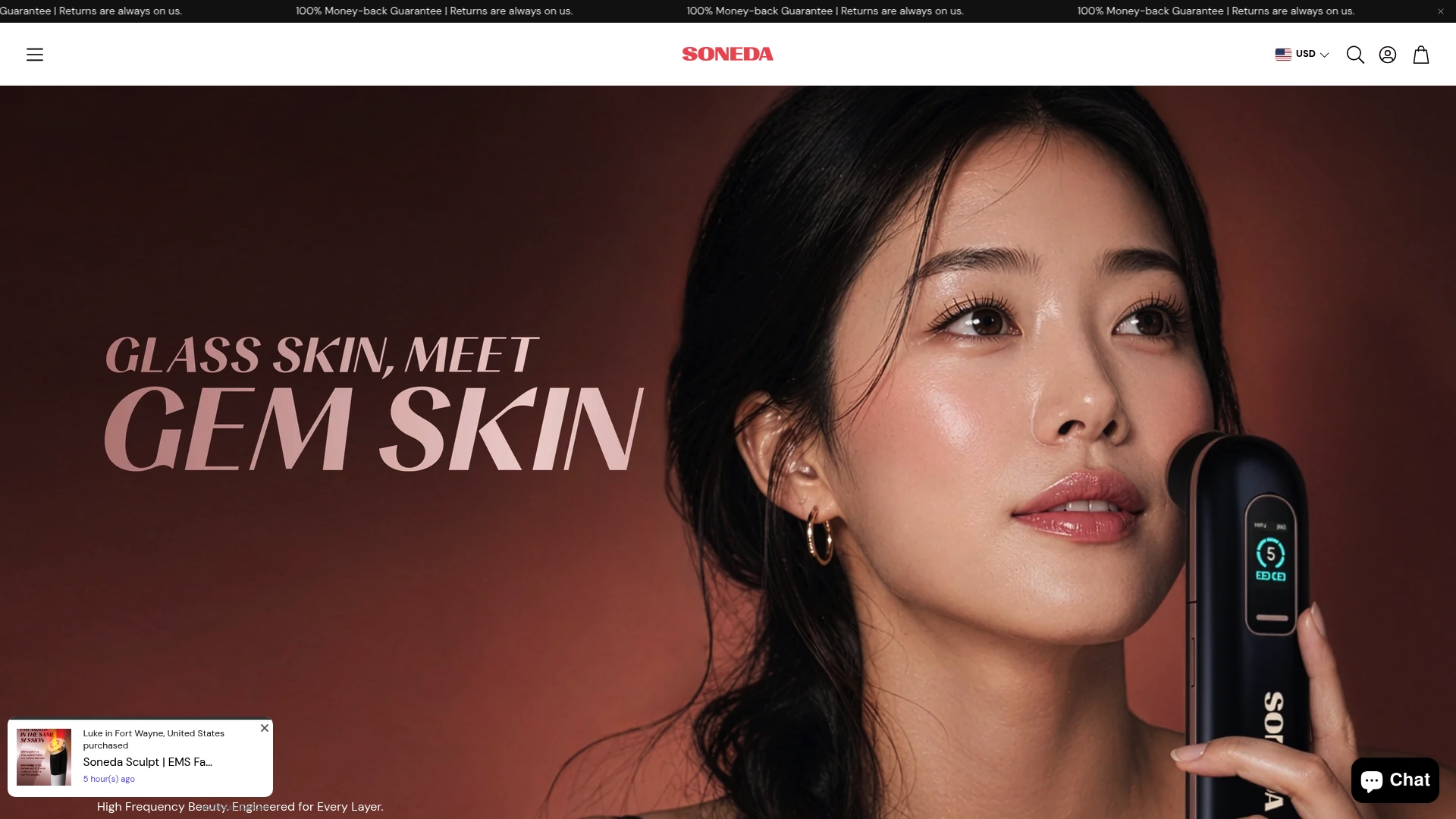
See the full details on the Soneda home HIFU device page.
FAQ
Can red LED light strengthen capillary walls or prevent new vessels?
The idea is that red light encourages collagen, which could support the tissue around vessels. We found no study showing that it prevents new visible vessels. Sun protection and managing triggers such as rosacea are the steps with clearer backing.
Will red light help with spider veins?
There is no solid evidence that red light clears spider veins or facial telangiectasias. In a small 2023 trial, combined red and near-infrared LED produced moderate improvement in redness markers, while IPL did better. A dermatologist can recommend vessel-specific treatment.
How long after laser or IPL do broken capillaries disappear?
The EADV says treated facial vessels progressively fade over 10 to 20 days, and post-treatment changes settle in 4 to 6 days. Some people need more than one session, so ask your dermatologist for a plan for your skin.
Is at-home LED safe to use on my face?
Short-term red-light therapy appears safe according to the AAD, and the most common effects are mild, temporary irritation. Use eye protection, follow your device’s instructions and see a dermatologist if redness or irritation lasts.
Sources
- Red Light Therapy in Cosmetic Dermatology: Marketing Claims vs. Evidence (Journal of Drugs in Dermatology)
- Feasibility and Safety of Using Combined Light-Emitting Diodes (PubMed)
- Is red light therapy right for your skin? (AAD)
- Laser- and light-assisted procedures to treat facial telangiectasias (EADV)
- Laser and light therapy for cutaneous vascular lesions (UpToDate)
- Split-face comparison of KTP and pulsed-dye laser (PubMed)
- Rejuvenation of photoaged skin: 5 years results with IPL (PubMed)
- Long-pulsed dye laser vs. intense pulsed light (PubMed)
- Lasers and lights: How well do they treat rosacea? (AAD)
- LED Light Therapy: How It Works, Colors, Benefits & Risks (Cleveland Clinic)
- 10 reasons your face is red (AAD)
- When to See a Doctor About Rosacea (Rosacea.org)
- Red Light Therapy and Your Eyes: Safety and Goggles